TL;DR
8.6 Blackout is the move if you want a short rifle that’s chambered in a full-power cartridge and easily suppressed. Pick Q’s The Fix if you want a lightweight bolt-action hunting rig, go with their Boombox rifle if you want a semi-auto setup, and stick to .300 Blackout if ammo cost and availability is more of a priority for you.
- Best Suppressed Full-Power Rifle Cartridge – 8.6 Blackout: Fires a .338-caliber projectile that generates up to 760+ ft-lbs of muzzle energy with subsonic ammunition, and 1,800+ ft-lbs with supersonic ammo; achieves a full powder burn in a 12-inch barrel.
- Top Lightweight Bolt-Action – Q Fix: Weighs just 5.6 pounds in its 12-inch configuration (5 pounds at 8 inches) and includes a folding stock or brace for easy storage and transport.
- Top Semi-Auto – Q Boombox: The bigger brother to the Honey Badger, allows for quick follow-up shots; available in a 16-, 12-, or 8-inch configuration
- When to Skip It: If you want a more affordable suppressed rifle setup, use .300 Blackout; ammo costs around $0.48 to $2.00+ per round while 8.6 Blackout ammo costs around $1.90 to $4.00+ per round.
What is 8.6 Blackout?
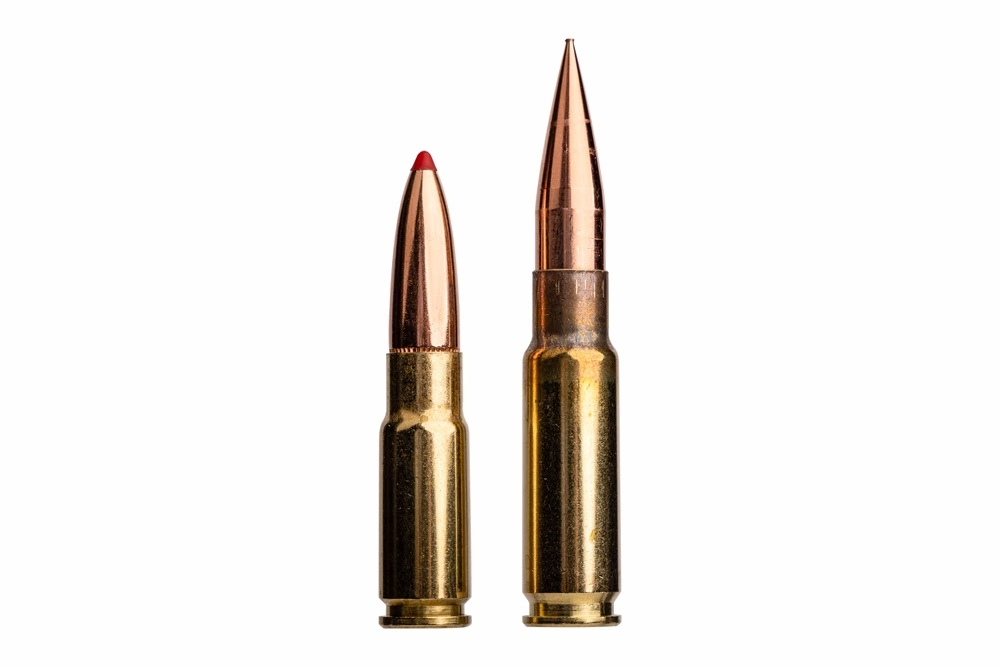
8.6 Blackout is a full-power cartridge developed by Q that was engineered to provide optimal terminal ballistics, cyclic reliability, and suppressibility at subsonic speeds. It does so by using a combination of a .338 caliber projectile, and a resized 6.5 Creedmoor casing. It’s designed for use in semi-automatic rifles based on the AR-10, as well as bolt-action rifles for even quieter subsonic applications. Basically, 8.6 Blackout is to the AR-10 what .300 Blackout is to the AR-15. It’s a heavy-hitting caliber that cashes in ranged performance for greater stopping power at close range and easier suppressibility.
History of 8.6 Blackout
8.6 Blackout was developed by Kevin Brittingham, the founder and CEO of Q. Prior to starting Q, he led the development of .300 Blackout while working for Advanced Armament Corp., better known as AAC.
His goal was to create a full-power rifle cartridge that offered the same inherent benefits as .300 Blackout. It needed to run effectively out of shorter barrels, offer strong terminal ballistics for hunting large game, and be easily suppressed. The resulting cartridge was 8.6 Blackout, which was first introduced at SHOT Show in 2022.
8.6 Blackout Specs
Projectile
8.6 Blackout makes use of a .338 caliber (.338-inch/8.58mm) projectile. Compared to other full-power rifle cartridges, 8.6 Blackout’s .338-caliber projectiles weigh much more. On average, .308 Winchester loads can weigh anywhere from as low as 110 grains to as much as 150+ grains. Meanwhile, 8.6 Blackout loads can weigh anywhere from 160 grains to upwards of 360+ grains, depending on the type of load.
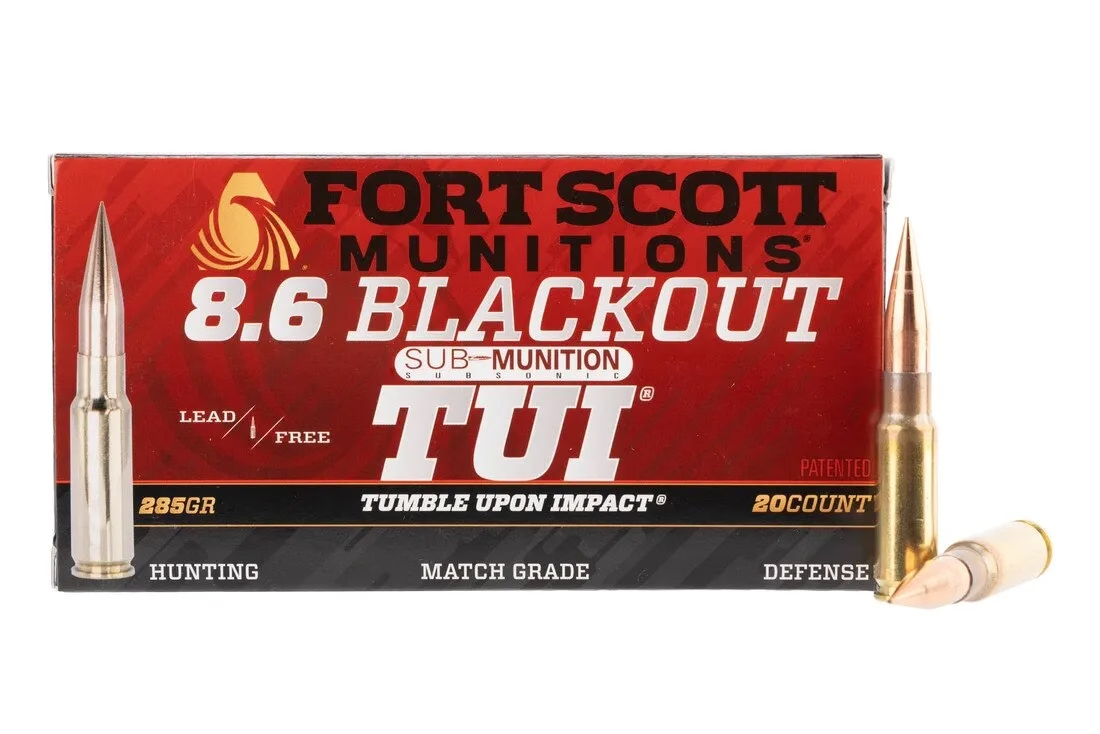
With .338 projectiles being larger and heavier than .30 caliber ones, 8.6 Blackout is great for suppressed shooting. Subsonic cartridges typically need to be heavier to both offer usable ballistic performance and cycle efficiently in semi-auto platforms. And in 8.6 Blackout’s case, the .338 projectile provides the mass needed to effectively be used across defensive and hunting applications. In fact, select subsonic 8.6 Blackout loads use specialized monolithic projectiles made from solid copper to provide optimal sound suppression and terminal ballistics.
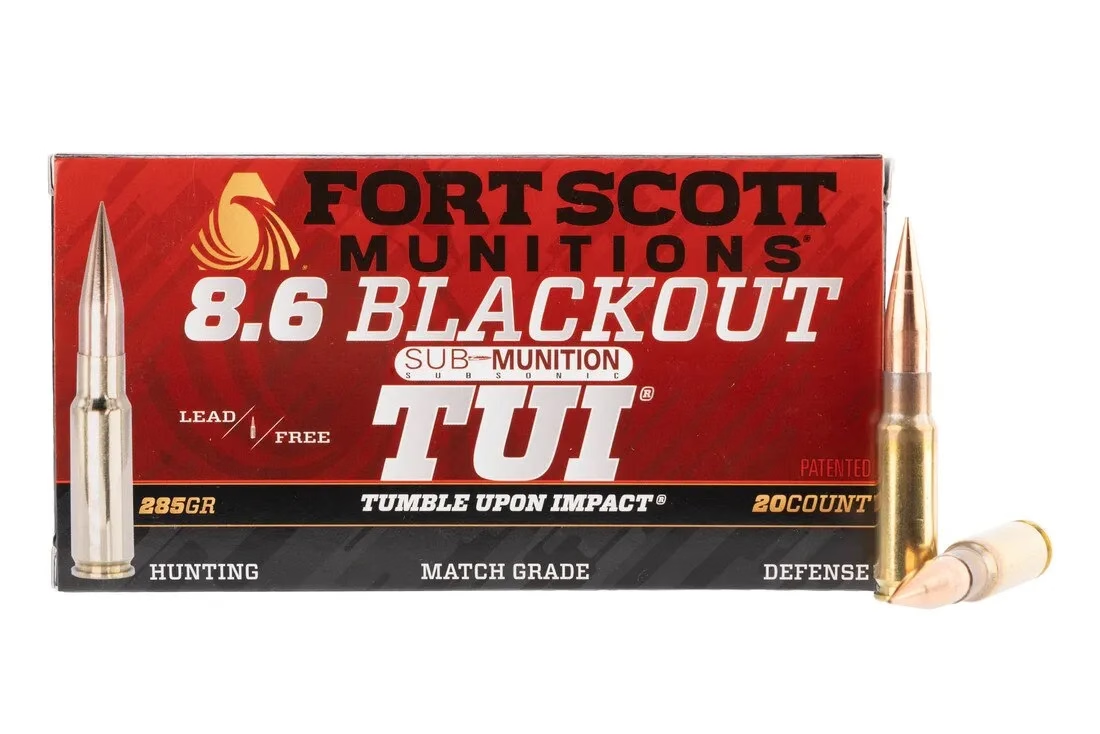
Being a newer cartridge, 8.6 Blackout isn’t as standardized as other, more common, full-power cartridges like .308 Winchester and 6.5 Creedmoor. There aren’t as many options available as far as ammo manufacturers go. But, as 8.6 Blackout grows in popularity, the number of available ammo options grows with it.
Casing
The 8.6 Blackout casing is based on the dimensions of its parent cartridge, 6.5 Creedmoor. The main reason Q used 6.5 Creedmoor as the parent cartridge was because it allowed them to continue using the .308 bolt face. This makes rifles chambered in 8.6 Blackout easier to produce, and it also allows rifles like the AR-10 to need nothing more than a barrel swap.
The greatest difference between 8.6 Blackout and its parent cartridge, 6.5 Creedmoor, is its length. 8.6 Blackout casings have a shorter length of 1.685 inches (42.8mm). The neck diameter is wider, measuring 0.37 inches (9.40mm) to accommodate its larger projectiles. Lastly, the overall length of 8.6 Blackout cartridges can range from 2.56 to 2.81 inches long.
Heavier .338 projectiles like the monolithic ones mentioned above, are often a lot longer than standard supersonic ones. As such, the casing of the cartridge needs to be able to accommodate this, thus, the casing was made shorter. In doing so, Q was essentially able to use the same methodology needed to first produce .300 Blackout, giving 8.6 Blackout an adaptable casing that could easily accommodate multiple projectiles and loads.
Ballistic Performance: Supersonic vs. Subsonic
In general, most supersonic 8.6 Blackout ammunition has an effective range of around 300 to 450 yards, while subsonic ammunition has an effective range of around 150 to 250 yards. Now, this is dependent on the bullet’s grain weight, the powder charge, environmental conditions, and your individual skills as a marksman. Regardless, 8.6 Blackout just isn’t as capable at distance as .308 Winchester or 6.5 Creedmoor are. But it’s not designed for such applications in the first place.
Depending on the load, 8.6 Blackout can be a formidable cartridge across multiple applications. Supersonic loads can reach a peak muzzle velocity of around 2,400+ feet per second (FPS) and produce upwards of 1,800 ft-lbs (foot-pounds) of muzzle energy, in some instances. Even though it doesn’t have the same ranged performance as other full-power cartridges, it packs a punch at close-range. The same is true of subsonic loads as well. They can travel around 900 to 1,050 FPS and produce as much as 760+ ft-lbs of muzzle energy. It can even be suppressed down to a hearing-safe level too, so long as you use the right ammo and suppressor combination.
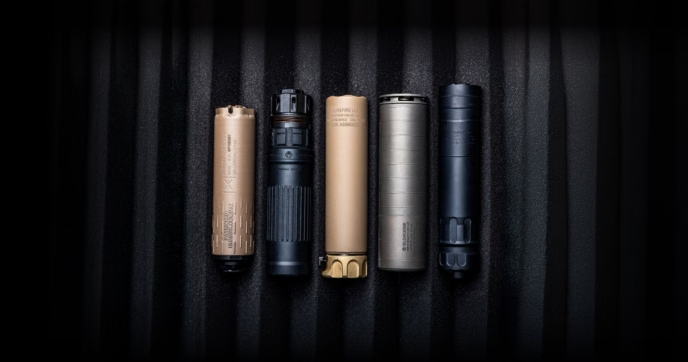
Q offers various suppressors designed specifically for 8.6 Blackout. Their Porq Chop suppressor line is one of the go-to options for their rifles, as they’re directly compatible with their 8.6 Blackout rifles, as well as their Cherry Bomb muzzle devices. Currently, it’s available in three configurations: the standard Porq Chop, the Short Chop, and the Long Chop. All three are rated for .338 caliber projectiles, with the main difference between them being their length.
Optimal Barrel Length and Suppressibility
To get a complete powder burn with 8.6 Blackout, your rifle only needs to have a 12-inch barrel, allowing you to have a far shorter setup that’s still practical. For instance, a rifle chambered in .308 Winchester needs around an 18- to 20-inch barrel to achieve a full burn, and you’ll need a longer 22- to 24-inch barrel for 6.5 Creedmoor.
8.6 Blackout is also easily suppressed. It’s a low-pressure round that can reliably cycle with both supersonic and subsonic ammunition. Like we mentioned earlier, it pairs exceptionally well with suppressors, and since it doesn’t need a long barrel for a full powder burn, you can run a shorter setup with no issues.
Neither .308 Winchester nor 6.5 Creedmoor are easily suppressible. Both calibers, especially 6.5 Creedmoor, are exceptionally high-pressure cartridges that produce high velocities. Because of how fast their projectiles fly, you’ll almost always have a supersonic crack after firing. Down-loading the powder in either cartridge isn’t the most practical choice either. Although there are select subsonic .308 Winchester loads that can produce a hearing safe sound signature when paired with the right suppressor, they’re only compatible with bolt-action setups. And since 6.5 Creedmoor is very velocity-dependent for its performance, subsonic loads aren’t really feasible.
How 8.6 Blackout Compares to .300 Blackout
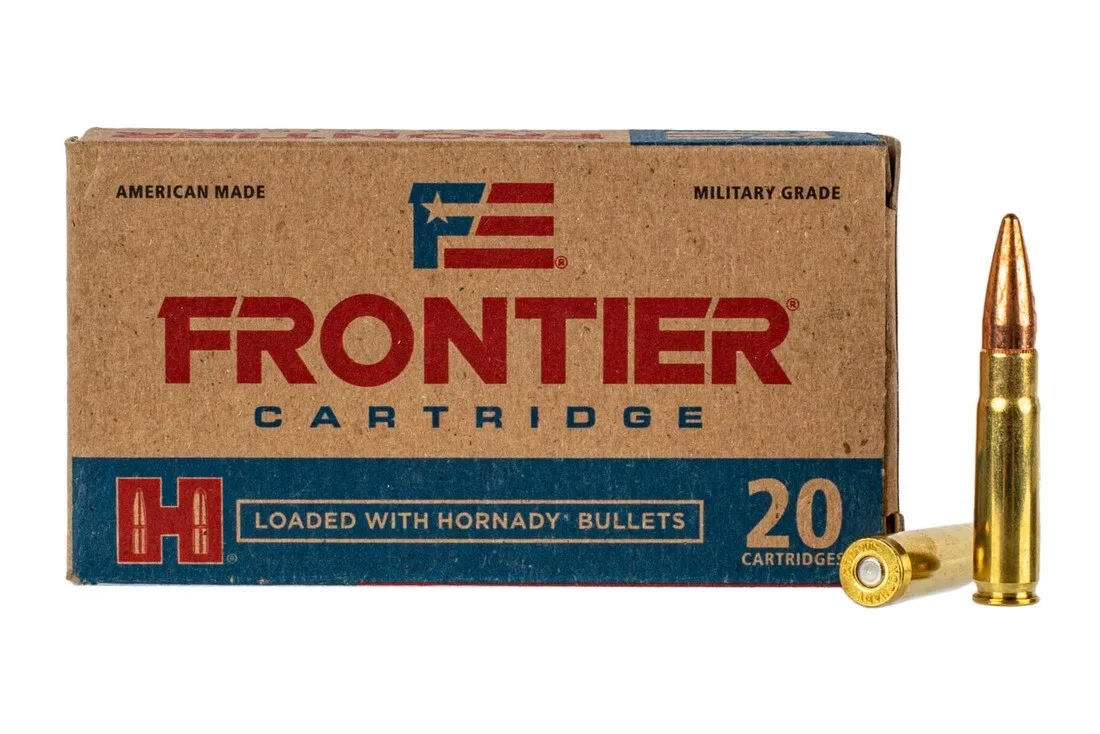
8.6 Blackout is essentially the bigger brother of .300 Blackout. It offers much more stopping power while still being easily suppressible. While some may assume that 8.6 Blackout is now better than .300 Blackout by default, neither caliber is inherently better than the other. Both are designed to fill similar roles and come with their own distinct advantages. It’s better to look at their pros and cons to make picking one over the other easier.
8.6 Blackout vs. .300 Blackout
| 8.6 Blackout | .300 Blackout | |
|---|---|---|
| Bullet diameter | .338 inches (8.58mm) | .308 inches (7.82mm) |
| Subsonic Load Grain Weight | Around 285 to 360+ Grains | Around 190 to 220+ Grains |
| Supersonic Load Grain Weight | Around 160 to 220 Grains | Around 110 to 150 Grains |
| Optimal Barrel Twist Rate | 1:3 | 1:7 or 1:8 |
| Trade-offs | Designed For Larger Rifle Platforms; Expensive Per Round Cost | Less Muzzle Energy; Diminished Terminal Ballistics at Distance |
8.6 Blackout offers far more muzzle energy than .300 Blackout. As mentioned earlier, supersonic 8.6 Blackout loads can reach upwards of 1,800+ ft-lbs of muzzle energy, with subsonic loads producing as much as 760+ ft-lbs. Meanwhile, .300 Blackout doesn’t offer the same performance. Supersonic loads generate upwards of 1,300+ ft-lbs of muzzle energy, while subsonic ammo generates around 450+ ft-lbs, depending on the ammo. .300 Blackout is still exceptionally effective, it’s just weaker by comparison.
However, just because .300 Blackout is a weaker cartridge than 8.6 Blackout doesn’t mean you should immediately disqualify it. .300 Blackout is much more widely available than 8.6 Blackout, both in terms of ammo as well as for the firearms that use it. .300 Blackout was first introduced to the market in 2011 and has been around longer than 8.6 Blackout. Since its creation, manufacturers have continued to produce their own .300 Blackout ammo as well as firearms chambered in it.
Because of this, the difference in the cost per round between the two is stark. 8.6 Blackout can cost anywhere from around $1.90 per round to upwards of $4.00+ depending on the load and manufacturer. Meanwhile, .300 Blackout typically hovers around $0.48 per round to as much as $2.00+ per round, depending on the load and manufacturer.
Still, as 8.6 Blackout grows in popularity, more manufacturers will produce 8.6 Blackout ammunition, potentially lowering its cost per round. Still, as of this article’s publication in late 2026, 8.6 Blackout is a much more niche cartridge compared to .300 Blackout.
The Fix: Q’s Bolt-Action 8.6
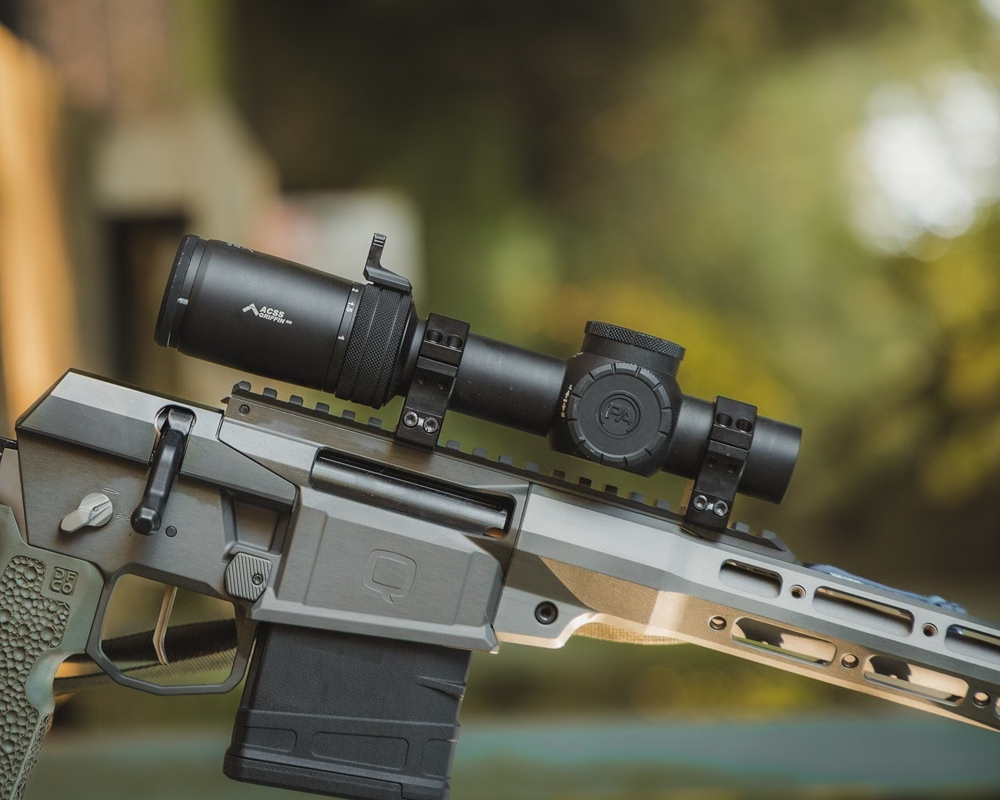
The Fix is a bolt-action rifle that breaks the norm in a clever way. Rather than using a well-known action design, like the Remington 700 for example, Q designed the Fix entirely from the ground up, giving it a new operating system and capabilities. Their endeavor resulted in a lightweight, reliable rifle.
Rifle Overview
The Fix blends the best elements of bolt-actions with the familiarity of the AR platform. Its silhouette is very reminiscent of the AR-10, as it comes equipped with a free-floating Q-Sert™ handguard, is compatible with SR-25 pattern magazines, and it uses AR-style controls. It also has a lot of features found on more premium tactical bolt-action rifles, such as a folding stock (or a stabilizing brace if you opt for the pistol variant) and a 45-degree bolt throw. Outside of this, there is a lot that distinguishes this rifle from other premium bolt-actions.
The Fix was one of the first commercial rifles that was chambered in 8.6 Blackout, making it a natural pairing for the cartridge. Since 8.6 Blackout doesn’t need a long barrel, the Fix is available in a 12-inch and 8-inch configuration, and one of the core advantages this offers is weight reduction. Both variants, when chambered in 8.6 Blackout, weigh less than 6 pounds, with them weighing 5.6 and 5 pounds, respectively. Outside of making your rifle easier to carry for lengthy periods of time, you can also mount other gear and accessories to it without bogging it down too much. This is especially important when you consider the weight of optics and suppressors.
While 8.6 Blackout isn’t the most practical cartridge for long-range use, it’s still effective out to around 250 yards with subsonic ammunition, and up to around 450 with supersonic loads. This makes LPVOs, prism scopes, as well as red dots with magnifiers all practical choices. And depending on which one you choose, your optic setup can weigh as little as a few ounces to multiple pounds. Plus, you’ll also need to factor in the weight of a suppressor.
The weight of a suppressor can vary, but larger cans designed for bigger diameter calibers like 8.6 Blackout can weigh anywhere from around 9.5 ounces to over a pound in some instances. So, once you factor in optics, suppressors, and any other accessories you may want like a bipod, sling, or IR/thermal units, the weight of your rifle adds up quick. Fortunately, with the lightweight design of the Fix, this is less of an issue.
Best Use Case
Overall, the Fix is a solid compact rifle designed to offer heavy-hitting power while staying easy to suppress. Given its characteristics, the Fix excels as a hunting and backpacking rifle. Its compact form factor paired with its folding stock, or brace, makes it easy to stow on your person with a sling, or in a range bag. For hunters spending long periods of time in the field, or making long treks to hunting sites, it’s a great rifle. Plus, with it being chambered in 8.6 Blackout, it provides the terminal ballistics needed for ethically hunting large game, while also being easy to suppress.
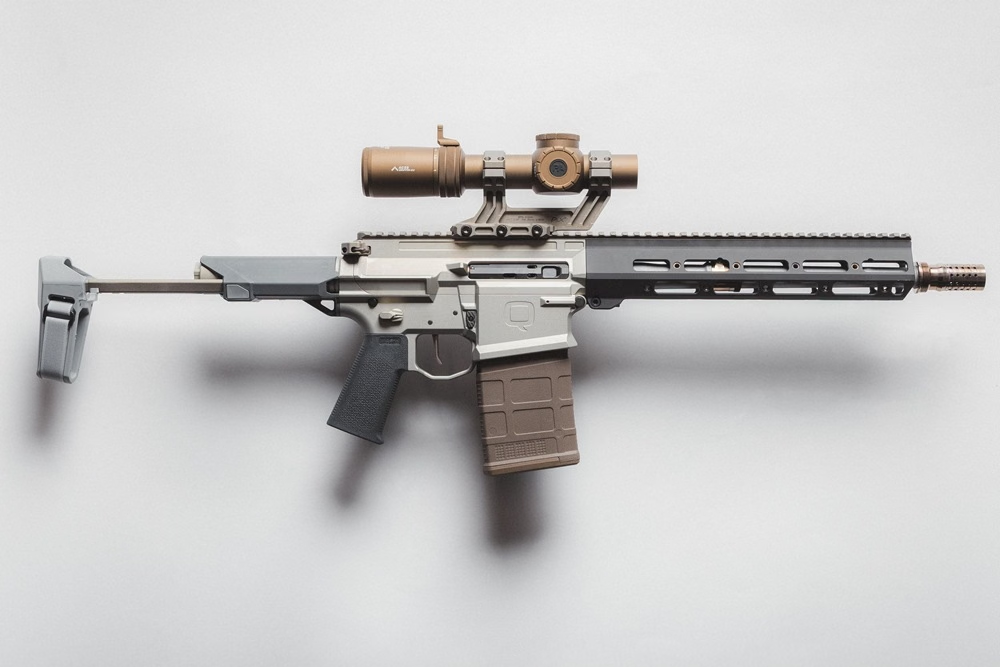
The Boombox: Q’s Semi-Auto 8.6
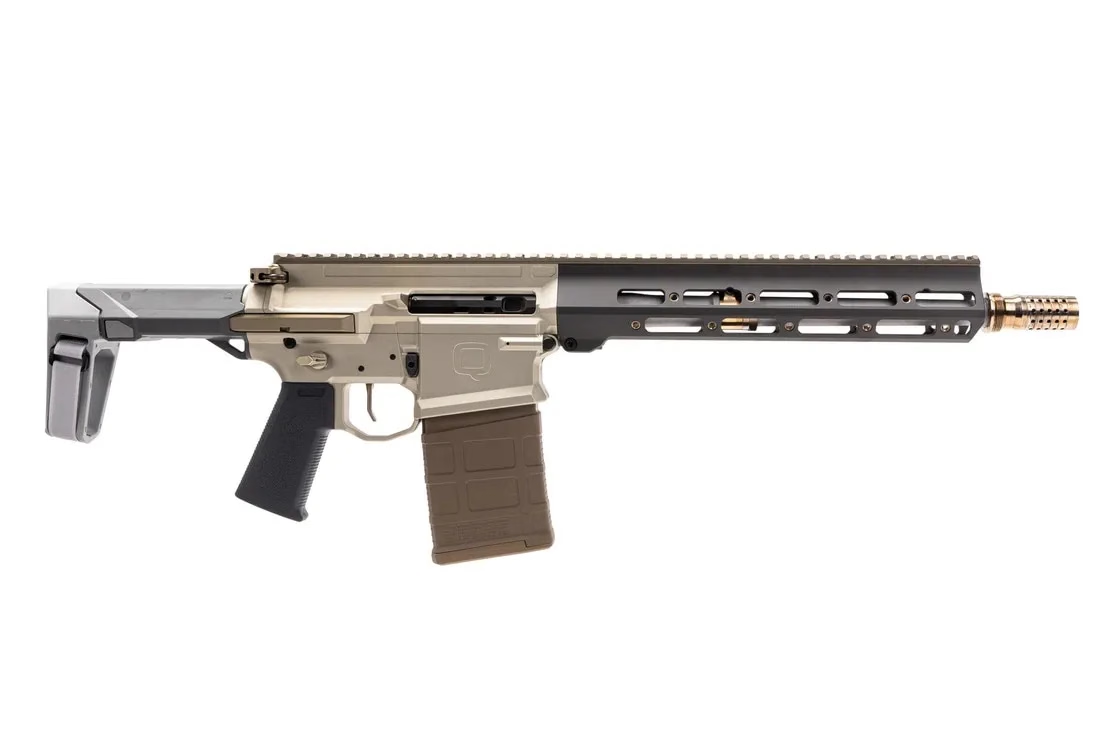
Announced alongside the Fix, the Boombox is Q’s other flagship rifle system designed around the 8.6 Blackout cartridge. For simplicity’s sake, you can look at the Boombox as the AR-10 equivalent of the Honey Badger. It uses the same design philosophy as the Honey Badger, has a similar look, and even uses the same stock system. The most critical, and obvious, difference between the two is their size. However, even with the larger size of the Boombox, it fills its role quite nicely.
Rifle Overview
The Boombox draws a lot of inspiration from its little brother, the Honey Badger. In fact, if you were to put the two side-by-side, the Boombox basically looks like a bigger version of the Honey Badger. With that in mind, the Boombox offers a familiar manual of arms that’s practically one-to-one with most other AR-10s. The Boombox uses standard AR-10 style triggers, grips, safety selectors, and charging handles. It’s also compatible with SR-25 pattern magazines like the Magpul PMAG and Lancer Systems’ L7AWM® magazines.
As of publishing this article, the Boombox is available with either a 16-, 12-, or 8-inch barrel, and both the 12- and 8-inch variants are offered as both SBRs or pistols. No matter which one you look at, each Boombox model comes standard with a free-floating Q-Sert handguard, an adjustable gas block for suppressor tuning, and a Cherry Bomb XL muzzle device. The 12-inch and 8-inch variants come standard with two-position stock (brace if opting for a pistol), while the 16-inch variant comes standard with a more traditional carbine stock instead of the two-position adjustable one.
Also, each Boombox variant is light compared to other similar large-caliber AR-platform rifles. They weigh roughly 6.4, 5.5, and 5 pounds, respectively. They fill a similar role as the Fix—a powerful compact rifle that’s easily suppressed. The Boombox has some obvious advantages over the Fix, the most notable of which is its semi-automatic design.
Although the addition of a gas system and recoil assembly does increase the weight of these rifles, it’s far easier to make rapid follow-up shots when needed. When paired with its light base weight, it’s easy to configure the Boombox in a way that maximizes agility for more dynamic applications. This also makes kitting out your rifle an easier task. Like we noted earlier, the weight of optics, accessories, and other gear adds up quick. But with a lighter base rifle, you can create a wieldier rifle with good balance so long as you’re smart about how you mount everything.
As far as optics go, the Boombox can effectively run any optic that the Fix can. Optics like LPVOs, prism scopes, and red dots with dedicated magnifiers make the most sense from a usability perspective. Remember, 8.6 Blackout’s effective range tops out around 400 to 450 yards with supersonic ammo, so you don’t necessarily need a high-power optic setup. With an LPVO you can easily range out to land hits on far-off targets, while still having a relatively light setup. Plus, regardless of which setup you use, they can be supplemented with night-vision devices like clip-on thermal units, or IR Illuminators if you train/hunt at night with NODs.
Another advantage for the Boombox is its compact form factor. If you opt for either the 12- or 8-inch rifle or pistol, they come with a PDW-style stock like the Honey Badger. When collapsed they have an overall length of around 26.75 and 23 inches, respectively. So, with a sling or a range bag, they’ll be easy to carry, transport, or stow away when in the field. This also makes them a solid pick for dedicated suppressed builds as well, with Q’s own suppressor models being some of the best options for the rifle.
Best Use Case
The Boombox is one of the more unique rifles on the market as it’s an easily suppressed rifle that still makes use of a heavy-hitting full-power rifle cartridge. And, with it being semi-automatic, it can be used across a wide range of applications.
Much like the Fix, the Boombox excels as a dedicated suppressed hunting rifle. Even though it’s a bit heavier than the Fix and doesn’t have a folding stock, the Boombox is still rather light for an AR-10 platform rifle. It’s more than capable enough for hunting large game, and its ability to make fast follow up shots makes it good for hog hunting too. Additionally, the Boombox is also a viable choice for competitive shooting and nighttime training too.
Frequently Asked Questions (FAQs)
What is 8.6 Blackout used for?
8.6 Blackout is primarily used for suppressed shooting and hunting. 8.6 Blackout is a low-pressure cartridge that pairs a .338-caliber (.338-inch) projectile with a shortened 6.5 Creedmoor case, allowing it to hit hard at close range while being easy to suppress. Subsonic ammunition travels around 900 to 1,050 FPS and produces around 760+ foot-pounds of muzzle energy. Supersonic ammunition can travel upwards of 2,400 FPS and generate up to 1,800+ ft-lbs of muzzle energy. It isn’t a long-range cartridge, though. If you need to reach past 450+ yards, .308 Winchester or 6.5 Creedmoor is a better fit.
Is 8.6 Blackout better than .300 Blackout?
Not necessarily. 8.6 Blackout hits harder than .300 Blackout, but that doesn’t mean it’s automatically better than .300 Blackout by default. 8.6 Blackout does generate far more energy than .300 Blackout, but .300 Blackout has been around since 2011 and it’s arguably the second most popular cartridge for the AR-15, making it much easier to find ammo and rifles chambered in it. It’s also more affordable, at around $0.48 to $2.00+ per round compared to around $1.90 to $4.00+ for 8.6 Blackout as of this article’s publication. We recommend going with 8.6 Blackout if want to use the same rifle setup for hunting pests like wild hogs as well as large game like deer and elk. If you plan to hunt just small game and pests, or if you just want a more affordable suppressed setup, stick with .300 Blackout.
What is the effective range of 8.6 Blackout?
8.6 Blackout’s effective range varies depending on the type of load you use. Subsonic ammo tops out around 150 to 250 yards, while supersonic ammo can go as far as 300 to 450 yards. Those numbers can shift depending on your specific rifle setup, ammunition bullet weight, environmental conditions, as well as your own skill as a marksman. 8.6 Blackout trades long-range performance for close-range stopping power and easy suppression, so it won’t keep up with .308 Winchester or 6.5 Creedmoor at distance. That also means you don’t need a high-power scope. An LPVO (Low Power Variable Optic), a prism scope, or a red dot with a magnifier covers the cartridge’s whole useful range.
Can you use a .308 Bolt Carrier Group on an 8.6 Blackout AR-10?
Yes. 8.6 Blackout shares its base diameter with 6.5 Creedmoor and .308 Winchester, and it’s designed to use AR-10 components like the bolt carrier group. You’ll still need an 8.6 Blackout barrel with the right chamber and a 1:3 twist rate, but you won’t need a new bolt if you’re doing an upper swap.
What barrel length do you need for 8.6 Blackout?
12 inches is the barrel length 8.6 Blackout was designed for, but you can go shorter to 8 inches, or longer to 16 inches if you want. 8.6 Blackout gets a complete powder burn from a 12-inch barrel; that’s why Q builds its 8.6 Blackout rifles short. As of this article’s publication, the Fix comes in 12- and 8-inch versions, and the Boombox comes in 16-, 12-, and 8-inch versions. A shorter barrel keeps the rifle light and maneuverable, even after adding a suppressor, optic, and other gear. Keep in mind that a rifle with a barrel under 16 inches is a short-barreled rifle (SBR) under the National Firearms Act. Although SBR registration is now voluntary as of October 9th, 2026, state laws still exist and vary state-by-state, so be sure to confirm your state and local laws before buying.