The optics industry is chock-full of brands offering solid rifle and pistol sights. But for one stay relevant for over 100 years after their initial founding is an incredible feat. And there aren’t many that have done it quite like Leupold.
Leupold has long been known for crafting some top-tier rifle scopes. Each of their optics is backed by decades of innovation, and rigorous testing. And over the years, they’ve expanded their lineup to include more than just traditional rifle scopes. Among them, the DeltaPoint® Pro mini-reflex sight has been one of their most successful optic lines.
Since its inception, it’s been favored for everything from intensive competitive and duty to use, to recreational shooting and personal defense. And of all those applications, concealed carry has been one of the go-to reasons enthusiasts choose the Delta Point Pro.
What is the Leupold DeltaPoint Pro?
On its own, there are a lot of features that make the DeltaPoint Pro (DPP) a solid pick for concealed carry. But before getting too in the weeds on what makes it such a good optic for EDC use, it’s important to break down what the DPP is in the first place.
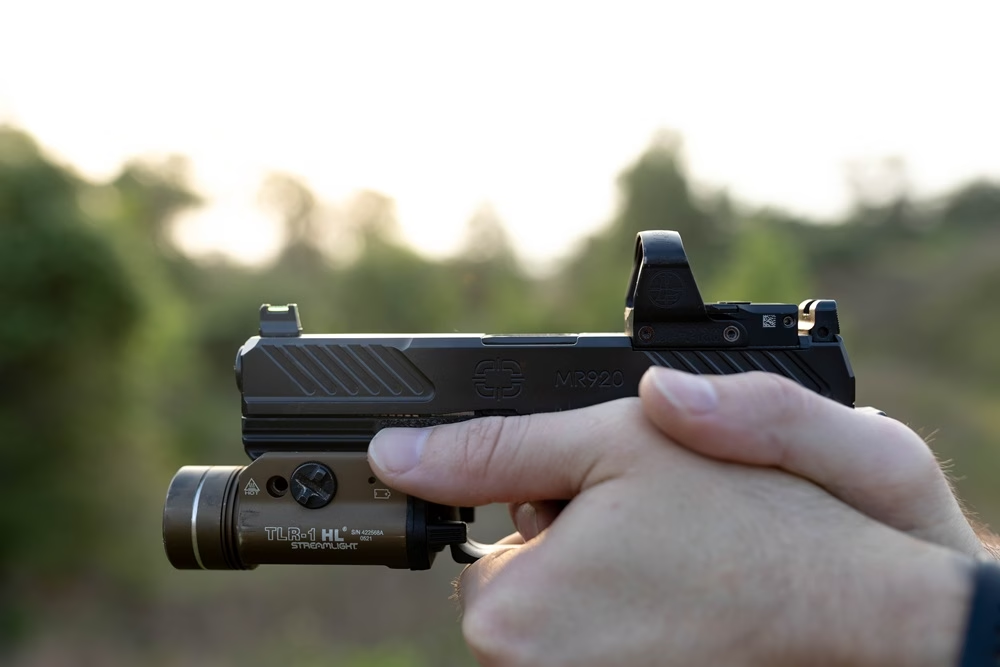
The DPP is an open-emitter mini-reflex sight designed for use on handguns. It was originally released in 2015 as the successor to Leupold’s previous DeltaPoint optic. And compared to the original, the DPP had several enhancements—many of which we’ll cover further below. Since its release, it’s been used widely by many Military and Law Enforcement Agencies, as well as civilians across multiple scenarios.
What Makes the DPP Good for Concealed Carry?
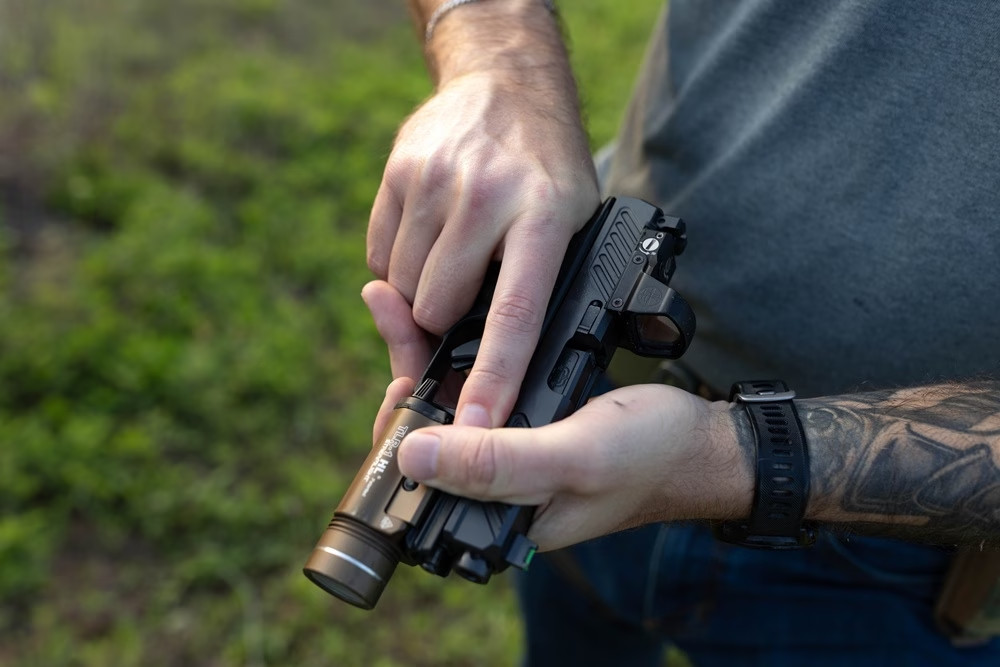
By far, one of the most common uses for handguns is personal protection, with many enthusiasts opting to carry their pistols on their person for concealed carry. And, as noted by the title of this article, there are a lot of features that make DPP a solid option for such purposes.
For starters, the DPP has an incredibly large window comparable to its size, measuring 25.7mm by 17.5mm. While having a larger lens may seem counterintuitive for concealed carry purposes, it gives you a wider field of view (FOV), and a more forgiving eye box. This is why most dedicated competition red dot sights have such large windows. And while the DPP doesn’t have quite as large a window like such optics, it’s big enough to make it more practical for defensive shooting, while small enough to be relatively easy to conceal. Just keep in mind that your ability to conceal a pistol with a mounted optic is depends on your stature, holster type, and how well you dress around your setup
In addition to its size, it also has a decent battery life. Being powered by a CR2032 battery, it can last up to 1,600 hours on a full charge—a little over 66 days of constant run time. Despite not being quite as long as other popular optics, the DPP is equipped with Leupold’s MST™ (Motion Sensor Technology). This feature automatically powers down the optic after 5 minutes, as long as the optic is stationary. And just like many other popular mini-reflex sights, it automatically turns back on once it senses movement. Also, it has a top mounted battery too, so whenever you do need to change it out, you won’t lose your zero in the process.
Also, The DPP is a rather lightweight optic since open-emitter optics, in general, tend to be some of the lightest on the market. And since the DPP doesn’t use multiple lenses, or an enclosed optic body, they have some great weight savings. With the battery installed, these optics weigh just shy of 2 ounces (1.95 ounces, specifically). It makes hardly any difference to your pistol’s overall weight, allowing you to carry your pistol the same as you would without an optic.
One of the only real caveats of its design stems from the fact that it’s an open-emitter optic. Inherently, open-emitter optics are just that, open. Because of this, their emitter diodes are exposed, leaving them susceptible to occlusion by dirt, dust, and other environmental debris. Our guide on Open- vs. Closed-Emitter Optics has a good breakdown on each optic’s respective performance, but rest assured, the DPP is still a solid pick for EDC.

Choosing Your Dot Size: 2.5-MOA vs. 6-MOA
The DPP is available with either a 2.5- or 6-MOA dot reticle, both of which are more-than-practical enough for concealed carry use. But, while both are good options, if you’re new to running optics on your handguns, having to choose between reticle sizes can be a bit tricky. One of our previous guides, “Choosing the Right Dot Size”, goes in-depth on the advantages different dot sizes offer. But below, we can get you up to speed on the DPP’s options.
2.5-MOA vs. 6-MOA
The 2.5-MOA dot is a smaller option that offers more precision when engaging targets past around 20 yards. As such, it’s generally a more well-rounded option if you plan on using your optic for multiple applications like competition or duty. But, its smaller size does make the reticle slightly harder to acquire under stress. They’re still plenty usable, but they might take some extra practice to get used to if you aren’t already adept with using smaller dots on pistols.
If you’re new to running pistol optics, a 6-MOA dot can be a solid choice. Being a larger dot, they’re typically easier to acquire under stress. The tradeoff comes with ranged accuracy. The bigger the reticle, the less precise it becomes at distance. As such, a 6-MOA dot is most usable within 15 yards and back. And although they don’t perform as well at distance, if you’re new to running pistol optics, the learning curve isn’t as steep.
Which is best?
Ultimately, the ‘best’ DPP reticle option is the one that works best for you. As anticlimactic as that may sound, choosing a reticle is always a matter of personal preference. Still, if you’re only going to be using your pistol for concealed carry, having a larger 6-MOA dot can be more beneficial. Being able to quickly get your dot on target is critical when time is of the essence. And while this is still possible with a smaller 2.5-MOA dot, it’s arguably easier to do with a 6-MOA one.
That said, you can’t go wrong with either option, but if you’re new to pistol optics or just want something easier to use, the DPP with a 6-MOA dot is a solid pick. Just keep in mind that the DPP currently isn’t available with other options like the circle-dot reticle.
Compatible Pistols and Mounting Options
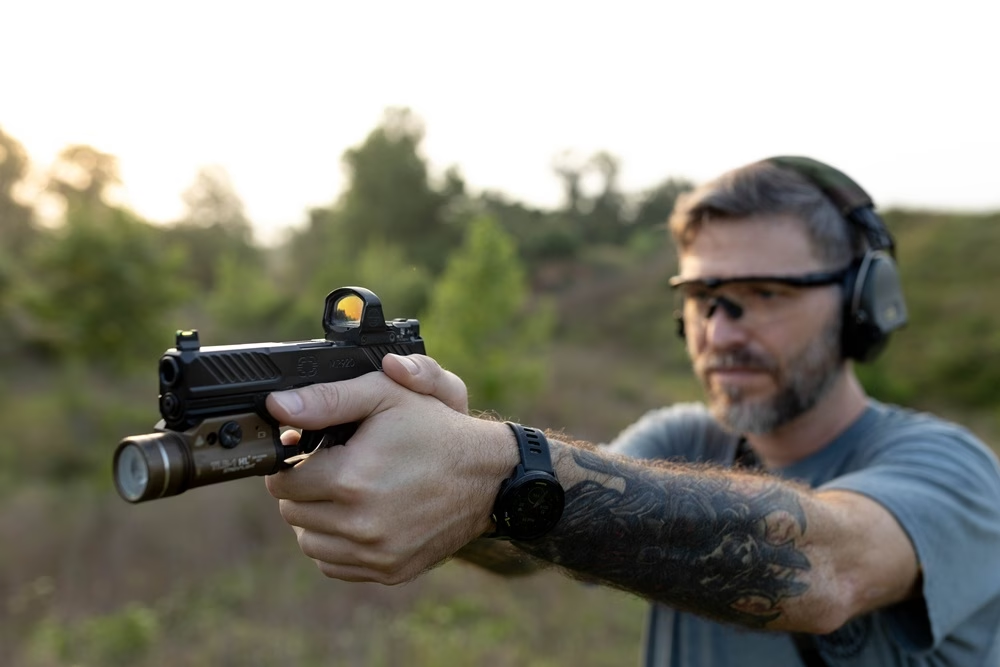
Most, if not all, handguns on the market today are optic ready. But just because a pistol slide is ‘optic-ready’ doesn’t automatically mean it’s compatible with your optic. Not every optic uses the same mounting footprint. The DPP uses its own mounting footprint, aptly named the Delta Point Pro footprint.
On top of this, different handgun manufacturers use different slide cuts for mounting optics, while others come cut for specific optics. For the DPP, there are some handgun options that are cut specifically for it or at least come with adapter plates to make it so. Handguns like the Springfield Armory Echelon, FN 509, the GLOCK 19/19x/17 MOS, as well as GLOCK’s new Gen 6 pistols, are all compatible with the DPP.
In most instances, you’ll need to use an adapter plate to run your optic on your pistol, raising the height of your optic. And if you want to properly cowitness your iron sights, it can cause some challenges.
Proper Cowitness
There’s nothing wrong with running a reflex sight as your primary optic. But their batteries only last so long. And if you aren’t careful, your optic can go down without warning, potentially at a time when you need to use it. So, to keep your pistol running properly if your optic goes down, it’s best to have a set of iron sights that can properly cowitness with your optic.
On its own, the DPP is already a taller optic than most other mini-reflex sights, and if you have to run an adapter plate, it’ll sit even higher. Fortunately, being able to cowitness is a simple swapping out your pistol’s iron sights. A set of suppressor height iron sights, or other taller iron sights can give you a good cowitness. Your options may be limited depending on your pistol of choice, and whether you’re running an adapter plate or not.
Conclusion
Leupold’s DPP has long been one of the industry’s most popular mini-reflex sights. Building on the success of their original DeltaPoint optic, it’s been used widely for just about all applications. And with it being backed by Leupold’s unwavering commitment to crafting high-quality optics, it’s easily a top pick for concealed carry.
Its large window size provides you with a wide FOV, giving you a full picture of your target and its surroundings. And it also makes it easier to find the dot when moving quick or when under stress. It has a good battery life and the features needed to make it last a long time, and finally, its mounting footprint is one of the industry’s most common.
Despite there being dozens of mini-reflex sights to choose from, the DPP will always be a solid pick, especially for concealed carry.
Frequently Asked Questions (FAQ)
-
Is the Leupold DeltaPoint Pro good for concealed carry?
Yes. The DPP’s wide window, light weight, and Motion Sensor Technology make it a highly capable optic for EDC use. It does have a shorter battery life compared to other optics, and its open design leaves the emitter diode exposed to your environment. Still, if you prioritize fast dot acquisition and solid glass clarity, it’s a strong option to consider.
-
How long does the DeltaPoint Pro battery last for everyday carry?
Depending on the brightness setting you use, the DPP’s battery has a runtime of either 1,600 hours (low setting), 1,000 hours (medium setting), or 300 hours (high setting). With its Motion Sensor Technology active, it can potentially last longer. Either way, we recommend swapping out its CR2032 battery every 3 months on a carry gun as a precaution. But the frequency in which you change your battery is up to your discretion.
-
What pistols are compatible with the DeltaPoint Pro for CCW?
So long as you have the right adapter plate, just about any full-, carry-, and compact- pistol can be compatible with the DPP. Popular handguns like the GLOCK 19/19x/45/17 MOS, Smith & Wesson M&P 2.0, Springfield Armory Echelon, Walther PDP, and Staccato C2/CS are compatible are all either directly compatible or can use plates to mount the DPP. Always verify plate compatibility for your specific slide before purchasing.
-
Should I get the 2.5 MOA or 6 MOA DeltaPoint Pro for carry?
For a dedicated carry gun used primarily at defensive distances—typically within 3 to 15 yards—the 6 MOA dot is faster to pick up under stress. If the gun also serves as a range or competition pistol where you’ll shoot further than 20 yards, the 2.5 MOA dot offers better precision at distance without giving up much speed inside 15 yards.
-
Do I need suppressor-height sights with the DeltaPoint Pro?
In most instances, if you want to cowitness with iron sights, you will need taller ones. The DPP’s taller profile sits high obscures most pistol’s factory height iron sights. Suppressor-height sights from Dawson Precision, Ameriglo, or Trijicon provide a co-witness reference point in case of battery failure or optic damage. Leupold also sells a rear iron sight that mounts directly to the DPP housing as an alternative.