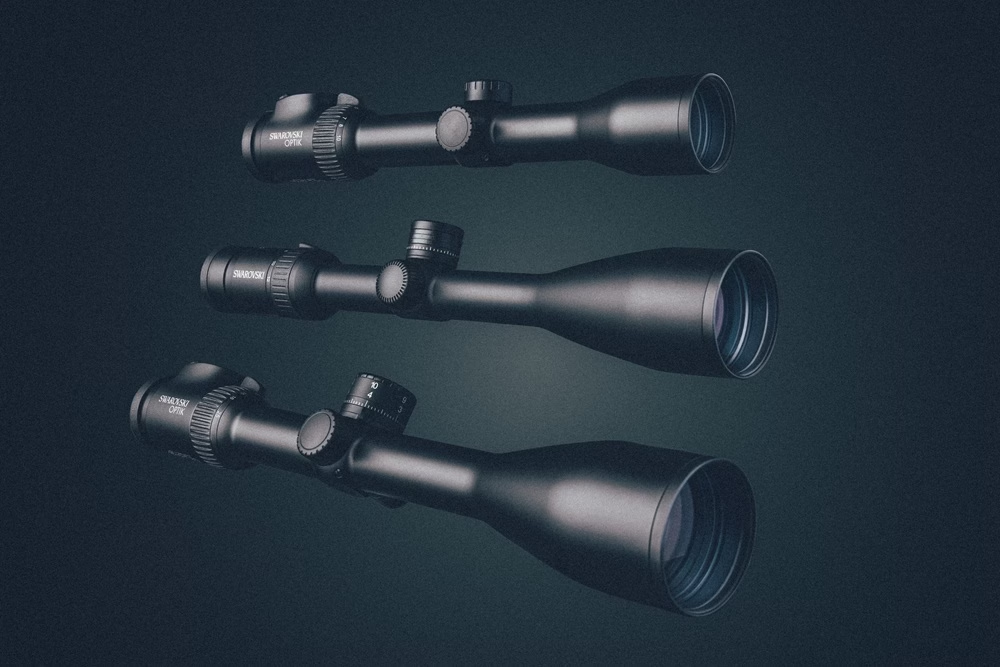
Swarovski Optik is a name that’s recognized globally and synonymous with quality. Despite being known by most for their fine crystal glass, they’ve long been one of the industry’s top optic manufacturers. From binoculars and spotting scopes to specialized rifle scopes, their reputation often precedes them.
One of the reasons that Swarovski Optik stands out so prominently lies in their rifle scope production. They almost exclusively produce optics in a second focal plane (SFP) configuration. While this might seem like an odd choice, SFP rifle scopes have a lot of utility.
This is especially true for hunting. And considering Swarovski Optik primarily makes rifle scopes for hunters, it’s easy to understand why they’ve chosen to design their scopes in such a configuration.
Quick Refresher: FFP vs. SFP
Before diving into deep end on Swarovski Optik’s design philosophy, knowing how an optic’s focal plane alters its performance is critical. “Focal plane” refers to where the reticle sits within the optic. And its position determines how the reticle moves in relation to its magnification level. There are two types of scope constructions: First Focal Plane (FFP) and Second Focal Plane (SFP). Our guide on FFP vs. SFP Rifle Scopes goes over this topic in-depth, but the gist is as follows:
First Focal Plane (FFP)
FFP scopes position the reticle in front of the magnification assembly. As you increase the magnification, the size of the reticle increases along with it. Once you’ve zeroed your scope, all its reticle elements remain accurate, regardless of the magnification level it’s set to.
Also, FFP reticles are almost entirely etched in design. This allows them to have greater complexity than traditional wire reticles used on SFP optics. But, at lower magnifications they can be difficult to see. Since FFP scopes are typically favored for long-range precision and dynamic applications, we recommend using them for competitive and duty use over dedicated hunting. That said, they can still be a great pick for hunting.
Second Focal Plane
SFP scopes position the reticle behind the magnification assembly. So, no matter what magnification setting you set your scope to, the reticle will stay the same size. One of the greatest advantages SFP scopes have over FFP ones is their visibility. Since the reticle never changes in size, you’ll always have a solid visual on it. This makes it a bit more adaptable at closer ranges, as you’ll still be able to see the reticle in its entirety, despite the rest of your sight picture being zoomed out.
Still, one of their cons is that SFP optics primarily use wire reticles. By design, they can’t be as complex as etched reticles, though they can still have holds and hashmarks. However, these holds will only be truly accurate when at maximum magnification. Regardless, your optic is still going to be usable across all its magnification levels, you’ll just need to remember that any holdover values it may have can change with magnification. Given their characteristics, we recommend using SFP scopes for hunting, although they can be used for other applications.
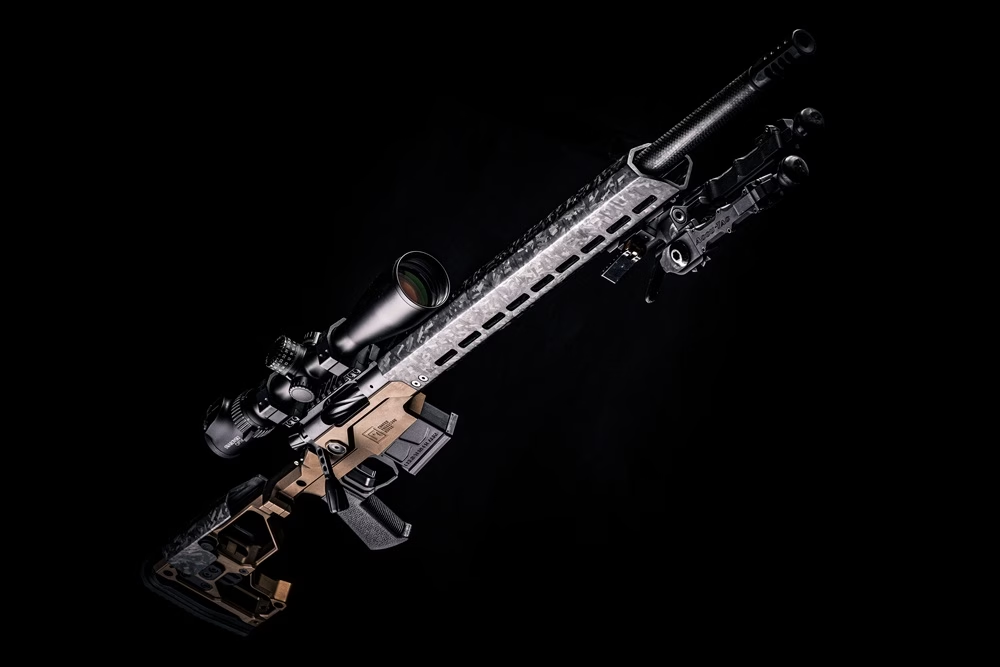
Why SFP Wins for Swarovski Optik
Most, if not all, of Swarovski’s scopes have been designed for European hunters. As such, the core design principles of their optics still revolve around hunting to this day. And, like we noted above, SFP reticles have some serious advantages when it comes to hunting.
Greater Reticle Visibility
Having and maintaining a proper visual on your target is imperative, but being able to see your reticle is equally so. Fortunately, reticle visibility is one area where SFP optics really shine.
As noted earlier, SFP reticles always stay the same size, regardless of the magnification. So, no matter what distance you’re shooting at, you’ll be able to see the reticle in its entirety. On an FFP optic, this isn’t always possible. Depending on an FFP scope’s reticle design, it’s easy for finer details to get harder to see as you zoom out. So, if you were to go from a higher magnification setting to a lower one, it’s possible to have some difficulty when tracking your target. With an SFP scope, this isn’t really much of an issue.
SFP optics tend to offer greater low-light visibility too. A lot of modern optics make use of reticle illumination to enhance reticle visibility. Despite being arguably the best way to make a reticle more visible, illuminated reticles aren’t always allowed for hunting. Depending on the state you live in, you might not be allowed to hunt with illuminated reticle scopes, forcing you to opt for non-illuminated ones. If you were to use an FFP scope with an etched reticle, many of its elements would get washed out in the lowlight hours of the day.
SFP scopes with wire reticles tend to be much bolder since the reticle is an actual physical piece of the scope. So, in low light, the harsher lines of the crosshairs and any other elements present in the reticle design are a lot easier to see. This makes it easier to use your scope in low light if your state prohibits the use of illuminated reticles. But, if you live in a state where hunting with illuminated scopes is allowed, Swarovski offers several to choose from.
Less Cluttered Sight Picture
Reticle simplicity is another key advantage of SFP scopes, as their simpler designs give them less potential to obscure your target.
Even though etched reticle elements on FFP scopes are typically fine enough to allow you to easily see your target beyond them, if they have a more complex design, all their extra elements can easily overcrowd your sight picture. Swarovski’s reticle designs are kept simple for this very reason. By keeping to a simpler SFP construction, you can have a clear, unobstructed view of your target since everything stays consistent.
Greater Practicality for Hunting
Finally, for hunting specifically, SFP reticles are widely considered a more practical option. While FFP reticles are certainly worth considering their great long-range capabilities, most hunters still prefer the simpler construction and usability that SFP rifle scopes offer.
In the field, hunters don’t usually make rapid adjustments to their magnification. Instead, it’s more common to stick with one practical magnification level that’s suited better for their environment. While this is doable with an FFP rifle scope, they’re usually designed for on-the-fly adaptability, which isn’t needed as much when hunting. In the same vein, hunters also don’t always need the rapid holdover scaling that FFP rifle scopes achieve, with them instead preferring a simpler, easy to read reticle picture.
Swarovski Optik Offerings
Having been a rifle scope manufacturer since 1959, they’ve garnered a sizeable lineup of industry-leading optics. Each one of them is crafted to an exceptional high level of quality, boasting high-quality glass clarity and many other premium features. And just like other optic manufacturers, Swarovski offers multiple different models that cater to different applications.
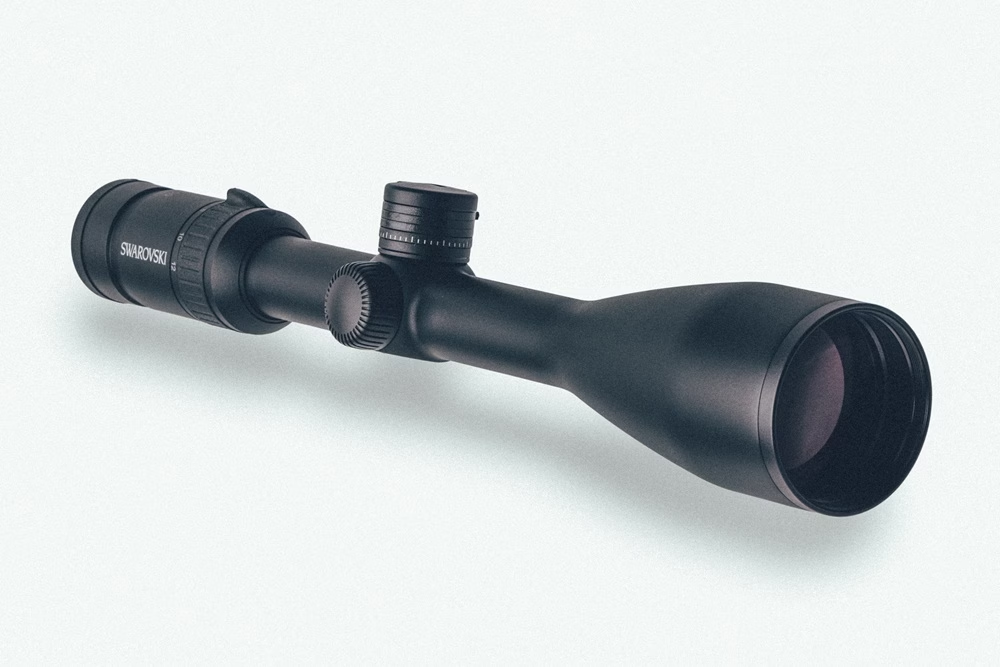
Swarovski Z3 Series
Swarovski’s Z3 series rifle scopes have long been some of the most popular in their lineup. Making up their entry-level optic line, they offer incredible clarity and have many features that make them ideal for hunting.
For starters, Z3 scopes have a 3:1 magnification ratio, hence the name ‘Z3’. They also have a slimmer, 1-inch scope body diameter. Swarovski offers Z3 scopes with either a 3-10x or a 4-12x magnification range, making them great for close to medium range hunting. Plus, they’re lightweight and easy to mount on a plethora of lever- and bolt-action rifles.
Of the various Z3 scopes, the Swarovski Z3 3-10×42 rifle scope is a particularly excellent choice for close range hunting. Despite being designated as a 3-10x scope, it has a 3.3-10x magnification range. Its lightweight construction makes it a solid pick for small caliber bolt-actions, as well as brush guns like lever-actions. Plus, its 42mm objective lens gives it a wide field of view (FOV), and impressive light transmission too.
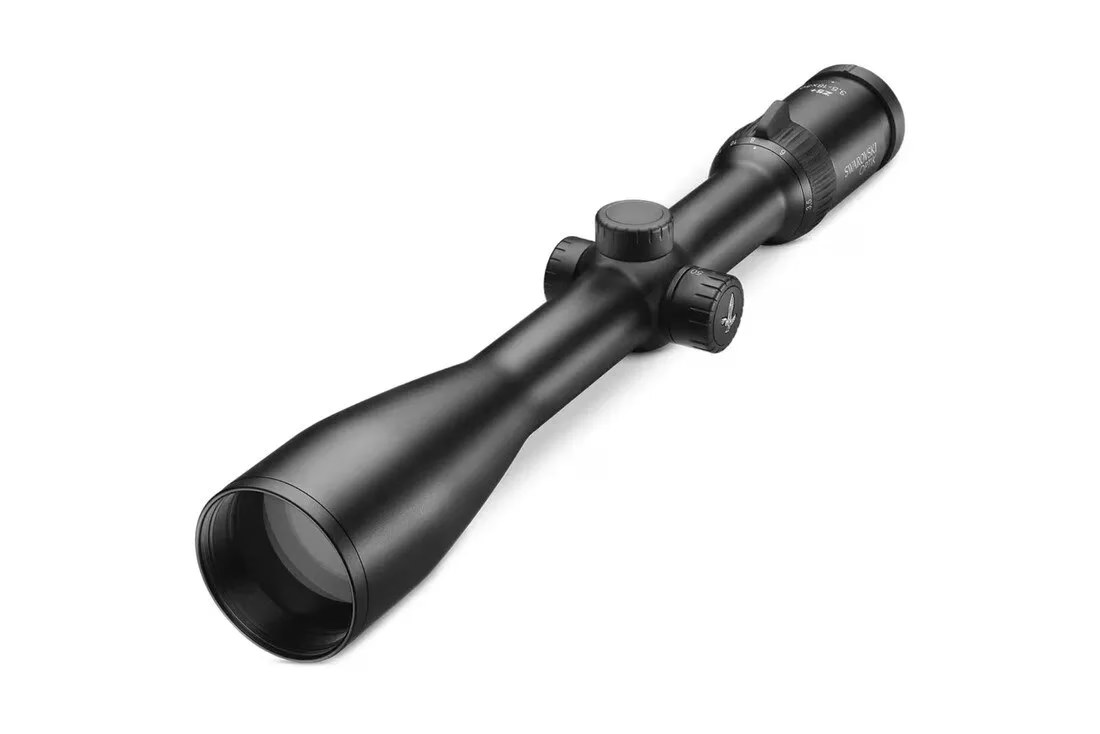
Swarovski Z5 and Z5+ Series
Z5 series rifle scopes are a step up from the Z3 series. They build on the latter’s foundation to provide a more premium option with a greater magnification range. Keeping their namesake, Z5 scopes have a 5:1 magnification range. But they also make use of the same slim and more compact 1-inch tube diameter. As such, they’re still remarkably light—in fact, they’re lightest scopes with a 5:1 magnification ratio that Swarovski offers. In addition to the standard Z5 optics, you can also find the Z5+ optics, which use a 30mm tube instead of a 1-inch tube. Although they’re marginally heavier than standard Z5 scopes, they offer much more elevation adjustments for longer range engagements. Plus, they’re available in multiple configurations, giving you more magnification ranges to pick from.
One of the more popular scopes in this line for close-range hunting is the Swarovski Z5+ 2-10×42 SFP scope. Its 2-10 magnification makes it a smart choice for everything from close- to medium-range hunting. Despite making use of the wider 30mm scope tube, it’s still impressively light thanks to its lower magnification range. It also has a wide FOV too, allowing you to more easily acquire targets in foliage dense environments.
If you’re planning to hunt game at longer distances, you can also opt for the Swarovski Z5+ 3.5-18×50 SFP. This optic is more at home on larger platforms like bolt-action rifles. With its 30mm tube diameter, it’s a solid optic that’s ready to see the rigors of field use, and with its large, 50mm objective lens, it provides a wide field of view, and great clarity
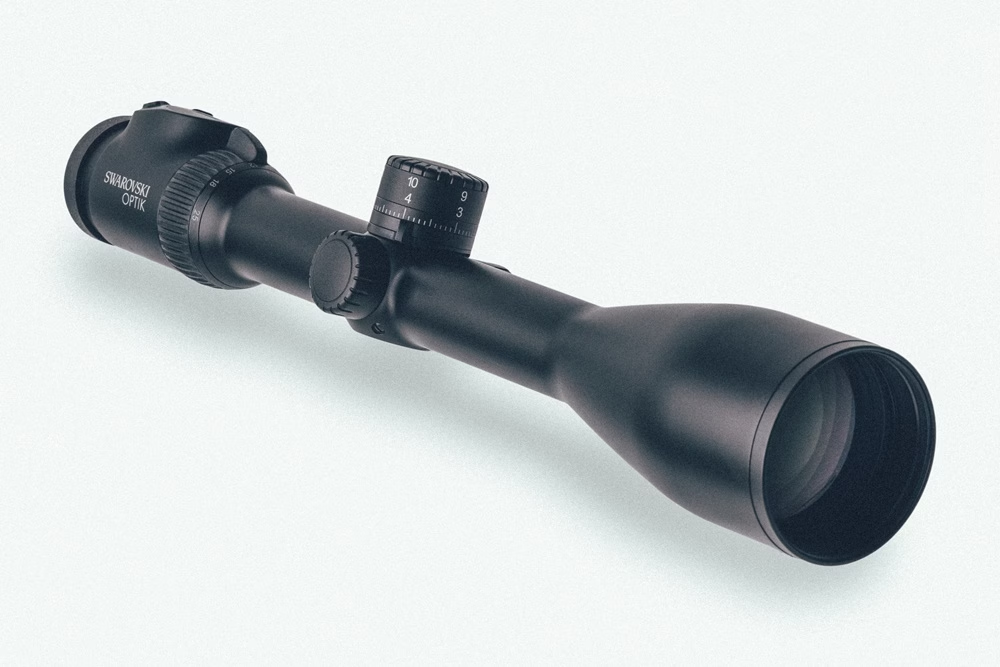
Swarovski Z5i Optics
Rounding out Swarovski’s Z5 optics, their Z5i optics are also used widely amongst hunters. Their Z5i optics are virtually identical to the Z5 and Z5+. The only difference they have in design is that they can come with illuminated reticles. As such, these optics are often used in states that allow hunters to use rifle scopes with illuminated reticles. And of the many magnification ranges Z5i optics are available in, arguably the most popular is the 3.5-18x model.
Models like the Swarovski Z5i+ 3.5-18×50 BRS-I are a well-rounded optic that’s great for both bolt-actions and semi-auto platforms. Its use of the BRS-I illuminated reticle offers exceptional versatility for both medium- and long-range hunting applications. It has an illuminated center dot, and a plethora of holds for far-off targets. Similarly, the Swarovski Z5i+ 3.5-18×50 BT 4W-I is great too. It uses the 4W-I reticle, which includes both an illuminated center dot, as well as multiple windage holds for more complex shots at distance.
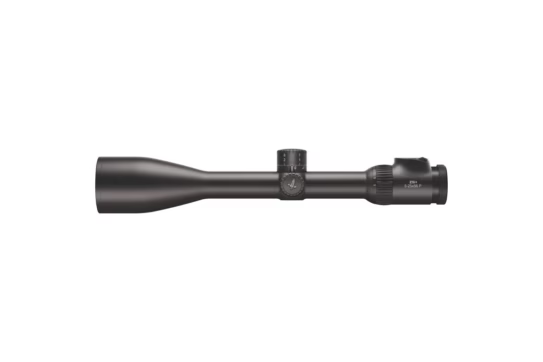
Conclusion
SFP rifle scopes and hunting are natural pairings. Their consistent reticle size offers an unobstructed view allow you to more easily track your target. And in the lowlight hours of the day, their easy to see reticles make them a highly versatile tool in the field. As such, it’s easy to see why Swarovski Optik has long preferred to craft such optics.
Whether you’re looking at their entry level Z3, or the more premium Z5 line, Swarovski rifle scopes are highly sought after for a reason. Their ultra-clear glass and intuitive reticles give you all the capabilities needed to hunt in all conditions. And since they’re backed by over 60 years of engineering, we can’t recommend them enough.
Frequently Asked Questions (FAQ)
-
Are all Swarovski hunting scopes SFP?
The vast majority are. Swarovski’s entire Z3, Z5/Z5+/Z5i, and Z8i hunting lineup all use a second focal plane design. They have offered limited-production FFP models like the X5i and dS Gen II, but these are designed for precision/long-range shooting, not necessarily for hunting applications.
-
Is SFP or FFP better for deer hunting?
For most deer hunting scenarios, SFP is the better choice. You get a clean, consistent reticle that’s easy to see in low light and at any magnification. FFP’s advantages are useful but aren’t really needed when taking a single shots at rangefinder-confirmed distances.
-
Why don’t Swarovski, Zeiss, and Leica make more FFP hunting scopes?
European hunting traditions prioritize glass clarity, low-light performance, and fast target acquisition over dialing turrets or using holdovers at variable magnification. SFP allows thinner, cleaner reticle designs and frees optical engineers to maximize light transmission—both of which align better with how European hunters shoot.
-
Can I still use holdovers with an SFP scope?
Yes, but the subtension values are only accurate at the scope’s highest magnification setting. If you use holdovers frequently at varying magnification, FFP is the better option. If you dial your turrets or shoot at max power, SFP works perfectly.
-
Does Primary Arms carry Swarovski hunting scopes?
Yes. Primary Arms now stocks Swarovski Z3, Z5+, Z5i+, and Z8i hunting scopes. Browse the full selection – Swarovski Rifle Scopes