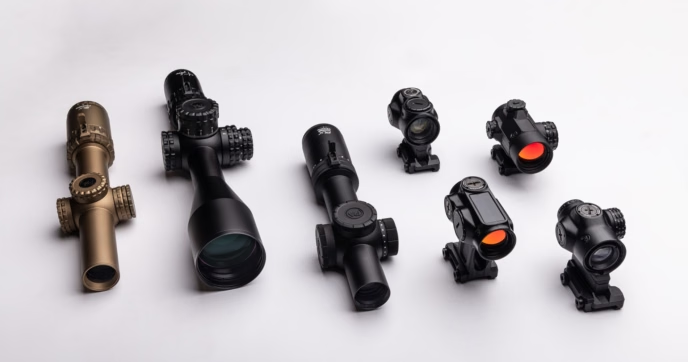
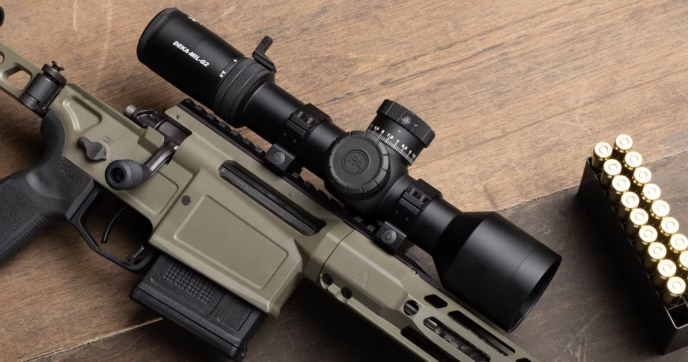
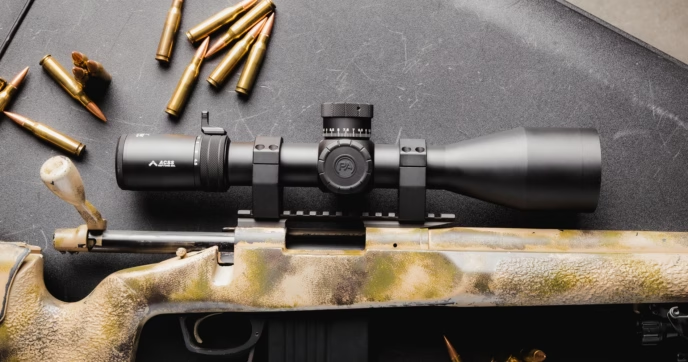
Primary Arms Optics has sought to push boundaries with their optic designs, creating some truly unique rifle scopes and reflex sights over the years. Today, their lineup is packed with several of the industry’s most innovative optic systems. And announced at SHOT Show 2026, they introduced the all-new PLxC® 1.5-12x Rifle Scope.
A new entry in their professional-grade PLx® Optic Tier, the PLxC 1.5-12×36 Rifle Scope has some serious advantages. Offering performance between LPVOs (Low-Power Variable Optics) and more powerful MPVOs (Medium Power Variable Optics), it excels across multiple applications. And with its other top-tier features, it’s an incredibly well-rounded optic.
What Makes the PLxC 1.5-12×36 Unique?
Perhaps one of the most unique features of this rifle scope is its magnification range. Unlike many other optics, it has a 1.5-12x magnification range, making it well-suited for both close-range engagements, as well as long-distance ones. While many may assume that it’s an LPVO because of its 1.5x zoom at low power, it’s actually more of an MPVO.
One of the defining characteristics of an LPVO is its 1x setting. It allows the optic to nearly match the agility of a reflex sight. The PLxC 1.5-12×36, as denoted by the name, doesn’t have a 1x setting, but a 1.5x zoom on the low-end. So, you won’t have the same performance as an LPVO, but this doesn’t mean that the PLxC 1.5-12×36 isn’t quick at close-range. 1.5x magnification falls right within the visual sweet spot that allows you to comfortably aim with both eyes open. You’ll still have full access to your peripheral vision, even while placing your full focus on your target. It won’t be as agile as a dot sight, but it’s still useful in dynamic scenarios.
Once you crank up the magnification, the long-range capabilities of this optic start to shine. Most LPVOs top out at 8x magnification though some have a 10x setting, depending on the model. While this does give LPVOs some ranged performance, it’s not what they’re designed for. The PLxC 1.5-12x, on the other hand, offers some extra power for those longer-distance shots. At 12x magnification, this optic can land accurate hits on targets out to 1,000+ yards away. Granted, this is dependent on your rifle and caliber of choice.
Either way, it’s a solid optic for applications where extra medium-range performance is needed. Plus, extra magnification is great for target identification too.
How does it compare to the PLxC 1-8×24 Rifle Scope
One of PAO’s most popular optics is their PLxC 1-8×24 LPVO. Being another optic in the PLx line, it boasts the same rugged reliability as the 1.5-12×34 MPVO, but it’s important to recognize that both optics are built for different applications, though they share the same DNA.
As a true LPVO, the PLxC 1-8×24 is better suited for more dynamic scenarios. At 1x magnification, it’s nearly as agile as a reflex sight, and its many specialized reticle systems allow you to easily range out to 600+ or even 800+ yards, depending on the model. However, while it does have solid ranged capabilities, it’s important to recognize that it was not designed with that in mind. LPVOs are designed to bridge the gap between 1x optics like reflex sights and prism scopes and more powerful rifle scopes. They excel at adaptability but aren’t necessarily the best option for dedicated close- or long-range use.
This isn’t to say that optics like the PLxC 1-8×24 aren’t good. By design, they’re some of the most versatile optics on the market. It’s just that it doesn’t have the same long-range performance as the 1.5-12×36, just as the 1.5-12×36 doesn’t have the same close-range performance as the 1-8×24. Ultimately, it all comes down to what your rifle’s intended purpose is. If you’re planning to use your rifle at both close and medium- to long-range distances, the 1-8×24 is a solid pick. But, if you’re planning to use your rifle in an SPR, DMR, or another long-range configuration, the 1.5-12×36 is the move.
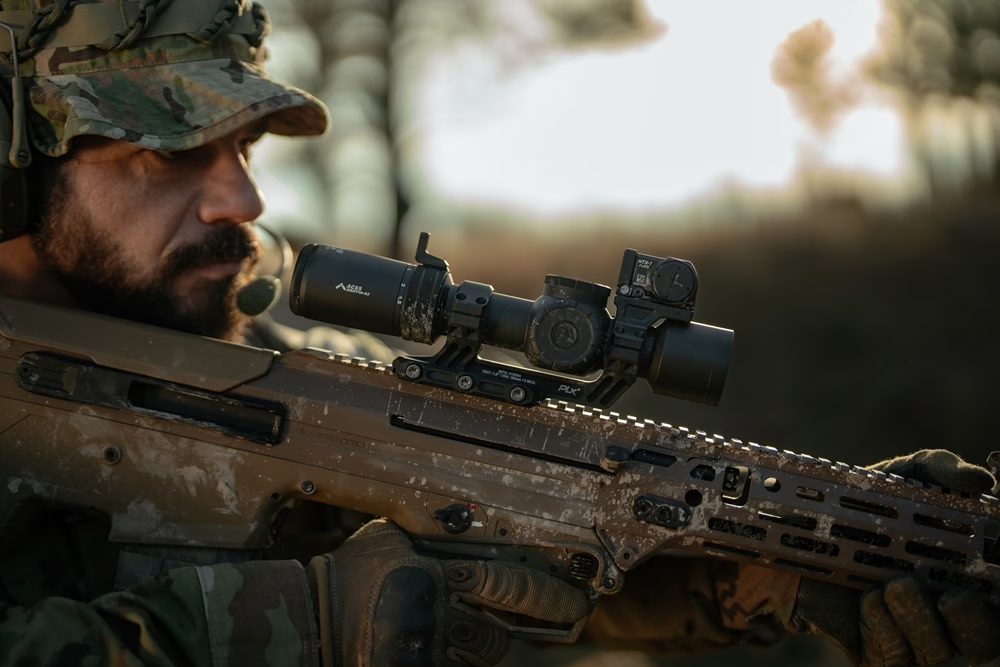
Specs and Construction
Being a part of PAO’s premium PLx Optic Line, the PLxC 1.5-12x Rifle Scope has some unique advantages over other MPVOs.
Size and Durability
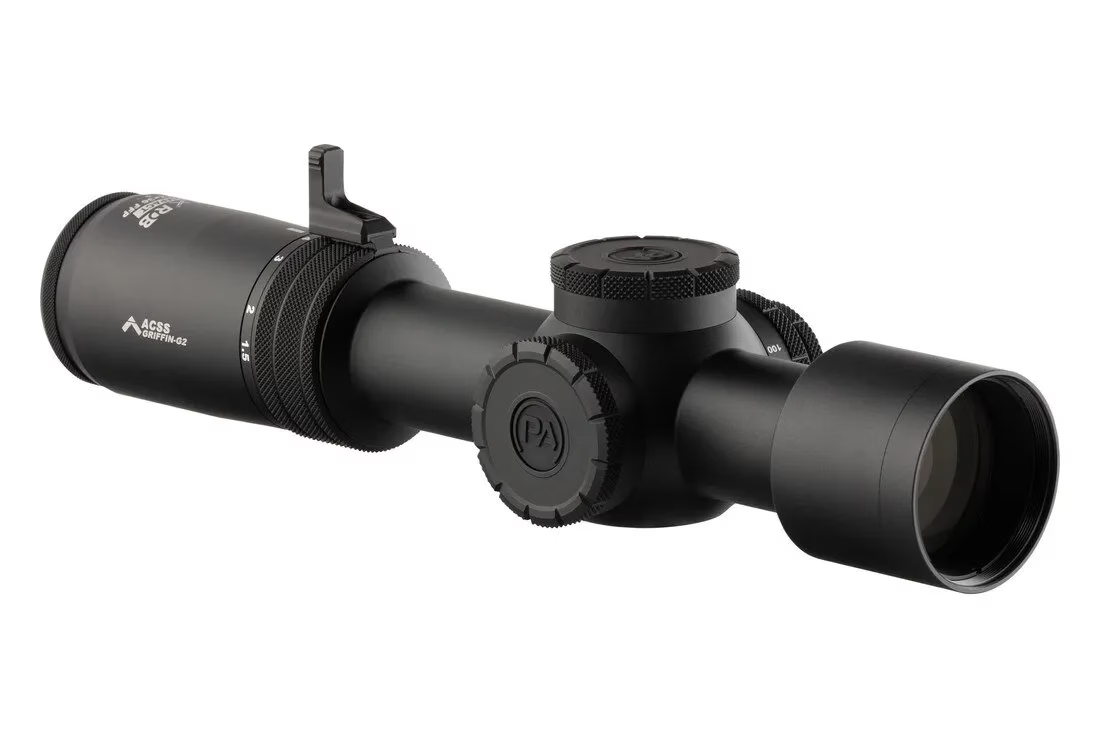
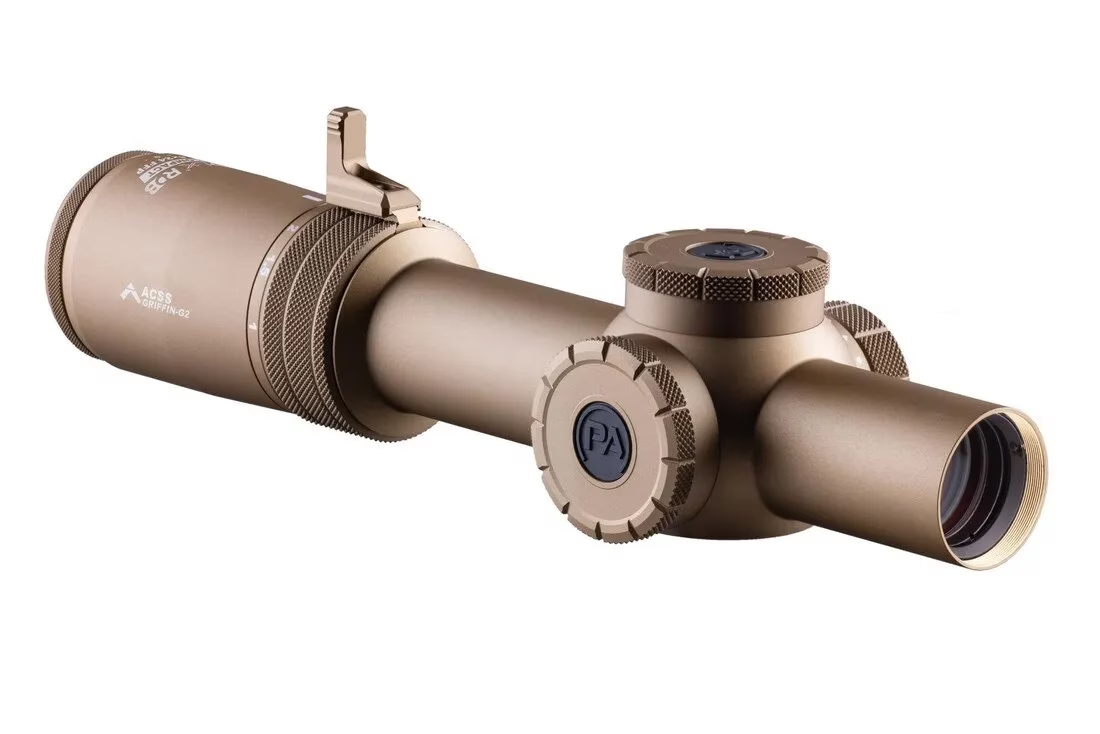
For starters, it’s incredibly compact compared to its magnification range. It measures just 9.75 inches long, which is shorter than many 1-10x LPVOs. It also weighs 19.67 ounces—a little over 1.2 pounds—which is also lighter than many LPVOs. Needless to say, it packs a lot of power in an extraordinarily compact optic body.
While its size is impressive, its overall construction is too. PAO’s PLx optics are designed to handle the rigors of professional use, and this optic exemplifies these standards. Its durable aluminum construction is waterproof and resistant to shock and fog, and it’s more than tough enough to survive harsh field use, drops, and heavy recoil. It also comes equipped with PAO’s SOS® (steel on steel) turret system. With it, the optic’s turrets are user-configurable, allowing you to run them in either a capped or exposed configuration. And with turret’s internals and caps being made of steel and aluminum, respectively, they can handle the same stress as the optic body with no problems.
Glass Clarity
An optic is only as good as the glass it uses, and the PLxC has exceptional glass clarity. Just like other PLx optics, it comes outfitted with top-tier, Japanese Extra-Low Dispersion (ED) glass lenses. This glass offers excellent light transmission, providing you with a bright image of your target. Additionally, it’s great for creating a wide field of view (FOV) too. Japanese ED glass has incredible edge-to-edge clarity. So, no matter what magnification you set it to, you’ll have a clean and detailed image of the optic’s entire field of view.
Finally, as far as color fidelity is concerned, the PLxC 1.5-12×36 has excellent visibility. The lenses are fully multi-coated to reduce chromatic aberration—a distortion that can cause color change around the edges of the optic lens. No matter whether you’re in a low- or high-light environment, you’ll have a clear image of your target.
RDB Reticle and Autolive
While an optic’s glass clarity is certainly important, having a reticle that’s visible at all times is right up there with it. The PLxC 1.5-12x rifle scope makes use of the same RDB (Red Dot Bright) technology that’s used on the PLxC 1-8x RDB LPVOs.
Although standard etched reticles can be illuminated, they aren’t necessarily all that bright compared to other optics. Standard etched illuminated reticles are filled with another material, like titanium powder, that disperses the light within the reticle. The problem lies in how bright the reflected light is. In brighter environments, the reticle can get washed out. So, to fix this, PAO introduced their new RDB diffractive reticle design to brighten up the reticle’s center chevron and horseshoe.
RDB reticles are immensely bright. Rather than just filling in the etched reticle to give light something to reflect off, RDB reticles have a micro-etched reflective grating filling in the illuminated portion of the reticle. The reflective grating intensifies the light that’s shone onto it, resulting in a truly Red Dot Bright reticle, something that was previously only possible when using the ACSS NOVA® Reticle. With it, there’s less risk of the reticle being washed out by your environment. And its use of refractive grating doesn’t change its battery life either. Because the light reflects at such a high intensity, the optic doesn’t need to draw as much power to create a brighter reticle.
Choosing your reticle: Griffin MIL G2 vs. Raptor Yard G2
Every optic, no matter the power, needs a good reticle. And the PLxC 1.5-12x rifle scope has two incredible reticle patterns to choose from. Like other PLx scopes, it makes use of the venerable Advanced Combined Sighting System, or ACSS®, family of reticles, which we cover in our PLx Reticle Guide.
Depending on your preference, you have the choice between either the ACSS Griffin MIL G2 or the ACSS Raptor Yard 5.56 / .308 reticle designs.
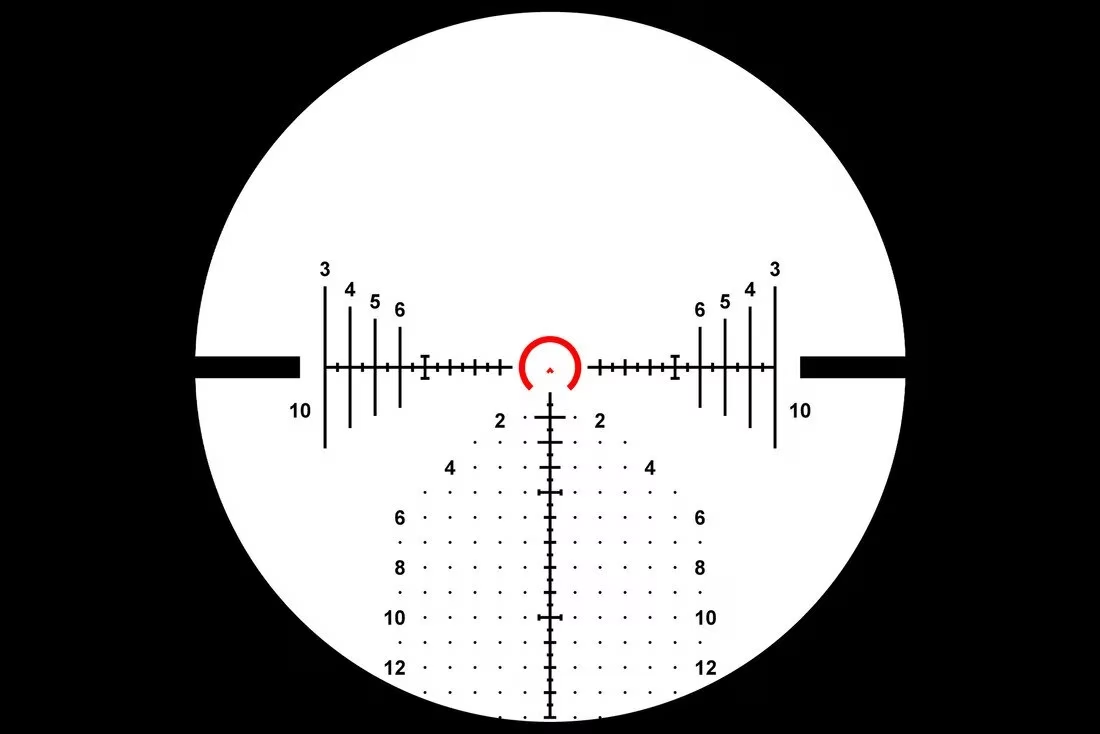
ACSS Griffin MIL G2
The ACSS Griffin MIL G2 reticle is an exceptionally versatile one. Building on the design of the original Griffin MIL reticle, the G2 has a fully MIL-based design, making it compatible with rifles of all calibers.
Much like many other popular reticles in the ACSS reticle family, the Griffin MIL G2 uses an infinitely precise chevron as its center aiming point, surrounded by an outer horseshoe. At 1x magnification, they form a bold point of aim, giving this optic a wide FOV and agility like that of a reflex sight. This reticle also houses a full MIL-grid. As you increase the magnification, more of the grid and other reticle elements come into view, letting you more easily make holds for complex shots at distance. Plus, this reticle also has moving target leads and auto-ranging stadia, allowing you to make quick adjustments and holds when needed.
As noted above, this reticle is compatible with any rifle caliber. As such, you aren’t locked into any specific one like you would be with a BDC reticle. So, whether you plan to use it on an SPR/DMR build in 5.56 NATO, .308 Winchester, 6.5 Creedmoor or another caliber, the Griffin MIL G2 is a solid pick. Plus, it’s great for compact bolt-actions chambered in low pressure cartridges like 8.6 Blackout too.
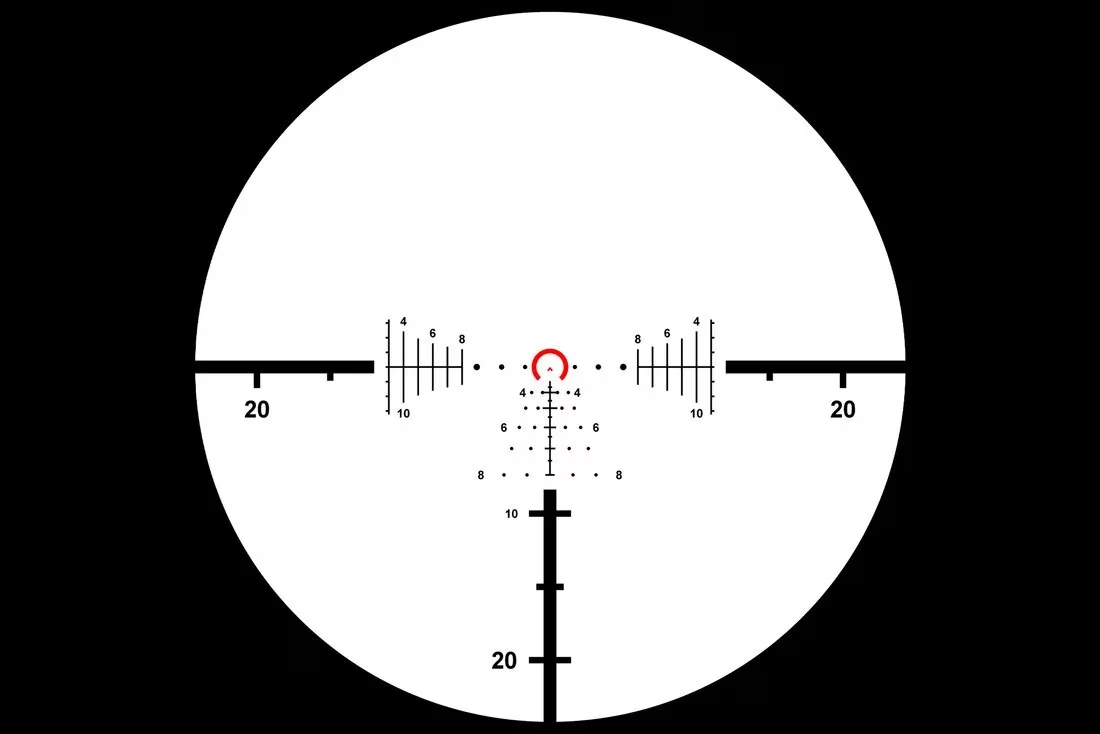
ACSS Raptor Yard 5.56 / .308 G2
A BDC reticle, ACSS Raptor Yard 5.56/.308 G2 is another solid reticle system. If you didn’t already know, ‘BDC’ is an acronym for “Bullet Drop Compensating”. The Raptor differs from MIL-based reticles, like the Griffin MIL G2, in that it’s made specifically for rifles chambered in 5.56 NATO and .308 Winchester.
Much like the Griffin mentioned above, the Raptor makes use of a chevron and horseshoe center aiming point. It also has full vertical and horizontal ranging stadia, moving target leads, and wind holds too. Instead of a MIL-grid, the Raptor reticle has a series of holds that are calibrated for 5.56 and .308, hence the name. After zeroing your scope, you can use these holds to quickly compensate for bullet drop out 800 yards. The only downside of using this reticle is that you’re locked in to using either 5.56, .308, or another similar caliber. You won’t have the multi-caliber adaptability that a MIL-based reticle offers. But this isn’t necessarily an issue.
This utility is great for SPR and DMR builds. With this reticle, you can more easily make on-the-fly adjustments when needed, dropping the guesswork and complex mathematics needed with a MIL-based reticle.
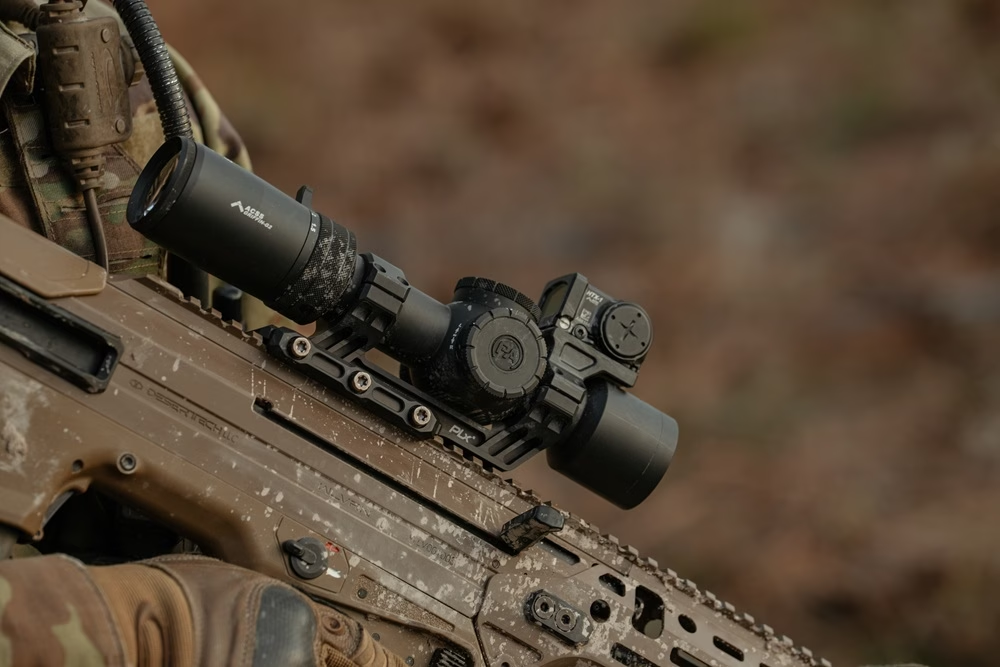
Mounting Options
Every optic needs a mount. And if you’re going to run the PLxC 1.5-12x, an optic designed to handle whatever the environment can throw at it, it’s best to have a mount with the same capabilities. This is where the PAO PLx series mounts come into play.
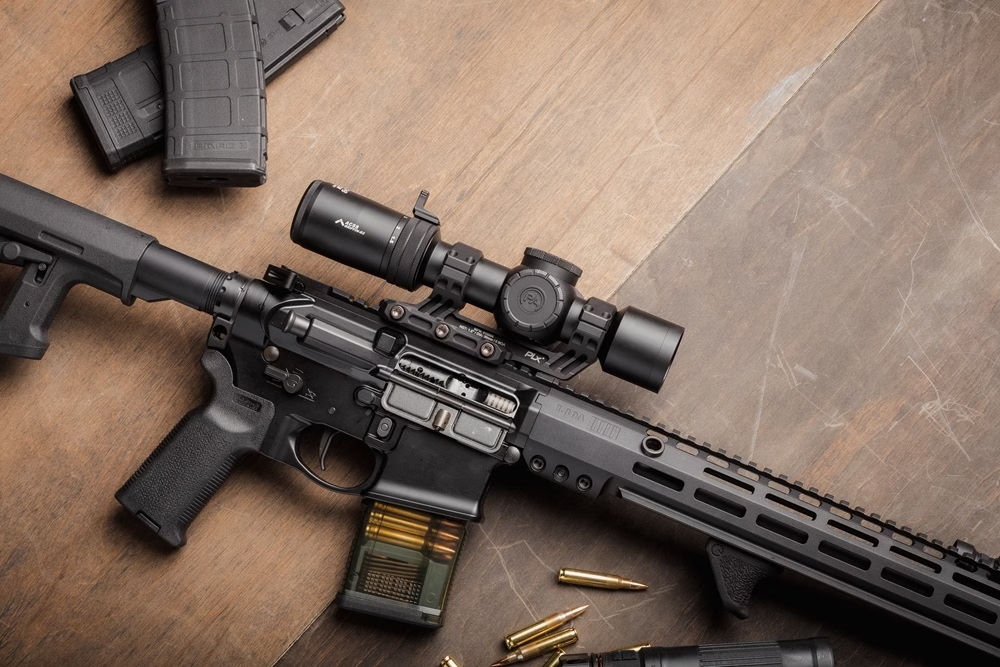
PAO’s PLx series mounts are a professional-grade mount, and solid addition to any optic. As such, they pair especially well with the PLx optics. Machined from 7075 aluminum, they’re exceptionally durable and resistant to abrasion with its Electroless Nickel coating. Its three-bolt design ensures the optic won’t shift within the mount when firing or facing an impact. With the ability to provide upwards of 6,500 pounds of clamping force onto the optic, it’s specifically designed to evenly distribute recoil forces after firing the rifle.
Since the PLxC 1.5-12x rifle scope has a 30mm tube diameter, you have your choice of three different PLx mounts to use:
- PLx 30mm 1.5-inch Cantilever Mounts are a solid choice for rifles like the AR-15 and AR-10. With no cant, they provide a nice, flat mounting solution for your scope. Plus, the lower 1.5-inch mount height allows you to get a good cheek weld when aiming.
- PLx 20-MOA 30mm 1.5-inch Cantilever Mounts are virtually the same as the standard 1.5-inch mount listed above, but they come with an added 20-MOA cant. This cant angles the optic down, and while this might seem counterintuitive to the uninitiated, it gives you more rising elevation travel. This makes it a good pick for dedicated ranged use, making it best for long-range AR builds and bolt-action setups.
- PLx 30mm 2.04-inch Cantilever Mounts are another excellent option to consider. This possibility is basically the same as the standard PLx 30mm mount, but instead of a 1.5-inch height, it’s a 2.04-inch mount. It pairs well with ARs, and since it’s higher, it makes it easier to use your rifle with NODs and IR lasers, or other night vision devices. Just remember that the PLxC 1.5-12×36 Rifle Scope doesn’t have any night vision compatible brightness settings.
How you plan to use your rifle will decide which mount is best for you. For instance, if you’re looking for more of a general-purpose setup, the standard 1.5-inch cantilever mount is great. But, if you’re setting up more of a long-range build, the 20-MOA canted mount is the move. Finally, if you prefer a taller optic setup, the 2.04-inch mount is good too.
Conclusion
Ever since it was announced back in January at SHOT Show 2026, the PAO 1.5-12×36 FFP Rifle Scope has been one of the most long-awaited optics in their lineup. And now, it’s finally here.
This rifle scope is one of the most advanced MPVOs in PAO’s lineup. At 1.5x magnification, it’s still easy to aim with both eyes open, allowing for quick target acquisition and engagement at close range. And with its detailed reticles, reaching out to targets as far as 800 yards and beyond is more than possible.
Whether you’re running a precision AR-15, a DMR-style AR-10, or a compact bolt gun, the PLxC 1.5-12×36 Rifle Scope is the move. If you’re thinking that the PLxC 1-8×24 LPVO might be a better fit for your build, our guide on Why the PLxC is the Ideal Optic for ARs.
Frequently Asked Questions (FAQ)
-
What reticles are available for the PLxC 1.5-12×36 Gen II?
Two ACSS options: the Griffin MIL G2 (a MIL-based grid for multi-caliber precision) and the Raptor Yard 5.56/.308 G2 (a BDC reticle calibrated for 5.56 and .308). Both use PAO’s Red Dot Bright diffractive illumination technology to provide ultra-bright illumination, so they won’t get washed out in bright environments.
-
How does the PLxC 1.5-12×36 compare to the PLxC 1-8×24?
The PLxC 1.5-12×36 extends the magnification range from 8x to 12x, while its larger 36mm objective lens allows for better light transmission, enhancing its long-range capabilities. It’s slightly longer (9.75 inches vs. 9.28 inches) and heavier (19.67 ounces vs. 16.95 ounces). However, both share the same RDB illumination, AutoLive motion-sensing illumination, and the PLx Compact build philosophy.
-
What is Red Dot Bright (RDB) technology?
RDB reticles have a diffractive grating micro-etched onto the reticle surface that focuses and intensifies light shined onto it. The result is FFP reticle illumination that approaches red-dot-level brightness without drawing too much battery power.
-
What mount does the PLxC 1.5-12×36 Gen II need?
The PLxC 1.5-12×34 Rifle Scope has a 30mm scope tube diameter, so any quality 30mm cantilever mount, or rings, will work just fine. Primary Arms offers PLx 30mm mounts in 1.5″ and 2.04″ heights, plus a 1.5″ / 20 MOA canted version for extended elevation range, and they pair exceptionally well with this scope.
-
Is the PLxC 1.5-12×36 Gen II available now?
Yes. The PLxC 1.5-12×36 Rifle Scope is available with either the ACSS Griffin MIL G2 or the ACSS Raptor Yard G2 reticle. They’re available on the Primary Arms store page for $1,999.99 each.