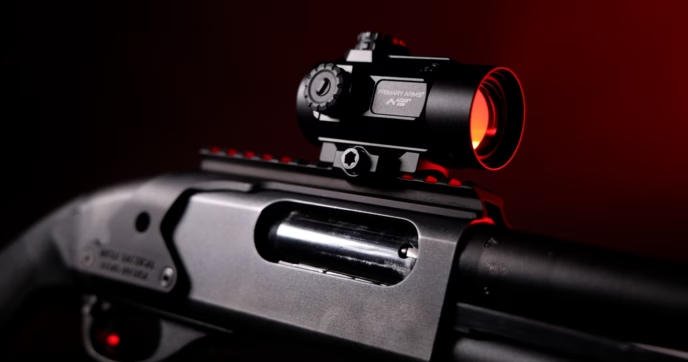
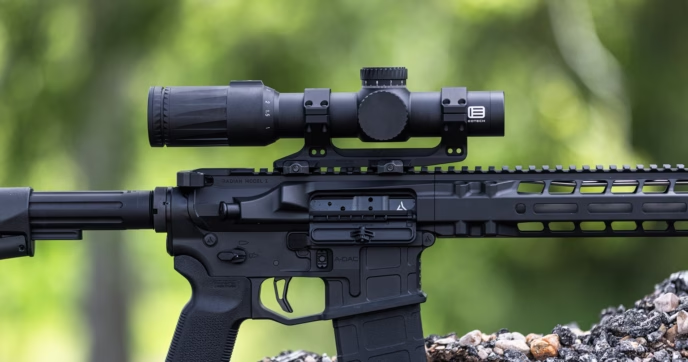
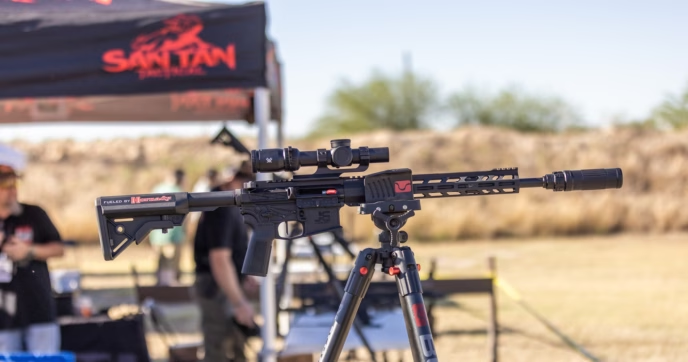
Primary Arms’ Advanced Combined Sighting System is one of the most well-known reticle systems on the market. ACSS® reticles represent the pinnacle of what modern reticles can be: versatile across many applications, and intuitive to use under pressure.
Reticles such as their ACSS Vulcan® and ACSS Cyclops® have revolutionized close-range performance. However, red dots and prism scopes aren’t the only optics PAO offer with ACSS reticles. In fact, many of PAO’s most sought-after long-range rifle scopes utilize specialized ACSS reticles.
But, with their being so many rifle scopes with ACSS reticles to choose from, it’s easy to get lost in the sauce when shopping for an optic. Below, we’re taking a look at the advantages ACSS reticles bring to the table.

What is Long-Range Shooting and Precision Rifle Use?
Before we get into the weeds on the unique features of ACSS reticles, it’s good to cover what “long-range” means in the first place.
For the most part, what’s considered long-distance is subjective. Most average enthusiasts view distances over 500 yards as long distance. Granted, this is entirely subjective. For instance, experienced sharpshooters will regularly engage targets far beyond 500 yards, with their usual engagement distances being over 1,000 yards in some places.
In terms of practical marksmanship, targets within 300 yards are typically considered close-range. At these distances, you can reliably land hits on targets with iron sights alone, with some practice of course. Once you go beyond this distance, irons start to feel ineffective. Medium range is generally viewed as anywhere from 300 to 600 yards. While it is possible to use iron sights, a magnified optic is a far better tool. Finally, long-range is anywhere from 600+ yards away. At these distances, having an optic is practically a necessity.
The Importance of Rifle Scopes for Long-Range Shooting
Rifle scopes can drastically improve your setup’s long-range performance. We go over this at length in our Long Range Rifle Scope Buyer’s Guide, but their core advantages can be explained simply. Nearly every long-range rifle scope has variable power. With it, you can dial in your scope’s magnification to get an impressively clear view of your target.
And to complement their increased zoom, modern options have the reticles needed to make precision at range possible. They often feature elements that provide crucial target and ranging data. Depending on the design, they can have MIL or BDC hashmarks, windage holds, as well as other specialized features.
This combination of high-power magnification and adaptable reticle systems is incredibly advantageous to hitting long-range targets.
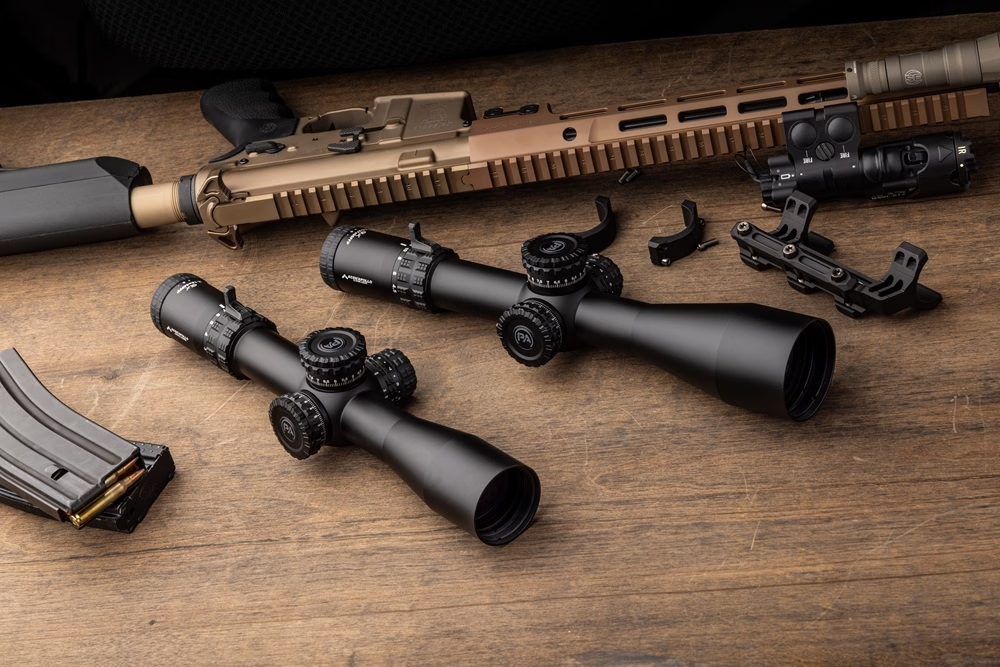
Types of Rifle Scopes
There are a lot of unique rifle scopes available. And although they’re all designed to magnify your sight picture, that doesn’t mean they’re all conducive to long-range use. To help you determine what fits each role, variable optics (scopes) are divided into three categories: Low-Power, Medium-Power, or High-Power. You might also see them simply as LPVOs, MPVOs, and HPVOs, respectively.
Of the three, MPVOs and HPVOs offer the best for dedicated long-range use, with HPVOs being the superior choice. Both can have impressive magnification ranges, depending on the model. And their reticles are usually designed to maximize performance and adaptability at those extreme distances. MPVOs can go the distance when needed, but their zoom usually tops out around 18x magnification. HPVOs, on the other hand, can offer over 35x zoom, in some instances.
LPVOs are characterized by their close-range versatility. They can be effective for long-range applications, but they aren’t designed for such roles. LPVOs are a nice in-between for reflex sights and higher power rifle scopes. LPVOs with specialized reticles can range out to 600 or even 800 yards, depending on their reticle. As such, understanding their performance is crucial. Fortunately, our guide, “LPVO vs. Precision Rifle Scopes”, covers LPVOs in-depth.
Still, if you’re planning to use your rifle primarily for long-distance shooting, stick with an HPVO.
Introduction to Primary Arms Optics
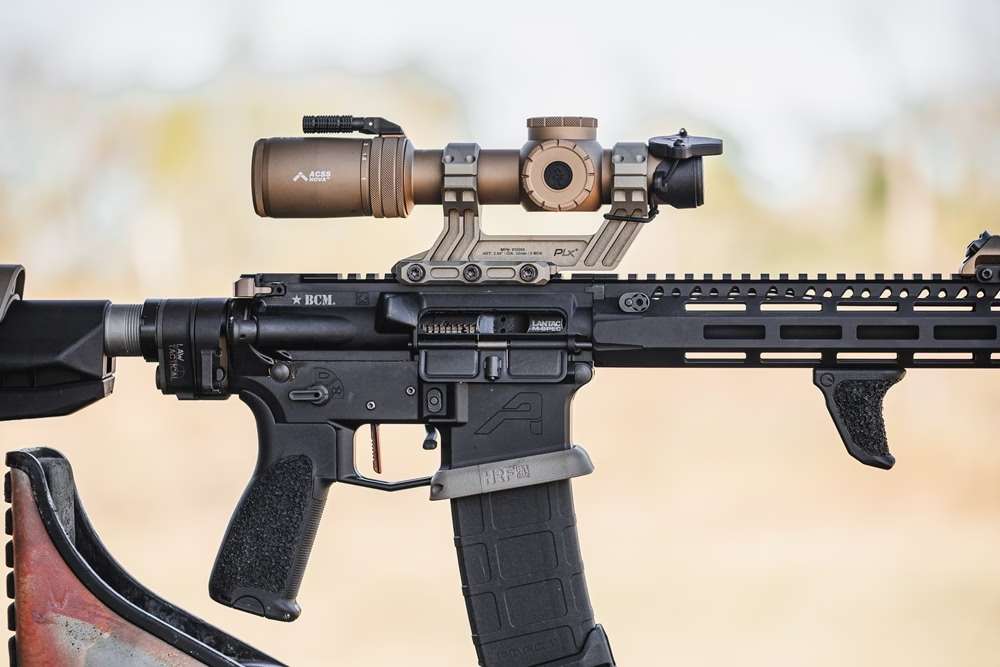
Since their start in 2008, Primary Arms Optics has worked consistently to change the landscape with innovative optic systems at a fair price. Now, they offer several unique rifle scopes, red dot sights, prism scopes, binoculars, and even premium scope mounts. Still, a large part of why their optics has garnered the level of acclaim that they have stems from PAO’s development and use of the ACSS Reticle Family.
Most, if not all, Primary Arms Rifle Scopes with ACSS Reticles, from the affordable SLx line to super-premium PLx line, are highly reviewed by customers. And for good reason, too.
What is the ACSS Reticle System?
The ACSS Reticle System isn’t just one reticle, but rather a family of them. By combining bullet drop compensation (BDC), target ranging ladders, and more, they can adapt to any role. No matter the optic, all ACSS reticles are designed to maximize performance in real-world conditions.
Advantages of ACSS Reticles
ACSS reticles offer a lot compared to other reticle systems. Regardless of whether you prefer using a BDC- or MIL-based ACSS reticle, they’re all designed to provide as much targeting info as possible. And, by design, they cut out most of the guesswork needed for more complex shots at distance. All these elements combine to form incredibly intuitive optics that are quick to learn. And at distance, they provide all the data needed to land hits on distant targets accurately.
ACSS Reticles on Precision Rifle Scopes
BDC-Based Designs: ACSS Apollo®
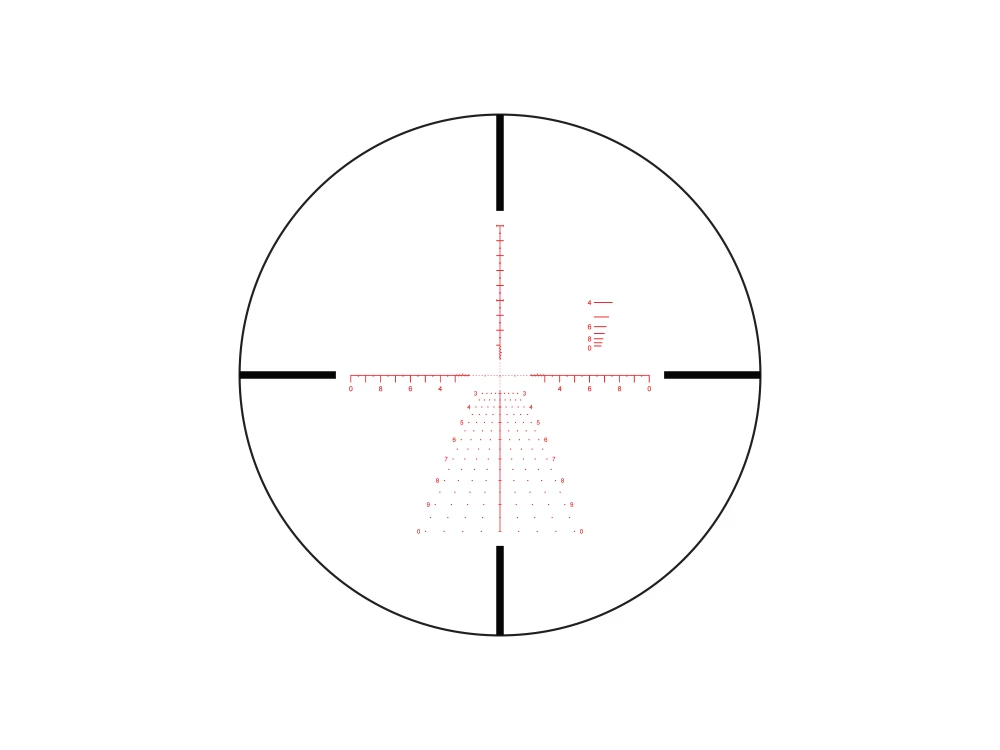
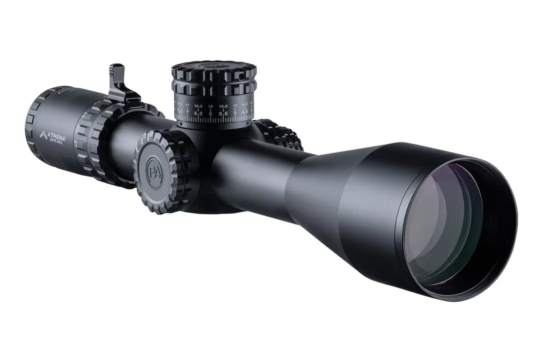
One of PAO’s most popular MPVOs, the SLx® 3-18x50mm, makes use of the ACSS Apollo .308/6.5 Grendel Reticle. As its name suggests, this reticle is calibrated for .308 Winchester and 6.5 Grendel. And, by design, it excels in medium- to long-range applications.
Being a bullet drop-compensating reticle, there’s next to no guesswork involved when dialing in your aim. The integrated BDC holds make long-range shooting simple. By zeroing your scope at 100 yards, you can use them to range out to 1,000 yards, all without needing to use any complex mathematics or turret adjustments. On top of this, it has additional wind holds in 5mph increments too, so you can effectively use this scope across recreational, hunting, and competition environments.
Additionally, it has an infinitely precise center chevron for its center aiming point. There are also stadia lines located on either side of the chevron. They’re spaced out in 0.2 MIL intervals, with a larger rectangle that represents 1 MIL from center. Rounding out this reticle is a target ranging ladder. With it, you can quickly estimate your distance to targets with a 5’10-inch tall and 18-inch wide profile without any math.
MIL-Based Designs: ACSS Athena® BPR MIL and ACSS DEKA G2
Although BDC designs are awesome for making fast, on-the-fly adjustments, they have some limitations. Mainly, since they’re calibrated for specific calibers, they only pair well with so many rifles. The ACSS Athena BPR MIL is certainly a standout pick for those who prefer MIL-based reticles. It’s a widely regarded reticle design that’s been used on the SLx 3-18×50 and the new SLx 4.5-27×56 FFP Rifle Scope. Plus, it’s even getting an updated design for the upcoming PAO PLxC® 2.5-20x Compact Rifle Scope.
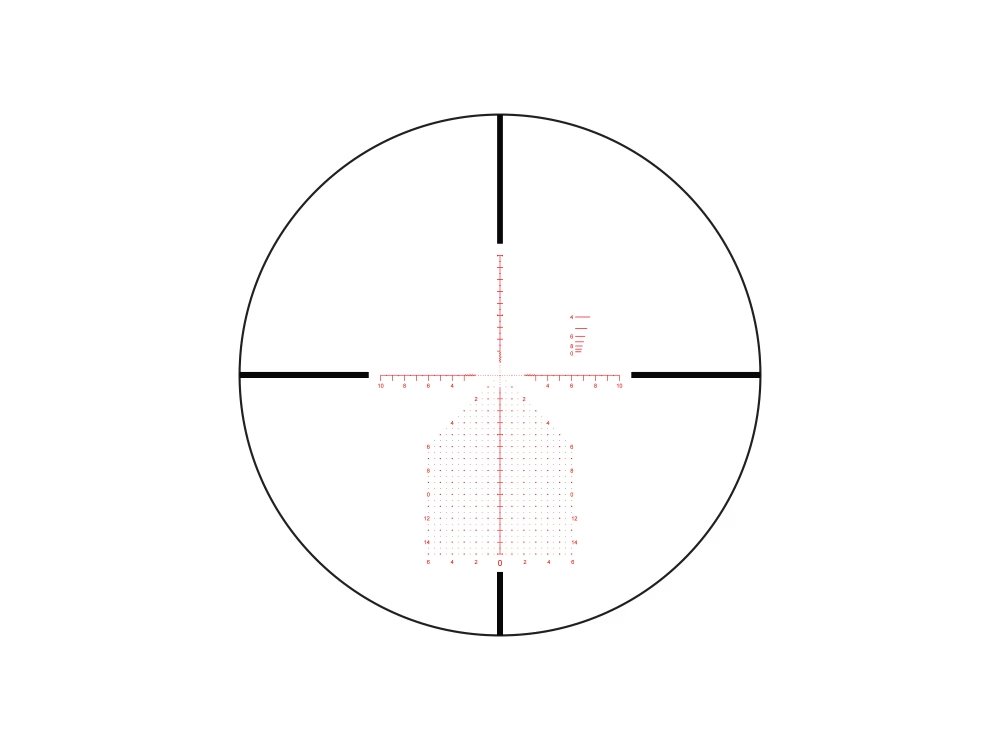
The ACSS Athena is an incredibly advanced long-range reticle system. Designed for long-distance precision, it’s packed with features. Using a center chevron aiming point, the reticle extends 10 MILs up, left, and right. Starting 2 MILs away from the center, Its horizontal stadia feature alternating hashmarks for ranging. This reticle also makes use of a MIL grid for enhanced accuracy. It uses 0.5 MIL dots spaced evenly for wind and elevation data. The grid extends 15 MIL below the center chevron and gives you plenty of holdover points for more complex shots. Plus, it still comes with a target ranging ladder like the ACSS Apollo.
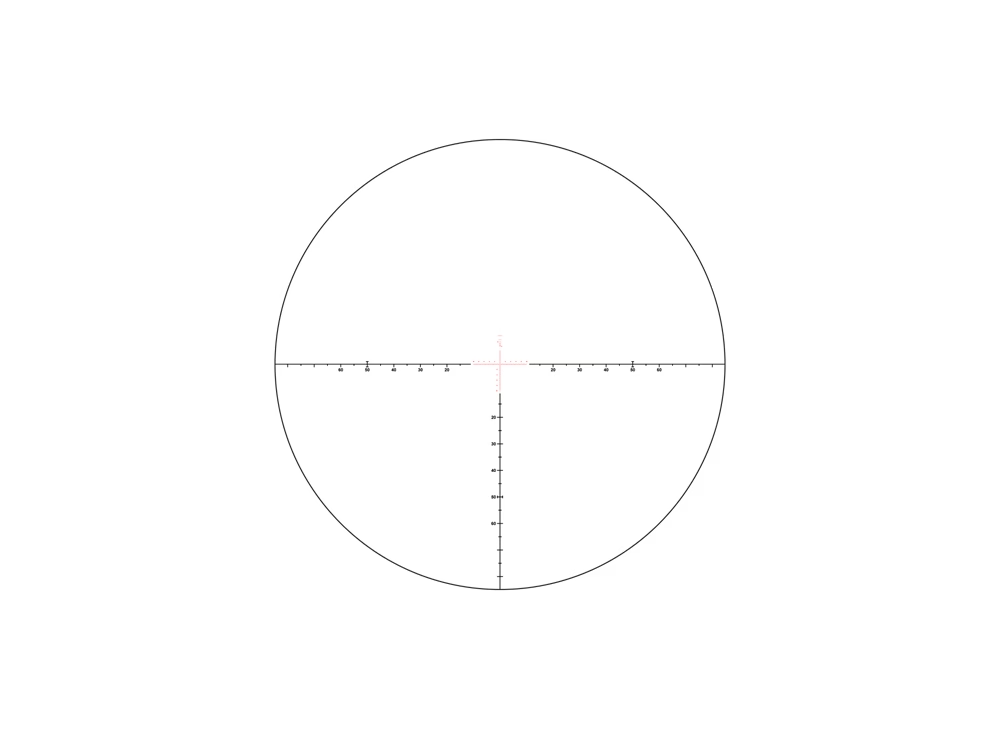
Another solid MIL based ACSS reticle is the DEKA G2. This reticle is also going to be used on the PLxC 4.5-36 rifle scope, as well as the upcoming PLxC 2.5-20 rifle scope. Currently, though, it’s available on the SLx® 4.5-27x56mm rifle scope. Compared to the Athena BPR MIL reticle, the DEKA G2 is much simpler. Its horizontal stadia has MIL subtensions with spaced 0.1 MIL apart from each other. Lastly, it retains the iconic target ranging ladder like the previous reticles, though it’s located above the vertical stadia instead of off to the side. For those who prefer a simpler, less crowded reticle, the DEKA G2 is the move.
Conclusion
A high-quality optic is a necessity for long-range shooting. But precision across long distances goes beyond having a high-power scope. Your scope’s reticle is one of its most critical features. As such, having the right one is imperative. So, if you’re planning to do some long-distance work, a rifle scope with an ACSS reticle can fill that role nicely.
Whether you prefer the speed and caliber specificity of a BDC reticle, or the precision and utility of a MIL reticle, ACSS reticles have you covered. They can provide you with all the tools needed to make long-distance accuracy and precision possible. And they do it all in an intuitive, easy-to-read design.
At the end of the day, you can’t go wrong with the ACSS Reticle System. Still, there’s a lot to cover when looking at the capabilities of different optics. Our guide, “First Focal Plane (FFP) vs Second Focal Plane (SFP)” offers some solid insight. Check it out!