TL;DR
The Primary Arms Optics PLxC® 2.5-20×48 FFP Rifle Scope offers supreme power and adaptability in a compact package, and utilizes their Advanced Combined Sighting System® family of reticles. With the ACSS® Athena® BPR MIL G2 reticle, you can maximize your holdover flexibility, while the ACSS DEKA MIL® G2 keeps more of your target visible when zoomed in, and both can easily engage targets beyond 1,000 yards away. If you need more reach, step up to the PLxC 4.5-36×56. If you want something lighter and more agile, drop down to the PLxC 1.5-12×36.
- Top All-Around Scope – PLxC 2.5-20×48: Built for close-, mid-, and long-range use out to 1,000+ yards away; measures 11.5 inches long and weighs 30.05 ounces.
- Top Reticle for Precision – ACSS Athena BPR MIL G2: Uses a 0.1-MIL center dot, a detailed Christmas Tree-style MIL grid, and a built-in ranging ladder for rapid distance-to-target estimation.
- Top Reticle for Speed – ACSS DEKA MIL G2: A simplified MIL-based reticle without a MIL grid that offers a less obstructed view of the target with its minimalistic design.
- Top Close- to Mid-Range Scope – PLxC 1.5-12×36: Lighter and more compact, it weighs 19.67 ounces and is 9.75 inches long; ideal for engaging targets up to and within 1,000 yards.
- Top Long-Range Scope – PLxC 4.5-36×56: The most powerful PLxC-series scope engineered to maximize precision and engage targets well beyond 1,000 yards.
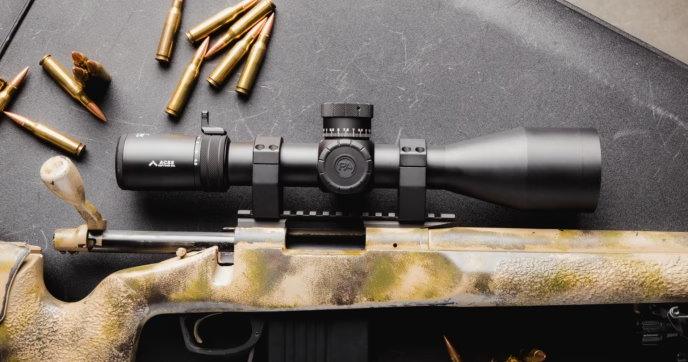
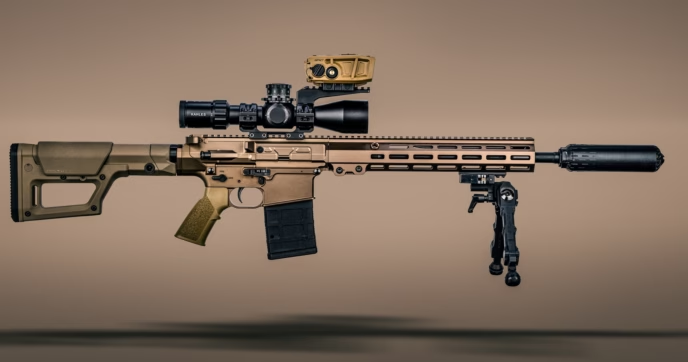
New to the scene is the Primary Arms Optics PLxC 2.5-20×48 FFP Rifle Scope, a first-focal-plane long-range optic engineered to cover ranges as close as 100 yards to as far as 1,000+. Pairing well with full-power semi-auto rifles, it’s remarkably compact at just 11.5 inches long while weighing 30.05 ounces. Plus, it serves as the perfect middle ground choice between Primary Arms Optic’s (PAO) other 2026 PLxC optic releases: the PLxC 1.5-12×36 and PLxC 4.5-36×56 FFP Rifle Scope.
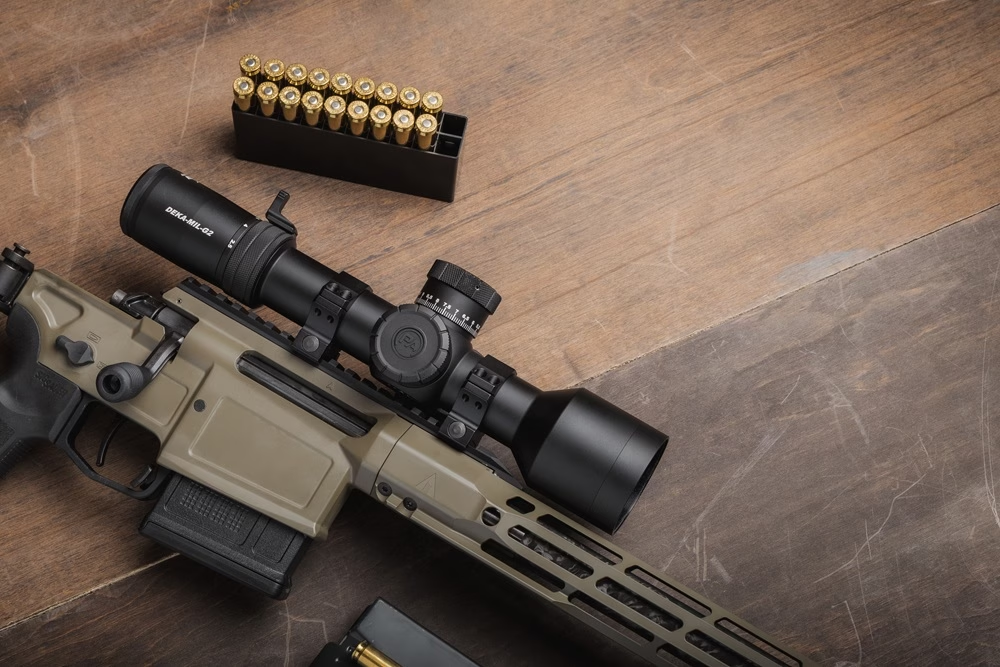
New PLxC Rifle Scopes: Spec Rundown
| PLxC 1.5-12×36 | PLxC 2.5-20×48 | PLxC 4.5-36×56 | |
|---|---|---|---|
| Magnification Range: | 1.5-12x | 2.5-20x | 4.5-36x |
| Objective Lens Diameter: | 36mm | 48mm | 56mm |
| Main Tube Diameter: | 30mm | 34mm | 34mm |
| Overall Length: | 9.75-inches | 11.5-inches | 14.49-inches |
| Weight: | 19.67 ounces | 30.05 ounces | 34.33 ounces |
| Eye Relief: | 3.3 to 3.6 inches (low/high) | 3.2 to 3.7 inches (low/high) | 3.1 to 3.7 inches (low/high) |
| Ideal Application: | Close- to mid-range use | Mid- to long-range use | Long-range precision use |
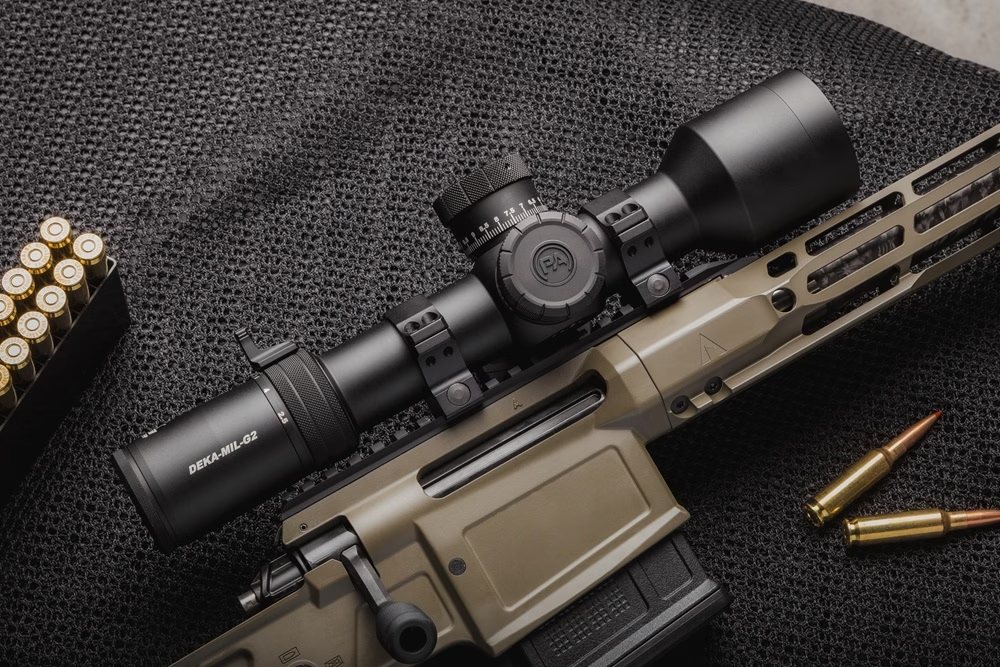
What Makes the PLxC 2.5-20×48 FFP Different from Other Long-Range Scopes?
| Magnification Range: | 2.5-20x |
| Objective Lens Diameter: | 48mm |
| Main Tube Diameter: | 34mm |
| Overall Length: | 11.5 inches |
| Weight: | 30.05 ounces |
| Eye Relief: | 3.2 to 3.7 inches (low/high) |
What Is the Magnification Range of the PLxC 2.5-20×48?
A 2.5-20x magnification range allows for some serious adaptability. On the low end, its 2.5x magnification level is great for close-range use. It isn’t going to be as agile as a red dot sight, or an LPVO at 1x for that matter, but it offers more than enough flexibility for engaging targets within 100 yards. It helps that 2.5x magnification falls right within the visual sweet spot that makes aiming with both eyes open easy to do. Again, it isn’t going to be reflex sight fast, but it’s still fast, nonetheless.
What really sets this optic apart from others is its top-end magnification. At 20x magnification, it’s possible to get a clear picture on far off targets, making long-range precision far more practical. Plus, considering this rifle scope houses ACSS reticles, it can easily be used to engage targets up to and beyond 1,000 yards.
Something else to mention though is its FFP (First Focal Plane) construction. As you increase the magnification, the size of the reticle increases too. And since the reticle isn’t locked to a singular position, your zero stays consistent across all magnification levels. Increasing magnification also brings more of the reticle’s finer details into view, giving you greater flexibility when making holds for windage and elevation.
Lastly, supporting its strong magnification range is its generous 48mm objective lens. Such a large lens allows a lot of light to pass through this optic, brightening your sight picture and increasing the exit pupil diameter. The optic’s exit pupil is the small circle of light that you actually see when looking through an optic, and the larger it is, the easier it is to get an adequate view of your reticle and target.
However, a large objective lens alone only does so much. But since the optic makes use of premium Japanese ED Glass—a specialized glass that reduces color fringing at high magnification—light can pass through the optic with less risk of chromatic aberration, a common optical distortion that can cause color fringing. This is especially beneficial in low-light scenarios. Plus, it gives the scope a much more forgiving eye box, or the zone behind the optic where you can actually see a full edge-to-edge sight picture. Despite being called an eye ‘box’ it’s more of a cone shape, and with the PLxC 2.5-20x’s eye box being a bit larger, you don’t have to position your eye in the same place every time you get behind the glass.
How Big and Heavy Is the PLxC 2.5-20×48?
Despite its powerful 2.5-20x magnification range, it’s just 11.5 inches long. While this frees up a good bit of upper rail space on most rifles, it also adds a lot to this scope’s maneuverability. Other high-power optics tend to suffer in this regard, as their added length makes them more prone to snagging gear or other things like tree limbs. With the PLxC 2.5-20x, this isn’t all that much of an issue. So, for dynamic applications in a duty or competitive capacity, or for hunting, it’s a solid choice.
The overall weight of the optic pairs well with its size too. On its own, this scope weighs 30.05 ounces. Compared to some other optics in its class, it’s both lighter and smaller. With its 34mm tube diameter, it’s compatible with a most of the industry’s most popular mounts. And when paired with something like PAO’s 34mm PLx Cantilever Mount, the whole optic package would only weigh 36.25 ounces.
Being a part of PAO’s PLx line of optics, it has a number of advantages. Starting with its overall construction, this optic has been thoroughly engineered to be as durable as possible. PLx optics are built for professional use, meaning they’re more than ready to face adverse conditions.
Built from high-quality aluminum alloy and Japanese ED glass, this rifle scope has been tested to ensure that it’s waterproof and shockproof. With such capabilities, it can be used across practically any long-range shooting discipline. Whether you’re building out a rifle for professional use in a duty setting, competitive shooting, hunting, or even just recreation, the PLxC 2.5-20x is the better fit.
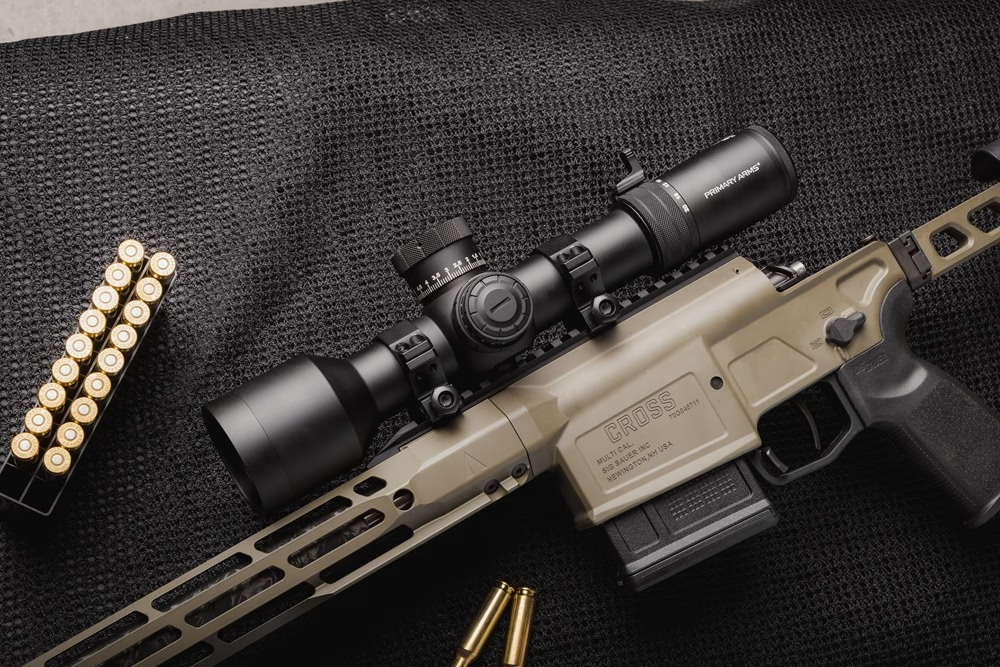
What Are the Interchangeable Cartridge Turrets on the PLxC 2.5-20×48?
One of the most innovative features present in the PLxC 2.5-20x is its Interchangeable Cartridge Turrets. These turrets, as their name suggests, are interchangeable, allowing you to tailor it to your specific ammo load and preferences, so you can fine tune its performance to match your rifle setup. PAO plans to release a series of additional turrets to go in place of the standard ones after launch. So, no matter what kind of rifle you plan to pair it with, you’ll be able to easily tailor the scope to your setup.
Out of the box, these scopes come standard with PAO’s EZ-Stop Elevation Cartridge Turret. This turret is designed to keep you from accidentally overturning the turret past your point of zero. With it, you can adjust in the field, and then quickly reset your turret back to zero without having to remember how many clicks you adjusted it. The EZ-Stop turret is made up of three main components: the turret cap, cap seat, and the collar. Once you’ve zeroed in your scope, you can set up the turret so that it’s locked to its position by following the instructions in the included optic manual.
In addition to the EZ-Stop Elevation turret, the 2.5-20x also comes with PAO’s Basic Windage Cartridge Turret. These turrets have a low-profile design to prevent snagging, and like the EZ-Stop turrets, they can be similarly configured. We understand that not a lot of enthusiasts adjust for wind like they do for elevation. And if you’re one of the many that don’t do so, you can just leave the turret caps on and not worry about adjusting. The reticles housed in these optics provide more than enough data to make correcting for wind is fairly straightforward.
Which Reticle Should I Choose in the PLxC 2.5-20×48?
Being a PAO optic, this rifle scope makes use of the ever-famous Advanced Combined Sighting System® (ACSS®) Reticle Family. In particular, the PLx 2.5-20x Rifle Scope can come equipped with either the ACSS Athena® BPR MIL G2 reticle or ACSS DEKA MIL® G2 reticle.
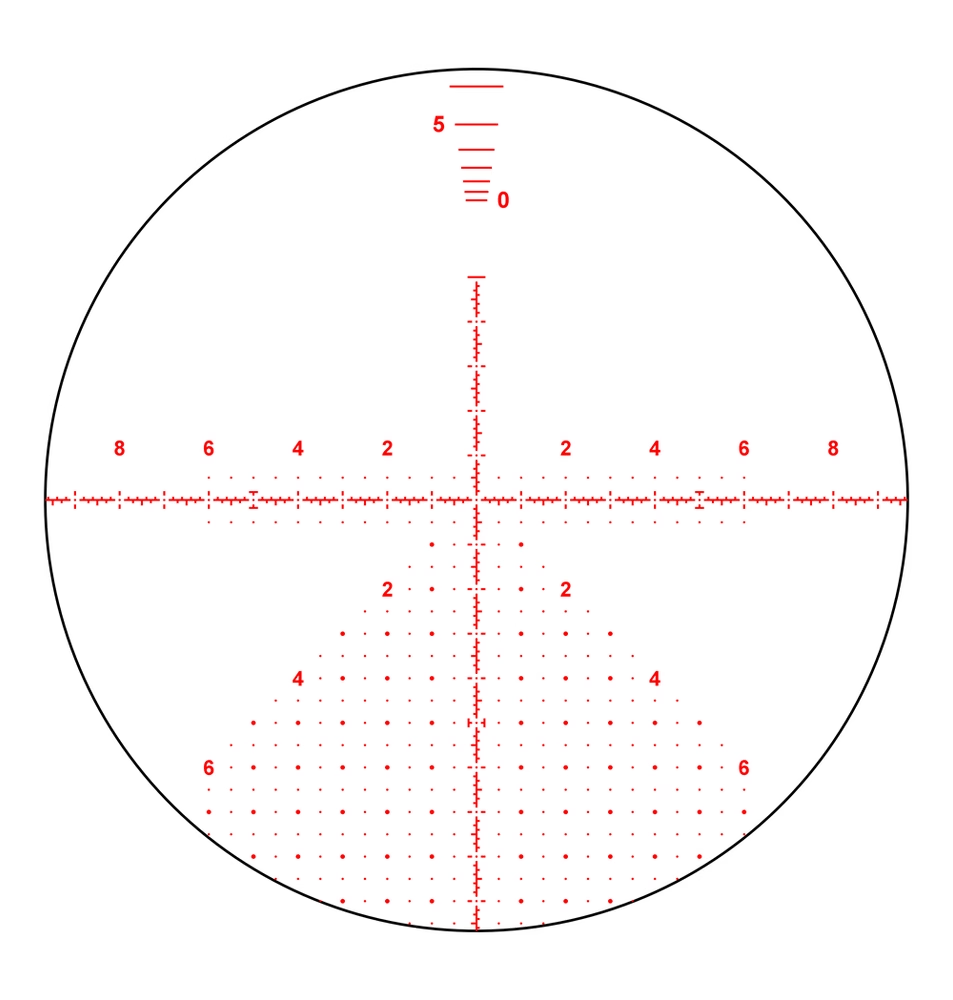
When to Choose the ACSS Athena BPR MIL G2
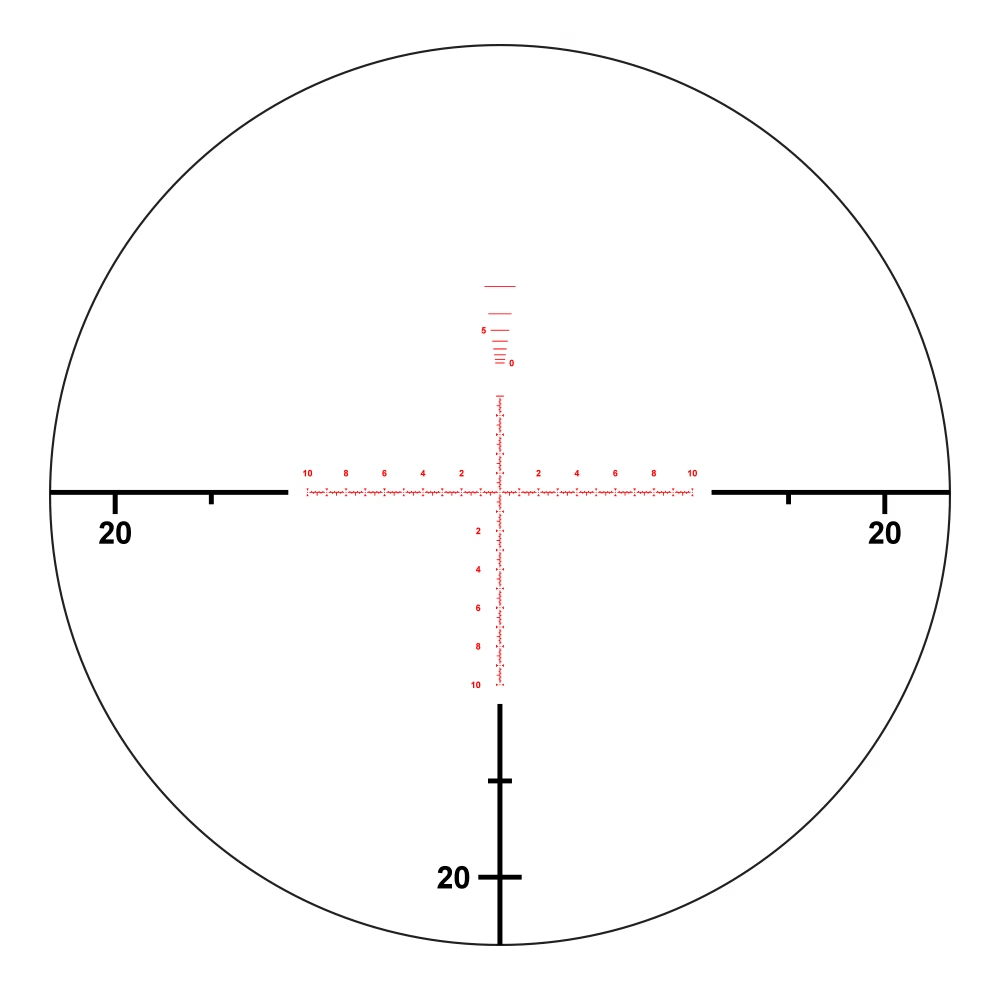
If you’re trying to max out your rifle’s long-range capabilities, the ACSS Athena G2 reticle is easily one of the top reticle choices. A MIL-based reticle, it’s designed for speed and adaptability. MIL is short for Milliradians, a type of angular measurement commonly used on optics of all sizes.
At the center of this reticle is a 0.1-MIL dot, allowing for ultra-fine aiming at distance. Surrounding the dot is a set of vertical and horizontal stadia lines, with the open space around the center dot measuring 0.2 MILs in all directions. The solid crosshair stadia are dotted with an alternating pattern of lower and upper hash marks. Each of the hash marks is spaced out 0.1 MIL apart, with full MIL increments being marked with an ‘I’. Below the horizontal crosshair is a full, Christmas Tree-style MIL grid. This style of grid is widely used in long-range precision scopes. As you move down the grid, it flares out, giving you a lot of flexibility for complex holds on targets at distance.
Finally, outside of the center section and MIL grid, this reticle also has a built-in target ranging ladder, a staple feature of the ACSS reticle family. It’s found above the vertical crosshair and allows you to measure the height of a standard 5 10’ silhouette target to gauge your distance to it. With it, you can quickly and effectively estimate your distance to target, giving you a better idea of how to adjust your aim.
Overall, this reticle is ideal for long-range enthusiasts wanting as much adaptability as possible. As such, it’s a solid choice for basically every precision application.
When to Choose the ACSS DEKA MIL G2
If simple and effective reticles are more your speed, the ACSS DEKA MIL G2 is worth considering. It’s an easy-to-read MIL-based reticle that consists of multiple elements that make long-range precision possible. And it does so without taking up too much of your target view in the process.
Much like the ACSS Athena mentioned above, at the center of the DEKA MIL G2 is a fine 0.1-MIL center dot that’s surrounded by a set of crosshairs. Both the horizontal and vertical stadia (the lines of the crosshair) are dotted with multiple hash marks that alternate between 0.1- and 0.2-MIL spacing. However, unlike the Athena, the DEKA MIL G2 does not have a MIL-grid. Instead, it relies on its crosshairs and hash marks to compensate for bullet drop and wind. While this might seem counterintuitive, its design gives you a far less obstructed view of your target.
This offers a lot of advantages across dynamic shooting applications like competition and hunting. Being an FFP scope, more of your target will remain visible after zooming in on it. The resulting image is still rich with detailed targeting information, while still offering a clear view of your target and its surroundings.
Finally, just like the Athena G2, the DEKA MIL G2 comes standard with a built-in target ranging ladder. With it, you can quickly estimate your distance target, making on-the-fly adjustments fast and effective. Just keep in mind that without a MIL-grid, more complex shots at distance can be a bit challenging
How Does the PLxC 2.5-20×48 Compare to the Other PLxC Scopes?
As of July 2026, there are a few scopes that are part of the PLx line of optics, and they share a lot of features in common. Both are equipped with Japanese ED glass that offers exceptional light transmission and clarity. Plus, they also both come with illuminated reticles and AutoLive® Motion-Sensing Illumination. That said, it’s important to recognize that both were designed to offer two different levels of performance.
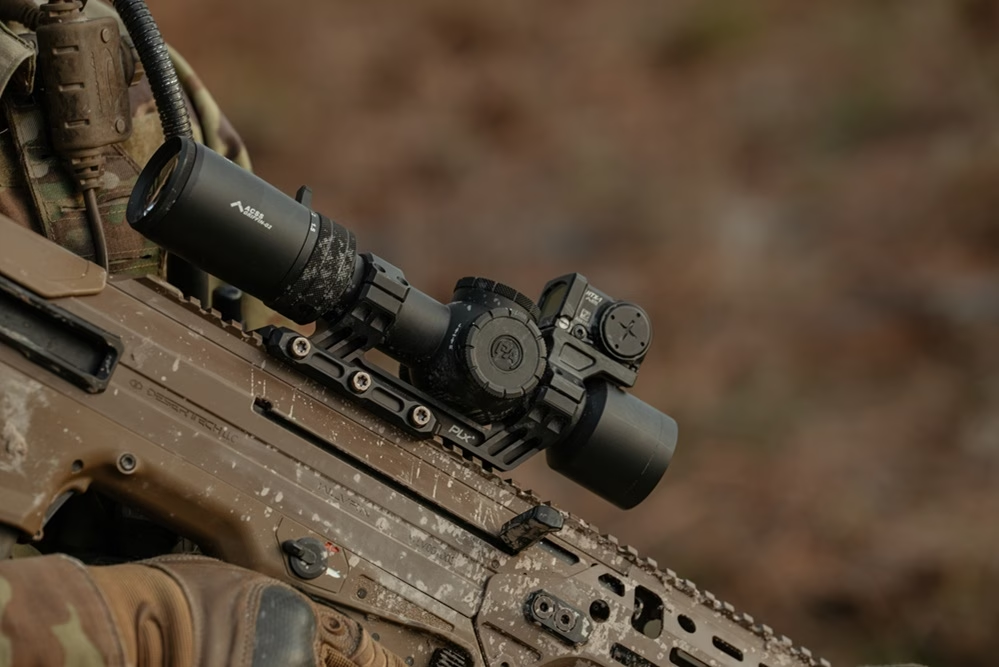
PLxC 1.5-12×36 FFP Rifle Scope
| Magnification Range: | 1.5-12x |
| Objective Lens Diameter: | 36mm |
| Main Tube Diameter: | 30mm |
| Overall Length: | 9.75 inches |
| Weight: | 19.67 ounces |
| Eye Relief: | 3.3 to 3.6 inches (low/high) |
Not all that long ago, PAO also released the PLxC 1.5-12×36. So naturally, there’s a good bit of curiosity to see how they stack up against each other. At its core, you can think of PLxC 2.5-20x as the next step above the PLxC 1.5-12x. Whereas the PLxC 1.5-12x is more geared towards close- to medium-range engagements, the 2.5-20x is better equipped for medium- to long-range use. Both are engineered to cater to different specializations. The PLxC 1.5-12x is a solid optic for engagements within 800 to 1000 yards. Meanwhile, the PLxC 2.5-20x can easily range out to 1000 yards and beyond. It’s true that both can be used for many of the same applications, but your specific rifle setup and overall goals are going to dictate which one is the better pick.
Take semi-auto setups, for instance, two platforms both optics pair well with. Both SPRs and DMRs are types of rifle setups designed to maximize long-range precision, with the core difference being the calibers they’re chambered in. SPRs are chambered in intermediate cartridges like 5.56 NATO, while DMRs make use of full-power cartridges like .308 Winchester and 6.5 Creedmoor. Being completely fair, you could easily use either optic on either type of rifle, but factors like your intended distance to target, as well as how maneuverable you want your optic to be all come into play here. If you prioritize a little more mobility and adaptability, the 1.5-12x is tough to beat. But, if you’re aiming to take more deliberate, methodical shots on long-range targets, the 2.5-20x is easily the better choice.

PLxC 4.5-36×56 FFP Rifle Scope
| Magnification Range: | 4.5-36x |
| Objective Lens Diameter: | 56mm |
| Main Tube Diameter: | 34mm |
| Overall Length: | 14.49 inches |
| Weight: | 34.33 ounces |
| Eye Relief: | 3.1 to 3.7 inches (low/high) |
New to the scene and released alongside the PLxC 2.5-20x Rifle Scope, the PLxC 4.5-36×56 FFP Rifle Scope is a dedicated long-range rifle scope. Just like how the PLxC 2.5-20x offers a step up in power above the PLxC 1.5-12x, the PLxC 4.5-36x fills a similar role between the two, as it was built from the ground up as a long-range precision scope.
As far as long-distance capabilities go, the PLxC 4.5-36x takes the victory, easily. While the PLxC 2.5-20x is certainly capable when engaging far-off targets, its bigger brother, the PLxC 4.5-36x, is better equipped for the job. This makes it a welcome addition to large-caliber semi-auto and bolt-action rifles. Still, it’s important to make note of their respective pros and cons. Where the PLxC 2.5-20x falls short in its total magnification range, it more than makes up for this in its adaptability. It’s lighter, smaller, and can more easily engage close-range targets. In such situations, the 4.5-36x is far from ideal. But then again, it wasn’t designed to do that.
The PLxC 4.5-36x is engineered to offer the utmost precision at a distance. And when used in conjunction with more powerful bolt-action and semi-auto rifles, it can easily go the distance and reach out to targets up to and beyond 1,000 yards.
FAQs
What are the differences between the ACSS Athena BPR MIL G2 and ACSS DEKA MIL G2 reticles?
Both are MIL-based reticles with a 0.1-MIL center dots, MIL hashmarks for windage and elevation holds, and built-in ranging ladders, but they solve different problems. The ACSS Athena BPR MIL G2 has a Christmas Tree-style MIL grid below the horizontal stadia that offers a lot of targeting information, making it the best pick if you want maximum adaptability for complex shots at distance. The ACSS DEKA MIL G2 relies entirely on its hash marks along dotted across its crosshairs. It doesn’t have a MIL grid, so you’re essentially trading the extra targeting data for a cleaner, less obstructive sight picture. It still holds its own past 1,000 yards, but it requires some extra know-how regarding MIL-based adjustments.
What is a first focal plane (FFP) scope, and why does it matter?
On an First Focal Plane, or FFP, scope, the reticle’s size scales with the scope’s magnification, so it stays accurate at every power setting. So, whether the magnification is set at 2.5x, 12x, or 20x, the measurements and drops will always be true. On a Second Focal Plane (SFP) scope, where the reticle always stays the same size, and its targeting data is only truly accurate at its max magnification. FFP is the standard for serious long-range work, since it lets you range and hold at any zoom level without doing conversion math first.
How much does the Primary Arms PLxC 2.5-20×48 FFP cost?
Currently, the PLxC 2.5-20×48 is available for preorder on primaryarms.com (as of this article’s release). Both the ACSS Athena and ACSS DEKA MIL models are available for $2,299.
What magnification do I need for shooting past 600 yards?
For most, something around 6x to 8x magnification is feasible for such shots, however, they still don’t offer the most visibility of your target. A scope like the PLxC 2.5-20×48, which tops out at 20x, is built to give you a clear image of your target while still allowing you to read all of your reticle’s targeting fata. With it, you can crank up the magnification to 10x or beyond for targets out to around 600 to 800 yards. And, you’ll still have enough incremental power to continue engaging targets out to 1,000 yards and beyond without giving up too much close-range usability on the low end.
How does the PLxC 2.5-20×48 compare to the PLxC 1.5-12×36 and PLxC 4.5-36×56?
You can think of these three scopes as a sort of ladder of progression, with each one being made for a specific purpose. The PLxC 1.5-12×36 is the lightest and most agile of the three, with it being good for long-distance engagements within 800 to 1,000 yards, and what it lacks in long-range performance, it makes up in close-range use with its 1.5x magnification. The PLxC 2.5-20×48 sits in the middle as a do-all option that covers close-, medium-, and long-range. It isn’t as agile at low power, but it gets the job done and still has the power to go the distance when needed. Lastly, the PLxC 4.5-36×56 trades in agility for dedicated long-range power. It’s the one to use when long-distance precision is the primary goal of your rifle build.