TL;DR
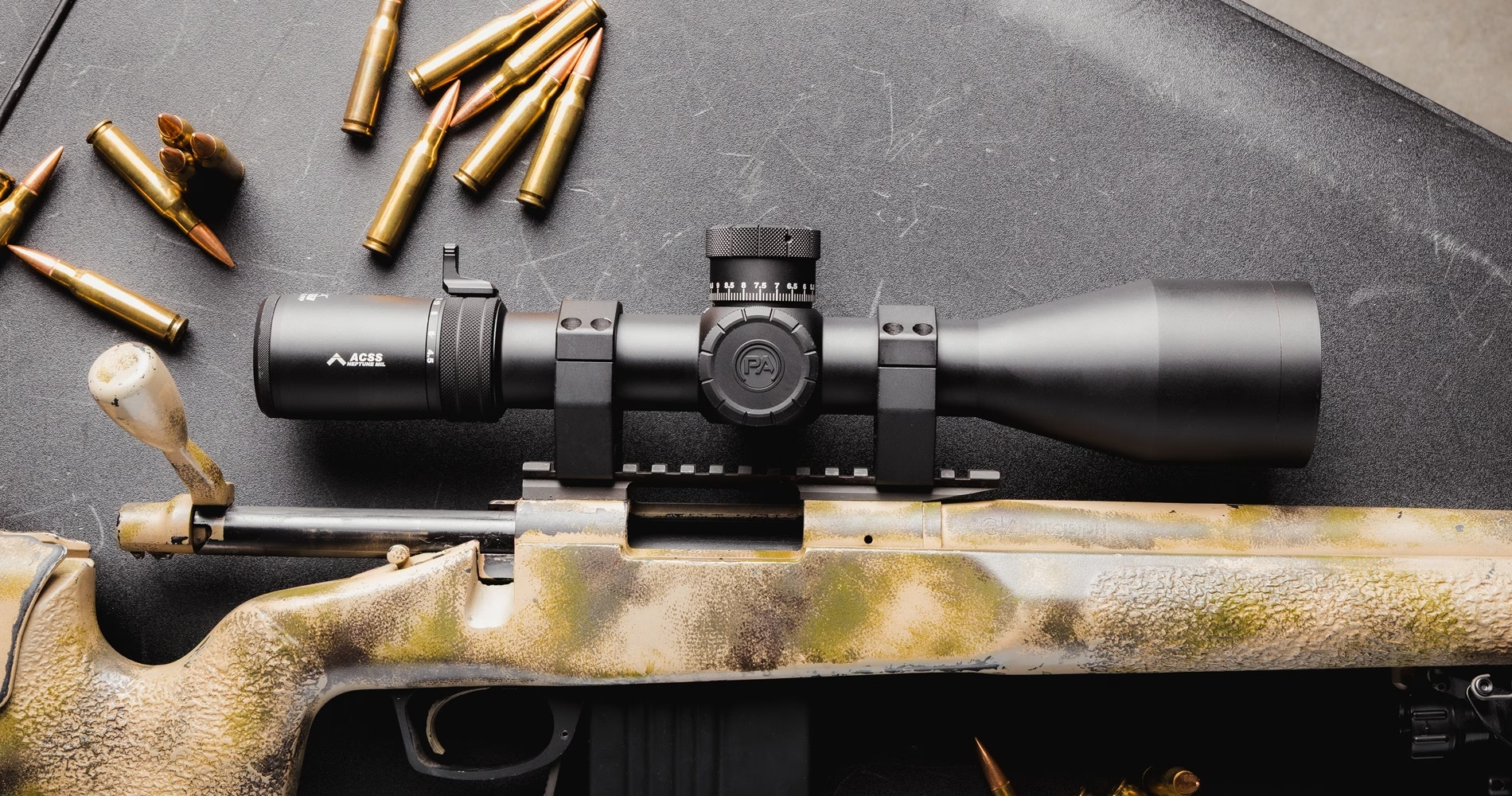
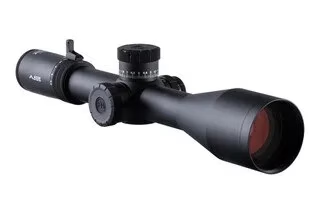
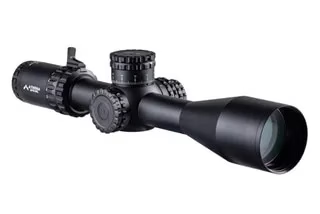
The all-new Primary Arms Optics PLxC® 4.5-36×56 FFP Rifle Scope with its impressive 36x top-end magnification and generous 56mm objective lens is the right pick for dedicated long-range marksmanship. Choose the smaller PLxC 2.5-20×48 for more adaptability across medium- and long-range use or step down to the PLxC 1.5-12×36 to maximize close- to medium-range adaptability.
- A dedicated long-range optic: 4.5–36x magnification with 8:1 zoom ratio, 56mm objective, 34mm tube diameter
- 14.49-inch / 34.33-ounce: Compact and light despite its high-power magnification range.
- Interchangeable Cartridge Turrets: Ships with EZ-Stop Elevation and Basic Windage Cartridge Turrets; more turrets planned post-launch.
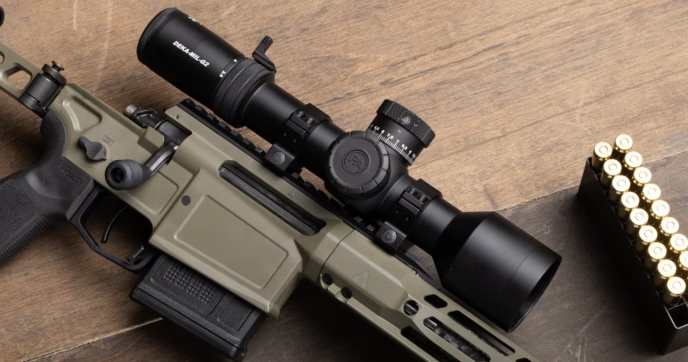
- ACSS® Reticle System: The ACSS Neptune® has a full MIL-grid, choose it for more complex shots at distance grid; the ACSS DEKA MIL® G2 is a simpler crosshair design, choose it for a less obstructive sight picture.
Why Choose the PLxC 4.5-36×56?
Optic Specifications
| Magnification Range | 4.5-36x |
| Objective Lens Diameter | 56mm |
| Main Tube Diameter | 34mm |
| Overall Length | 14.49 inches |
| Weight | 34.33 ounces |
| Eye Relief | 3.1 to 3.7 inches (low/high) |
What Is the Magnification Range of the PLxC 4.5-36×56?
PAO’s PLxC 4.5-36×56 FFP Rifle Scope has an 8:1 magnification ratio, giving it a 4.5-36x magnification range, as denoted by its name. This makes it the most powerful scope in the PLxC lineup. And while it boasts several other features, its magnification range is easily one of the most enticing.
At its lowest power, it offers 3.1 inches of eye relief (the distance your eye can be from the glass to see the full sight picture) and a wide 25.9-foot field of view (FOV). With this view you can effectively engage targets at close-range, giving it some extra adaptability that PAO’s earlier PLx® 6-30×56 Rifle Scope didn’t have. Don’t expect it to be like an LPVO at 1x magnification though because that’s not what this scope was made for. But, even with its 4.5x low-level zoom, it still offers the versatility needed to be formidable across multiple applications.
With that in mind, this rifle scope is one of the superior options for long-range capabilities. It has a generous 36x top end. With it, you’re able to get a close view of far-off targets, allowing for easier target identification and adjustments. Plus, it’s a first focal plane optic, so the reticle’s size increases along with the magnification, allowing its finer details to come into view, making it far easier to take more complex shots at distance. For those familiar with long-range rifle scopes, you’ll know that it’s not uncommon for their visibility to take a hit when the magnification range is so wide. However, this isn’t a problem with the PLxC 4.5-36x scope.
This is largely thanks to its use of the Advanced Combined Sighting System®, or ACSS, family of reticles. As of this article’s publication, these scopes are currently being offered with your choice for the ACSS Neptune and ACSS DEKA G2 reticles. Both are designed to use MIL-based (Milliradians) measurements and are usable at any magnification you set the optic to. They’re etched extremely thin, so even with the optic at 36x magnification, it won’t get in the way of your target. But we’ll cover them later.
How Clear Is the Glass on the PLxC 4.5-36×56?
This rifle scope is outfitted with some of the best glass the industry has to offer: premium Japanese ED (Extra-Low Dispersion) Glass.
ED Glass lenses are common in top-tier optics as they are renowned for their overall clarity. It has far less risk of chromatic aberration—a common optical distortion that can cause color shifting—and creates a much sharper image than lesser glass lenses. Both of these qualities really shine on the PLxC 4.5-36x. And with its impressive 56mm objective lens diameter, it offers more than enough light transmission to keep your sight picture bright and detailed.
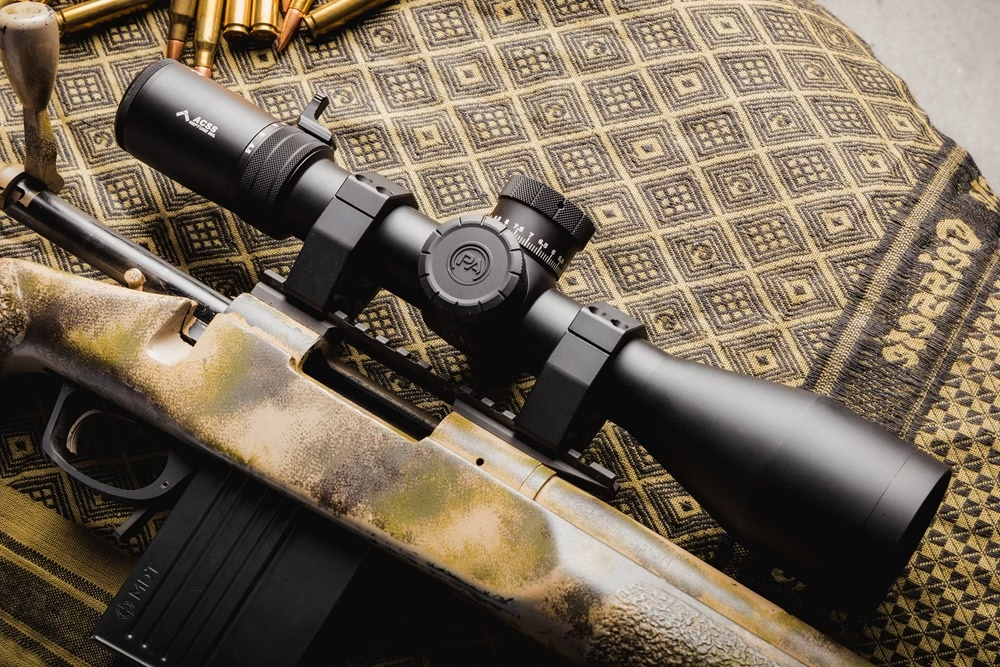
How Big and Heavy Is the PLxC 4.5-36×56?
PLx optics are engineered to exceed the exacting requirements of professional-level use. And if you’re already familiar with PAO’s PLxC 1-8x scopes, or even the newer PLxC 1.5-12x, you’ll know that they perform very well across all conditions.
These same qualities are present in the new PLxC 4.5-36x rifle scope. Just like other PLx rifle scopes, it’s built around a high-strength aluminum optic body that’s both waterproof and shockproof. Being built to exceed the taxing demands of professional use, it’s a solid pick for everything from recreational long-range use to more exacting competitive and duty use.
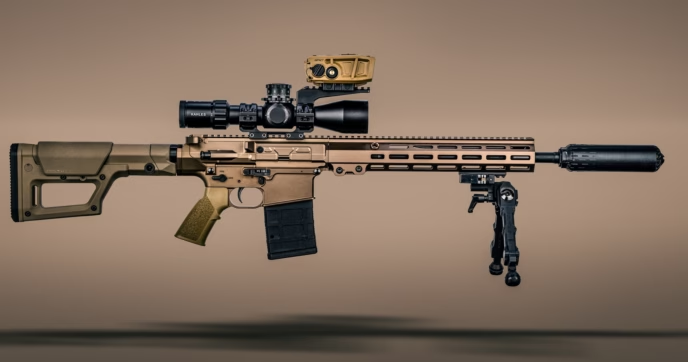
Something else to note is that this rifle scope isn’t a standard PLx optic, but rather a PLxC model. As such, it’s remarkably compact, considering how powerful it is. As noted in the table earlier, it’s only 14.49 inches long—a fair bit shorter than other comparable optics. Plus, it only weighs 34.33 ounces. So, it’s one of the more compact High-Power Variable Optics (HPVOs) around.
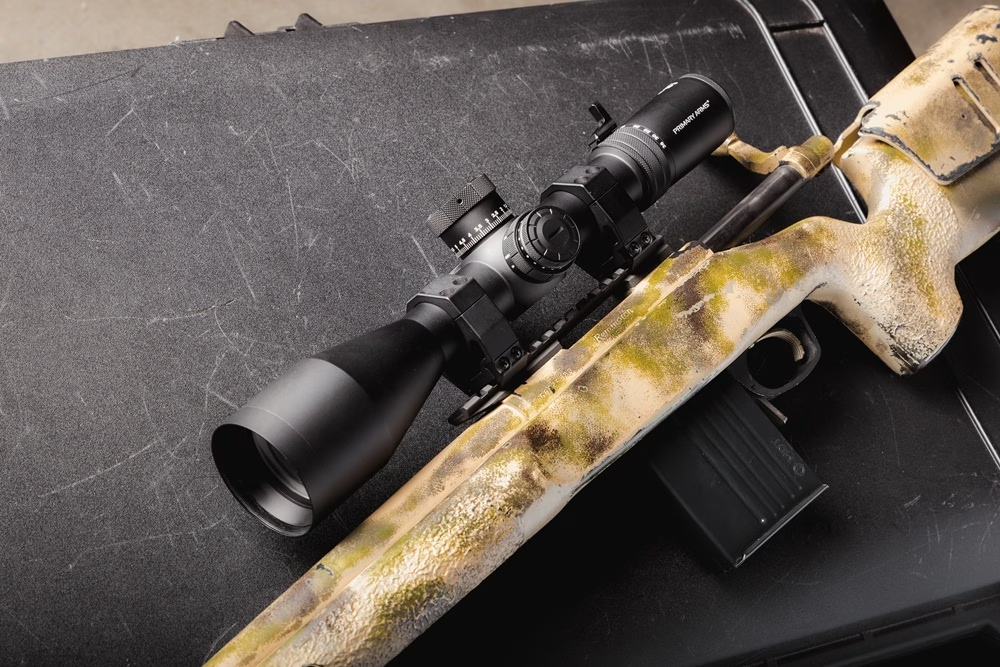
How Do the Interchangeable Cartridge Turrets Work?
The newest feature present in this rifle scope is its Interchangeable Cartridge Turret system, which makes both the windage (side-to-side adjustment) and elevation (up-and-down adjustment) turrets user interchangeable. As such, you can tailor the scope specifically to your ammo load and setup. By the time this article has been published, PAO doesn’t have any extra turrets available for this scope. But, once it goes live and has left the pre-order phase, PAO does plan to release more turrets. Until then, they’ll come standard with PAO’s EZ-Stop Elevation Turret and Basic Windage Turret.
What Is the EZ-Stop Elevation Turret?
The EZ-Stop Elevation Turret is a great one to start out with, as, put simply, it’s a Zero-Stop turret. Built into the turret is an over-travel stop—a physical block that keeps the turret from moving past the initial zero point. Once you dial in your zero after mounting the scope to your rifle, you can set the stop, making it easy to return to a known starting point (your zero) if you ever get lost in your rotations after dialing your scope. Features like this are incredibly useful in long-distance precision applications. While you can rely on just your reticle to hold over (compensate) for bullet drop, adjusting your elevation allows you to continue using your center aiming point.
The PLxC 4.5-36x can easily be used to engage targets well beyond 1,000 yards. At these distances you’re much more likely to have your magnification at 36x, or somewhere close to it. And with it being an FFP scope, less of your reticle’s MIL subtensions will be visible. But, if you adjust your elevation to match your distance to target, you can keep using your center aiming point with no issues.
What Is the Basic Windage Cartridge Turret?
Also included with the PLxC 4.5-36x Rifle Scope is PAO’s Basic Windage Cartridge Turret. This turret is capped, but like the elevation turret, it’s also interchangeable. So, if you want, you can use the dialing turret in the box. With it, you’ll be able to accurately adjust your windage for those longer shots. In all fairness, the windage turret isn’t one that necessarily needs to be changed out, that is, unless you actively adjust for windage using the turret rather than the reticle alone. Ultimately, swapping it out is up to you, but it’s nice to have the choice regardless.
Which Reticle Should I Choose in the PLxC 4.5-36×56?
A large part of any optic’s usability stems from its reticle, and with the PLxC 4.5-36x being such a capable long-range optic, it makes sense for it to house reticles that are designed to match its magnification range. So, PAO has equipped these optics with two of their newest reticles: the ACSS Neptune and ACSS DEKA MIL G2.
When to Choose the ACSS Neptune
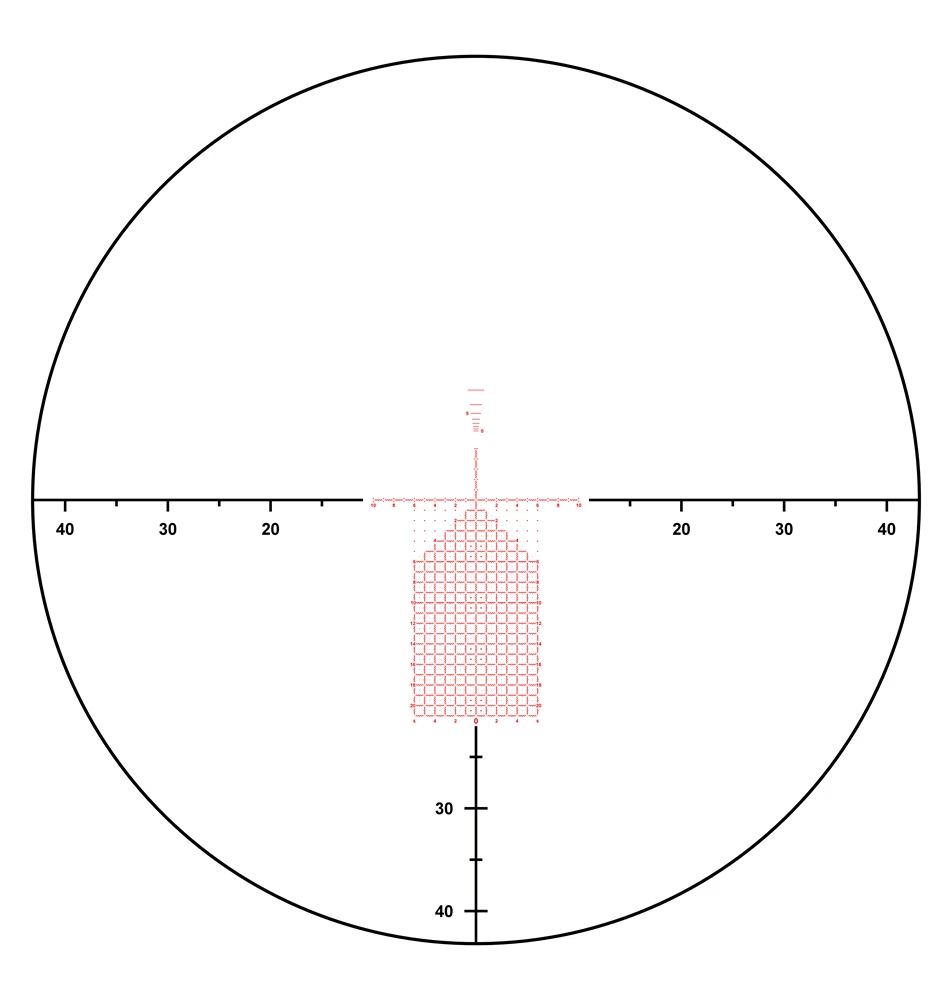
The ACSS Neptune is one of the newest reticles designed specifically for PAO’s long-range rifle scopes like the PLxC 4.5-36×56 FFP Rifle Scope. This reticle is a MIL-based reticle that uses a “Christmas-Tree” style design. It has plenty of elements that make long-distance precision as intuitive as possible.
Starting at the reticle’s center design, it has an ultra-fine 0.05-MIL dot as the center aiming point. Surrounding the center dot is a set of vertical and horizontal stadia (crosshair lines) that have alternating hash marks spaced 0.1 MILs apart. After 11 MILs on either side of the center dot, the reticle’s solid crosshairs come into view, and they have hash marks spaced 5 MILs apart, with a number marking every 10th MIL. The upper vertical stadia are also marked with alternating hashmarks, and above that line is a ranging ladder, a scale used to quickly estimate your distance to target.
Additionally, this scope has a large MIL-grid. The ACSS Neptune’s MIL grid is detailed. It consists of various 0.05-MIL and 0.1-MIL dots, as well as stadia lines that are marked with hashes, and “+” markers. This grid consists of several connected square-shaped lines, with each one being 1-MIL in total width and length. At its widest, the grid extends a full 6 MILs away on either side of the center dot, with it extending 21 MILs below the horizontal stadia line.
When to Choose the ACSS DEKA MIL G2
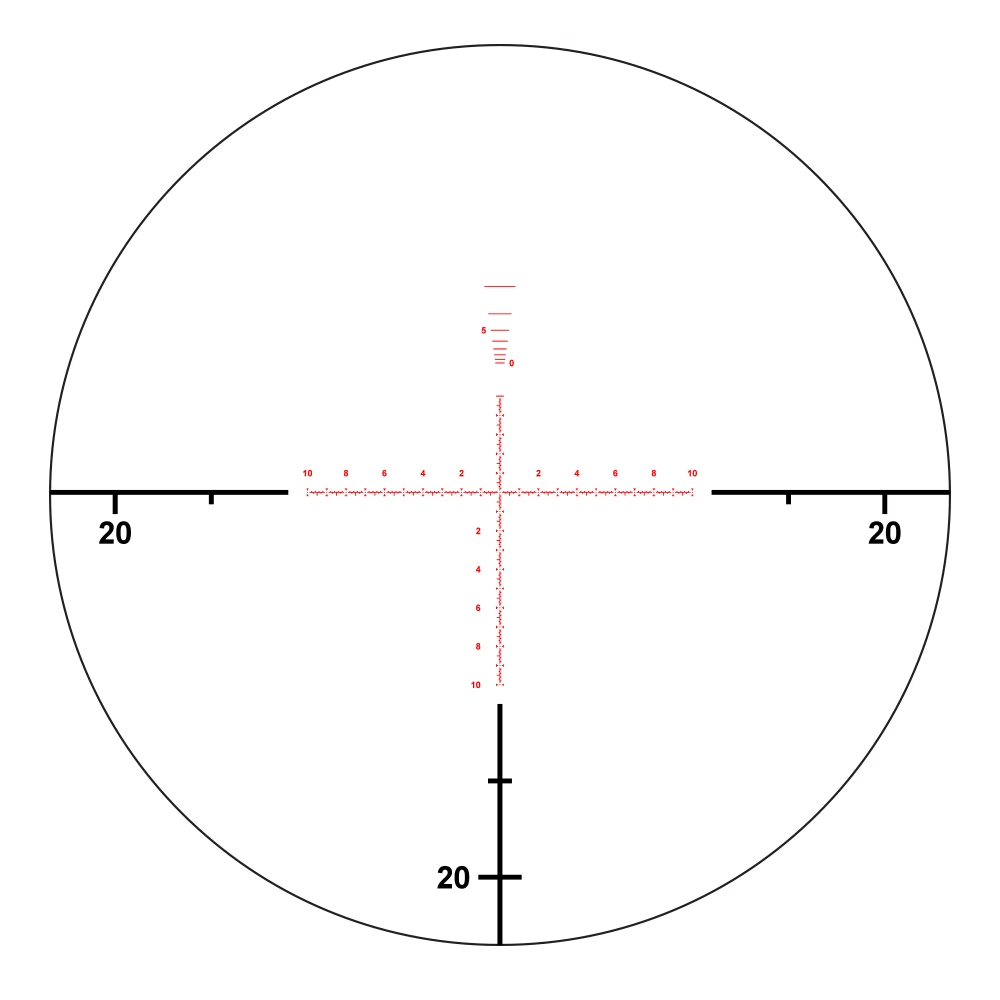
The ACSS DEKA MIL G2 is a much simpler reticle design-wise. However, it’s still a highly intuitive and effective reticle choice. At the center of the DEKA MIL G2 is an exceptionally fine 0.05-MIL center dot that has the same 0.2-MIL spacing between it and the crosshairs, just like the ACSS Neptune. Similarly, both the horizontal and vertical stadia of the crosshairs are dashed with hash marks; shorter ones are spaced out in 0.1-MIL increments, with larger ones being spread 0.2-MILs apart.
As we said above, the DEKA G2 is a much simpler reticle compared to the ACSS Neptune. It doesn’t have a MIL-grid, just a set of crosshairs. Again, though, its restrained design doesn’t mean it isn’t practical. One of the main benefits you get with such a simplistic design is the amount of open space it provides. With it, you can have a clean and clear image of your target without obscuring your view. This does come with the caveat of requiring a bit more estimation when making more complex holds at distance. But, if you’re already versed in adjusting for windage and elevation, this reticle can be exceptionally adaptable.

How does this Optic fit in the Current PLxC Lineup?
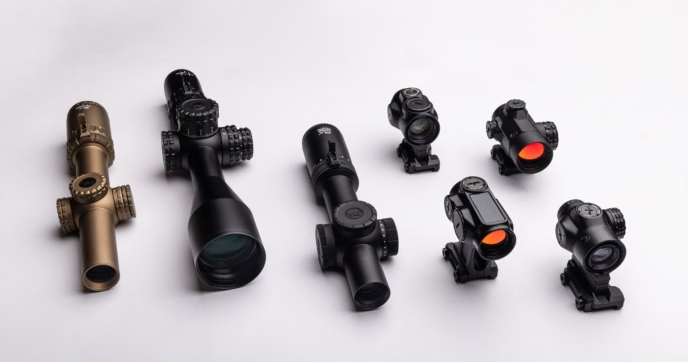
Right now, there are four optics that make up PAO’s PLxC rifle scope line: The PLxC 1-8x, PLxC 1.5-12x, PLxC 2.5-20x, and the PLxC 4.5-36x. And among them, the PLxC 4.5-36×56 FFP Rifle Scope is, by far, the most powerful.
| PLxC 1-8×24 | PLxC 1.5-12×36 | PLxC 2.5-20×48 | PLxC 4.5-36×56 | |
|---|---|---|---|---|
| Magnification Range | 1-8x | 1.5-12x | 2.5-20x | 4.5-36x |
| Objective Lens Diameter | 24mm | 36mm | 48mm | 56mm |
| Main Tube Diameter | 30mm | 30mm | 34mm | 34mm |
| Overall Length | 9.28 inches | 9.75 inches | 11.5 inches | 14.49 inches |
| Weight | 16.95 ounces | 19.67 ounces | 30.05 ounces | 34.33 ounces |
| Eye Relief | 3.2 to 3.7 inches (low/high) | 3.3 to 3.6 inches (low/high) | 3.2 to 3.7 inches (low/high) | 3.1 to 3.7 inches (low/high) |
Is the PLxC 4.5-36x right for you?
We recommend the PLxC 4.5-36x for anyone looking to kit out their long-range build. It has all the key features needed to thrive in such applications. Its large objective lens gathers a lot of light to provide you with a bright sight picture, and no matter whether you prefer the ACSS Neptune or ACSS DEKA MIL G2, they’re both extremely effective. And, of course, this scope has the greatest magnification range of any other PLxC optic.
However, it isn’t the best optic for every application. The PLxC 4.5-36x is a beast of an optic, one that’s purpose-built for long-range use. As such, it falls short at close range compared to the other optics in the PLxC line. Even though it’s low-end 4.5x magnification does offer some solid usability at closer distances, it isn’t exactly quick by any means. But, for long-range precision, it’s really hard to beat.
If you’re dabbling in long-range precision but want a more well-rounded build, the PLxC 2.5-20x is a good pick. Although your top-end magnification takes a hit, it more than makes up for it with its close-range adaptability. 2.5x falls within the visual sweet spot that makes aiming with both eyes open easy, making it much more practical for closer engagements.
In a similar vein, if your build revolves around intermediate cartridges, like 5.56 NATO in an SPR build, for example, use the PLxC 1.5-12×36. SPR-style rifles, and even bolt-actions chambered in intermediate cartridges, often have an effective range of around 750 to 1,000+ yards, depending on the cartridge. With the PLxC 1.5-12, you’ll still have the power to range out to such distances, while also having the close-range agility to engage closer targets. It won’t be as fast as a 1x optic, but it will give you more than enough versatility to match the performance of such rifles.
And finally, the PLxC 1-8×24 is the top choice for close- to medium-range use. Being an LPVO (Low-Power Variable Optic), it offers the most in terms of close-range performance. LPVOs, by design, are made to bridge the gap between reflex sights and higher power optics, making them very well-rounded. At 1x, it has a wide FOV and is nearly as agile as a reflex sight. Meanwhile, at its full 8x magnification, it can be used to engage targets out to 800 yards. Still, it isn’t a long-range optic, so if your goal is long-range precision, we recommend opting for a more powerful scope.
Frequently Asked Questions (FAQ)
-
What is a High-Power Variable Optic (HPVO), and when do I need one?
“HPVO” is a term used to describe rifle scopes that have a wide magnification range and a high top-end setting, usually past 20x or even 30x. Optics like these are generally made specifically for long-range precision, making them good for high-power semi-auto and bolt-action rifles. As such, they’re used widely in applications where targets are engaged from anywhere from around 600+ yards to upwards 1,500+. Compared to other optics, HPVOs don’t offer much close-range agility, so they’re less adaptable than something like an LPVO. But it’s important to keep in mind that such optics aren’t designed with that use in mind.
-
What’s the difference between the ACSS Neptune and ACSS DEKA MIL G2 reticles?
Both reticles use Milliradians for targeting measurements, have a fine 0.05-MIL center dot, and have target ranging ladders. The ACSS Neptune has a full Christmas Tree-style MIL grid that’s rich with targeting data, giving you much more adaptability for more complex shots at further distances. Meanwhile, the ACSS DEKA MIL G2 has a simpler crosshair design, trading the MIL-grid for a cleaner, less obstructed view of your target. Neither is inherently better than the other. It’s ultimately a matter of whether you want the data afforded by the Neptune’s larger MIL-grid, or the simpler design of the DEKA MIL G2’s crosshair’s open sight picture.
-
How do Primary Arms’ Interchangeable Cartridge Turrets work?
The elevation and windage turrets on the PLxC 4.5-36×56 are user-configurable, so you can tailor their abilities to match to your rifle and ammo without replacing the entire scope. Out of the box, it ships with an EZ-Stop Elevation Cartridge Turret and a capped Basic Windage Cartridge Turret. Primary Arms Optics plans to release additional cartridge styles once these scopes are fully released after preorder.
-
How much does the Primary Arms PLxC 4.5-36×56 FFP cost?
As of right now, the PLxC 4.5-36×56 is available for preorder directly from Primary Arms at primaryarms.com. They’re currently listed for $2,499.99 and have an estimated ship date of late September.
-
Which PLxC scope should I buy: the 1-8×24, 1.5-12×36, 2.5-20x, or 4.5-36×56?
The PLxC 1-8×24 is an LPVO—quick at close range and effective out to 800+ yards. The PLxC 1.5-12×36 pairs well with SPR-style builds and can easily range out to 1,000+ yards while still keeping some close-range agility. The PLxC 2.5-20×48 is a do-all middle ground choice that can be workable at close-range, though it excels in medium- to long-distances. Finally, the PLxC 4.5-36×56 is the most powerful scope of the bunch, offering superior long-range precision capabilities, as well as the ability to engage targets up to and beyond 1,000+ yards.