When seconds count, the quality of an officer’s duty holster can make all the difference. As one of the most important tools on an officer’s belt, a duty holsters must be purpose‑built for patrol and tactical teams, incorporating active retention mechanisms while remaining quick and easy to deploy under stress. And at the very forefront of this technology, is the Rapid Force Duty Holster from Alien Gear.
In this article, we’ll explore the essentials of duty holsters, from retention levels to mounting positions, and then introduce the Rapid Force Duty Holster from Alien Gear. We will discuss its unique features, the accessories that complete a full duty rig, and also how agencies (or individual officers) can purchase these products at a big discount through Primary Arms Government.
Duty Holster Basics
A duty holster is engineered to keep an officer’s sidearm secure through movement or grappling while still allowing a rapid draw when needed. High‑quality duty holsters use active retention systems such as rotating hoods, thumb breaks, automatic locking systems or combination mechanisms. These security features require deliberate hand movements to release the firearm and discourage weapon grabs by suspects. Duty holsters are also built from durable materials such as high‑grade Kydex, ballistic nylon, or injection‑molded polymers so they can survive years of daily use.
Duty Holster Retention Levels Explained
Understanding retention levels helps officers choose a holster that matches their mission. In general, a holster’s retention level describes the number of deliberate hand movements necessary to remove the pistol from the holster. This is usually rated on a scale of I (1) to IV (4).
- Level I holsters have no active retention mechanisms and are secured entirely by the friction and fitment of the holster itself. It requires only one movement to overcome this retention: physically drawing the pistol upwards.
- Level II holsters introduce a second deliberate motion, often incorporating a button that must be depressed by the thumb before the pistol can be drawn. It offers significantly more security than the previous level while remaining quick to deploy.
- Level III designs are the most common for duty use because they require three distinct movements, greatly reducing the risk of disarmament. While they’re slower than the previous levels, holster manufacturers have carefully designed the retention mechanisms to feel quick and repeatable under pressure.
- Level IV holsters add a fourth motion and are reserved for the highest‑risk environments, such as corrections. For most average patrol officers, this is considered overkill but can still be overcome by good training.
Most uniformed officers select a Level II or Level III holster for a balance between security and draw speed.
Duty Holster Attachment Systems
A holster’s attachment system determines how it connects to the duty belt or platform. Many modern holsters use modular systems that allow the user to switch between belt loops, paddles, MOLLE plates and drop‑leg adapters without unthreading their entire belt.
One of the most popular is the Quick Locking System (QLS) from Safariland. The QLS consists of a fork and receiver plate; three screws attach the fork to the holster body, and the plate mounts to a belt loop or paddle. Once installed, the holster can be removed or moved between belts and rigs with a simple “push‑to‑detach” motion. The QLS maintains the holster’s original retention level and strength, and different plate sizes allow the user to adjust ride height.
For agencies using the Rapid Force holster, Alien Gear offers a Quick Disconnect System (QDS), a similar fork‑and‑receiver design that is fully compatible with all Rapid Force Duty Holster configurations. QDS allows officers to swap between belt slide, MOLLE and drop‑leg platforms without removing their pistol from the holster.
Duty Holster Mounting Positions
Mounting height affects draw stroke, comfort and interference with body armor. Holsters can be set in low‑, mid‑ or high‑ride positions.
A low‑ride holster positions the grip about an inch and a half lower than mid‑ride, helping the pistol clear body armor and moving it closer to the user’s natural hand position; the trade‑off is discomfort when getting into or out of vehicles.
Mid‑ride is the most common height for patrol work because it offers a comfortable compromise between accessibility and stability whether the officer is standing or seated.
High‑ride places the firearm about an inch and a half higher than mid‑ride, which can be advantageous for officers who spend long hours driving but may interfere with armor and require more wrist articulation to draw.
If you’re unsure of which height you need, holster mounts such as Safariland’s Vertical Universal Belt Loop and Quick Universal Belt Loop let officers adjust between these ride heights without tools.
Drop‑Leg Holsters and Thigh Mounts
In situations where body armor or tactical vests block access to the belt line, officers may opt for a drop‑leg holster. This rig attaches to the thigh with straps and lowers the pistol to clear equipment on the torso. Drop‑leg holsters allow a faster draw because the gun sits closer to the hand and remains accessible even when seated. They can also place the grip below a bulky coat or winter gear.
However, drop‑leg platforms move with the leg, so it’s even more important that straps be properly tightened to prevent the holster from flopping around during movement. The gun should be positioned only as low as necessary to clear body armor, as lowering it further can reduce control. For routine patrol, mid‑ride belt holsters remain the standard, while drop legs are often preferred for SWAT or specialists.
Chest and Plate‑Carrier Mounts
Mounting a holster to a chest rig or plate carrier is occasionally seen in movies and training videos, but real‑world feedback suggests it is seldom the best option.
A chest‑mounted pistol can be easier to draw while driving, but it also interferes with using a rifle, feels awkward and heavy, and makes the muzzle sweep sideways when drawn. Such setups are mainly suited for niche scenarios, like home defense when grabbing a plate carrier quickly or for drivers who remain seated behind a steering wheel.
Outside of these specific circumstances, most professionals prefer belt‑mounted holsters, making chest mounts the exception rather than the rule.
Introduction to the Rapid Force Duty Holster
The Rapid Force Duty Holster is Alien Gear’s answer to the demanding needs of modern law enforcement. It was designed over an 18‑month research period involving extensive feedback from officers. The resulting product is available as Level II or Level III retention, uses a proprietary high‑impact polymer and supports common duty pistols with and without weapon lights. Alien Gear markets the Rapid Force as the “quickest, most secure and most durable” duty holster on the market.
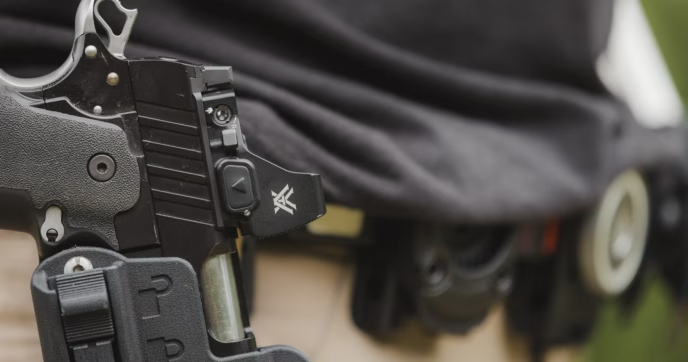
Rapid Force is distinguished by its dual‑retention mechanism that combines a backstrap and a locking block at the ejection port. The officer depresses a large thumb button and swipes down to release these devices, a gross‑motor action that meets Level II or Level III requirements while remaining instinctive under stress. The holster housing fully covers the trigger and protects large weapon‑mounted lights, and a removable optic hood made from high‑impact polymer shields red‑dot sights or closed‑emitter optics from damage. Alien Gear’s Quick Disconnect System sits between the holster and belt mount, enabling quick swaps between belt slide, MOLLE plate, or drop‑leg platforms without removing the pistol.
Selected models also feature an integrated mount for Axon’s Signal Sidearm, automatically activating nearby Axon cameras when the weapon is drawn. Users can tailor the release with interchangeable button sizes and adjustable retention screws, and the proprietary polymer chassis has been tested to withstand hundreds of pounds of static and dynamic force as well as extreme temperature and sand exposure.
Benefits of the Rapid Force Duty Holster
Ultimately, Rapid Force delivers security without sacrificing speed thanks to its cleverly engineered retention mechanism. It’s a holster that is difficult to beat externally but is still quick to access by the officer, even under duress. The mechanism is also large and tactile enough that you’re not likely to miss your grip as long as you’ve been training properly.
Beyond that, the Rapid Force line is fully compatible with modern optics with a removable hood that covers red‑dot and closed‑emitter sights. It can also fit popular duty lights with a generous trigger‑guard cavity and adjustable retention screws.
Alien Gear’s QDS modular mounting system allows users to move the holster among belt slide, MOLLE, and drop‑leg platforms without unholstering the weapon, making it suitable for patrol, tactical teams and plain‑clothes assignments.
The holster’s polymer body has been torture‑tested under extreme static and dynamic loads and through harsh environmental conditions so officers can trust it to stay intact during struggles and climbs.
Customizable release buttons and retention screws let departments tune the holster to individual hands and duty pistols, and optional Axon Signal integration automatically activates body‑worn cameras when the firearm is drawn.
Combined, all these attributes have led agencies to select the Rapid Force line as their new standard in duty holsters.
Must‑Have Holster Accessories and Gear
Selecting a duty holster is only part of the equation. A robust duty rig also requires a quality belt and compatible mounting accessories.
Duty Belts
A secure holster demands a stiff, supportive belt capable of bearing the weight of the firearm, magazines and other gear. We recently published an article going into great detail on how to set up the best duty belt, which you should read if you’re interested, but here are the basics.
When selecting a belt, pay attention to width and stiffness; duty belts typically range from 1.5 to 2.25 inches. Wider belts provide more surface area for holster mounts but must still fit through belt loops, and stiffness prevents sagging by using materials like ballistic nylon, polymer stiffeners or leather. Dual‑belt systems pair a Velcro‑backed inner belt with an outer duty belt to distribute weight evenly and keep the rig from shifting during draws or foot pursuits. Finally, quality buckles and keepers are essential: a low‑profile, secure buckle prevents accidental release and maximizes available space, while belt keepers lock the inner and outer belts together.
Belt Slide Expansions and Mounting Systems
Alien Gear’s Rapid Force Belt Slides demonstrate how a modular mounting system can greatly enhance a holster’s versatility. This accessory allows officers to choose high‑, mid‑ or low‑ride positions. High ride positions the top of the holster 3.5 inches above the belt; mid ride places it 1 inch above; low ride positions it 0.25 inch below the belt. Each ride height includes a spacer to ensure a snug fit on duty belts between 1.5 and 2.25 inches.
You can also use the belt slide expansion to adjust the holster’s cant up to 17 degrees forward or backward to achieve a comfortable draw angle. The low‑ride configuration can be paired with a thigh strap for additional stability, anchoring the holster against the leg so it does not swing during running or defensive tactics.
Leg and Thigh Straps
When officers need extra stability or choose a low‑ride or drop‑leg setup, a leg or thigh strap becomes essential.
Alien Gear’s Rapid Force Dynamic Drop Leg platform is an example of a modern thigh rig. The drop‑leg adapter is crafted from high‑impact polymer and built to withstand extreme treatment, mirroring the Rapid Force’s rugged construction. It supports mid‑ and low‑ride belt slide expansions and includes an adapter for attaching a drop‑leg strap or TAQ‑STRAP tourniquet.
Users can adjust the holster’s cant up to 17 degrees forward or backward, and the platform is fully compatible with Alien Gear’s QDS system, meaning officers can quickly switch between belt and leg mounts without tools.
When setting up a drop‑leg system, ensure the strap sits high on the thigh—just low enough to clear body armor. Straps that are too loose or sit too low can flop during movement and slow the draw.
Holster Discounts with Primary Arms Government
Selecting the right holster and accessories is only one part of the procurement process. Agencies also need a partner who can deliver equipment quickly, provide competitive pricing, and support individual officer purchases.
Primary Arms Government (PAG) excels in this role.
PAG has comprehensive suite of programs and services that can give huge discounts to both individual officers and agencies. Their procurement and contract support teams partner with agencies to source mission‑critical equipment, connecting departments with high‑quality vendors and cooperative purchasing vehicles such as Texas BuyBoard or the Purchasing Association of Cooperative Entities.
Agencies can arrange product demonstrations and universal test‑and‑evaluation units to try gear before committing to a purchase, and PAG hosts demo days and T&E events so departments can evaluate holsters like the Rapid Force firsthand. A dedicated trade‑in program helps departments with surplus or seized equipment earn credit toward new purchases, allowing them to upgrade to the latest technology without straining budgets.
Sworn officers who wish to buy equipment personally can use the Individual Officer Purchase program, which offers discounted pricing and access to gear that may not be advertised on the public site; officers verify eligibility through ID.me and then shop for optics, holsters and other accessories at reduced prices.
For agencies in need of a holster solution, partnering with Primary Arms Government ensures access to the Rapid Force holster, accessories like belt slide expansions and thigh straps, and the expertise to integrate these components into existing duty setups.
Conclusion
A duty holster must secure the weapon against grabs, protect it from the environment and allow a quick, instinctive draw. Retention levels guide agencies toward appropriate security, while mounting options allow officers to tailor their rig to body armor, vehicles, and their own body type.
To meet these requirements, the Rapid Force Duty Holster combines Level II or Level III security with a simple draw, rugged materials and compatibility with modern optics and lights. Its modular design, enabled by the Quick Disconnect System and adjustable belt slides, allows a single holster to serve multiple roles. Accessories like supportive belts, thigh straps and drop‑leg platforms complete the system and ensure stability during dynamic situations.
By combining the right holster with supportive belts, modular mounts and a vendor who understands the demands of law enforcement, officers can focus on their mission rather than the shortcomings of their equipment. As technology evolves, the Rapid Force’s design and Primary Arms Government’s support ensure agencies stay ahead, providing tools that improve officer safety and public trust.