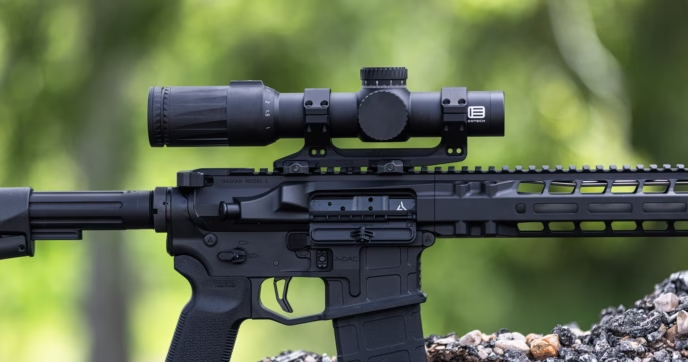
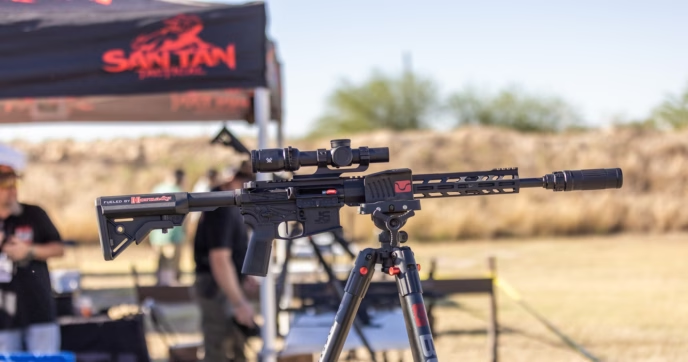
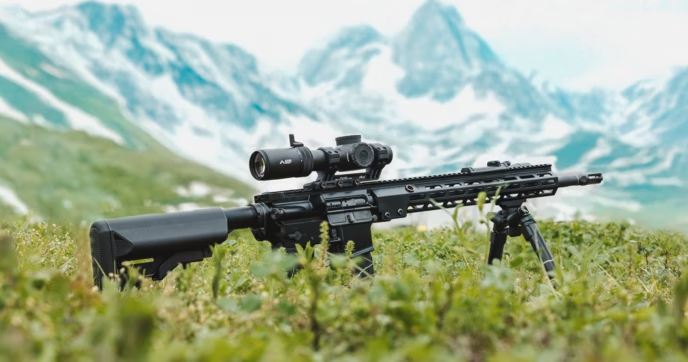
Primary Arms Optics has earned a strong reputation in the scope world, and for a few good reasons. The glass looks great and the adjustments work smoothly. They’ve built a lineup that covers nearly every need and gives great value for the price. Whether it’s a precision rifle, a defensive carbine, or an old bolt gun, there’s a great rifle scope for you.
We’ve spent enough time with Primary Arms Optics rifle scopes to see where each one excels. In this article, we’ll share our recommendations. We’ll cover PAO’s tier system, magnification ranges, and reticle options. Also, we’ll discuss budgeting and common mistakes when choosing an optic. Ideally, you’ll come away with knowledge of how to shop for both PAO and rifle scopes as a whole.
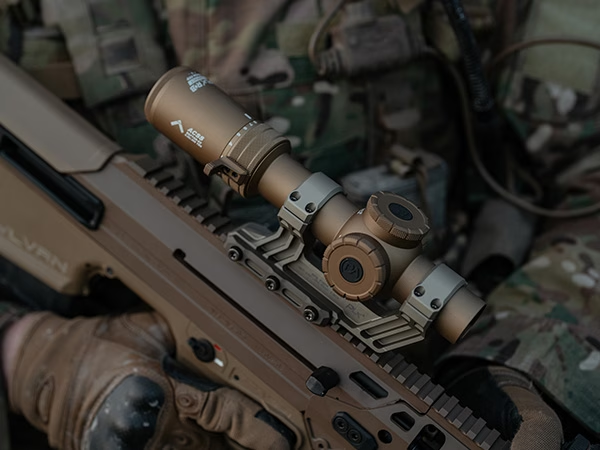
Primary Arms Scopes by Rifle, Role, and Budget
Before we dive too deep into the weeds, let’s start at the top. For a quick recommendation, these tables will guide you.
This first table matches preferred scope types to different rifle setups. I’ll preface by saying these aren’t strict rules. You can put whatever optics you want on your gun. However, these recommendations will work for most people in most situations.
Table 1: Scope Selection by Rifle Platform and Role
| Rifle Platform | Main Engagement Distance | Recommended Scope Type(s) | Common Magnification Range | General Use Case |
| Rimfire Plinking/Target (.22LR) | 0-250 yards | MPVO | 2–12x / 4–16x / 3–18x | Mostly benchrest/target shooting; little need for a true 1x |
| AR-15 SBR/Carbine (5.56) | 0–400 yards | Short LPVO | 1–6x, 1-8x (compact) | Fast target acquisition with enough magnification for practical carbine work |
| AR-15 Rifle (5.56) | 0–600 yards | Any LPVO | 1–6x / 1–8x / 1–10x | Versatile general-purpose setup for mixed-distance shooting |
| AR-10/Battle Rifle (.308) | 0–700 yards | Large LPVO/MPVO | 1–8x / 1–10x / 2–12x | Versatile general-purpose rifle but with extra reach of .308 |
| SPR/DMR | 200–800 yards | MPVO | 2–12x / 3–18x | Precision and clarity without full HPVO bulk |
| Bolt-Action – Short (.308 / 6.5 CM) | 300–1,000 yards | MPVO/HPVO | 4–16x / 3–18x | Dedicated precision rifle for mid- to long-range |
| Bolt-Action – Long/Magnum (.300 WM+) | 500+ yards | HPVO | 5–25x / 6–30x | Dedicated long-range and extreme distance shooting |
Now, what do you get from Primary Arms at different price points? Here’s a table showing their current lineup by budget tier. You can easily see what’s available.
Of course, if you’re reading this in the far future, the exact models may have changed. The good news is that their tier system is timeless, so you can run off that either way.
Table 2: Current PAO Scope Options by Budget
| Budget Range | Product Line | Key Models |
| Under $200 | Classic Series | [LPVO] 1-6×24 SFP [MPVO] 3-9×44 SFP (Small Calibers Only) |
| $200–$400 | SLx | [LPVO] 1-6×24 Gen IV SFP [LPVO] 1-6×24 FFP [MPVO] 2-12×40 SFP [MPVO] Compact 4-16×44 FFP |
| $400–$600 | SLx (Cont.) | [LPVO] 1-10×28 SFP [MPVO] 3-18×50 Gen II FFP [HPVO] 4.5-27×56 FFP |
| $600–$1,000 | GLx | Currently Unavailable |
| $1,000+ | PLx | [LPVO] Compact 1-8×24 SFP [LPVO] Compact 1-8×24 FFP RDB [HPVO] 6-30×56 FFP |
The table above holds all the currently available PAO rifle scopes. As you may have noticed, the $600-$1000 range is currently empty, though it lists the GLx tier.
Right now, the GLx line offers many Prism Scopes, Red Dots, Reflex Sights, Mounts, and Binoculars. But it lacks rifle scopes. That wasn’t always the case, though. Years ago, Primary Arms Optics offered GLx scopes priced between $600 and $1000. However, the company discontinued those scopes some time ago.
Will Primary Arms Optics bring back GLx scopes? It’s very possible, but so far, we haven’t seen any hints yet.
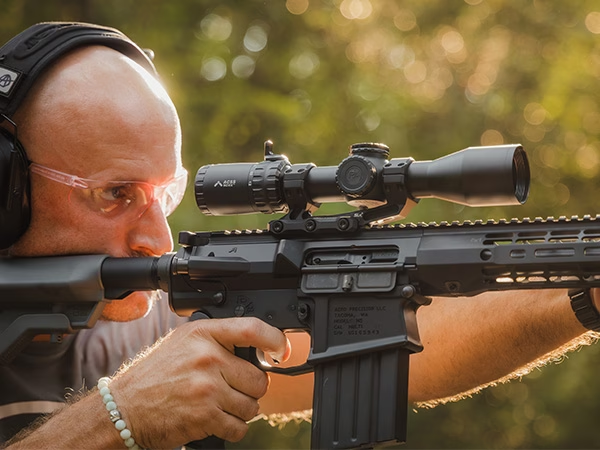
What are the Primary Arms Optics Tiers?
Primary Arms divides its catalog into four distinct product tiers. Each tier is more than a price range. They show differences in materials, build quality, and optical performance.
Knowing those differences will help you find the best scope for just about any rifle.
Classic Series®
The Classic Series is the entry point for Primary Arms. It is exactly what it needs to be: functional, affordable optics with traditional reticles. That might include duplex crosshairs, circle dots, or occasionally basic ACSS systems. The scopes are usually second focal plane, and the glass is clear enough for shooting several hundred yards.
These make sense for hunters on a tight budget, plinkers, or anyone setting up a rifle for casual target shooting. A Classic 3-9×44 on a range-only rimfire? Perfect fit. On a rifle you’re training with every weekend for defensive use? Probably worth stepping up to SLx.
SLx® Series
This is the biggest and most popular line at Primary Arms Optics. The SLx line has Primary Arms’ ACSS reticles. It offers better glass and stronger designs. You can choose between SFP and FFP options based on the model.
The SLx 1-6x Gen IV scopes are probably the best-known examples: solid LPVOs that compete well against optics costing twice as much. Glass is clear, illumination is bright, and the ACSS reticles help you make faster shots at distance. The Gen II 3-18×50 FFP scopes are also in the SLx category. They feature first focal plane ballistic reticles, making them great for precision work. Plus, their prices are tough to beat.
Build quality is where the SLx line really earns its reputation. These scopes hold zero reliably, tracking is consistent, and they handle recoil without issues. You’re not getting Japanese ED glass or hand-lapped lenses, but you are getting reliable optics for serious shooting.
GLx® Series
The GLx line sits between SLx and PLx, though, as we mentioned earlier, there aren’t any GLx rifle scopes right now.
Historically, this line used Philippine glass. The optical quality was impressive, and the fit and finish were excellent.
If you’re looking for a high-quality prism scope or red dot that goes a little bit above the feature set of SLx, be sure to check out your GLx options.
PLx® Series
The PLx line is Primary Arms’ top-end, flagship tier, and these optics compete directly with the best in the business. Here, you’ll find Japanese ED (Extra-low Dispersion) glass, advanced optical designs, and Red Dot Bright® reticle illumination.
The PLxC (Compact) models deliver great performance in smaller, lighter sizes. They don’t compromise on optical quality either. These are scopes you’d trust on a duty rifle, run in serious competition, or mount on a precision rig where glass quality is paramount.
Of course, this level of quality does come at a higher price. PLx scopes start around $1,500 and go up from there, but the performance is there to back it up. And despite the cost, the PLx options still manage to prove their value compared to some of the even more expensive options on the market.
Which Reticle Should I Choose?
Primary Arms’ ACSS (Advanced Combined Sighting System) reticle lineup can seem confusing at first. There are dozens of options across different models, each with specific calibers and feature sets.
But there’s a deeply logical structure that begins with one decision: BDC or MILs?
Your Core Decision: BDC vs. MIL
This is the first fork in the road, and it comes down to how you want to handle holdovers and ranging.
The original ACSS reticles were BDC reticles and were calibrated for specific cartridges and loads. The reticle’s hash marks correspond to actual distances (200 yards, 300 yards, 400 yards, etc.) based on the ballistics of your ammo. Point the 500-yard hash at a target 500 yards away, and if you’re using the right ammo at the right velocity, you’ll hit. They’re fast, intuitive, and require minimal math in the field. The trade-off is that they’re designed for specific loads, and if you change loads often, your holds won’t match perfectly. But for a regular AR-15 rifle, they can be incredibly effective.
MIL-based reticles (AKA milliradians or MIL-RAD) have a fixed measurement system that works with any cartridge. Each hash mark is evenly spaced from each other, and you use ballistic data (either from a chart, app, or memory) to figure out your holds. If your data says 2.3 mils of drop at 600 yards, you hold 2.3 mils and send it.
MIL reticles are more versatile across different loads and cartridges, but they demand more skill and memory. You’re doing the translation from distance to angular measurement rather than relying on the reticle to do it for you.
When they’re set up properly, BDC reticles are faster and simpler. MIL makes more sense if you shoot many cartridges or test different loads. It also works better if you prefer the consistency of a measurement-based system.
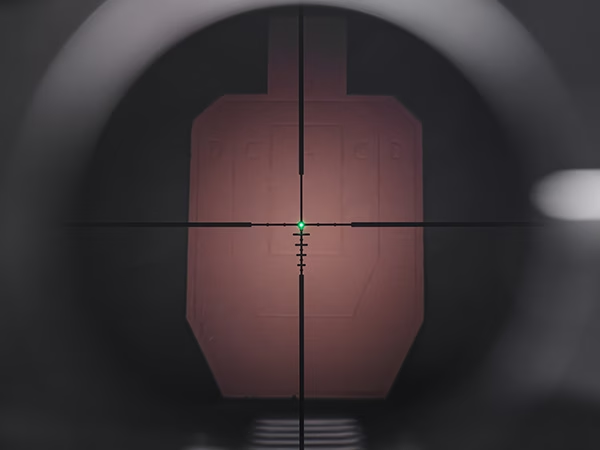
Primary Arms LPVO ACSS Reticles
Primary Arms’ low-power variable optics typically offer four main ACSS reticle families: Raptor, Griffin MIL, Nova®, and Aurora®.
| Reticle | Hold System | Best Use | Why Choose It |
| ACSS Raptor (FFP Only) | BDC (5.56 / .308) | General-purpose LPVOs | Fast at 1x, proven BDC, great all-around choice |
| ACSS Griffin MIL (FFP Mostly) | MIL | General-purpose LPVOs | Universal MIL holds, precision-friendly |
| ACSS Nova (SFP Only) | BDC or MIL | Speed & close-range | Ultra-bright, simple, very fast to pick up |
| ACSS Aurora (SFP Only) | BDC (multi-caliber) | Clean BDC setups | Uncluttered reticle, intuitive holdovers |
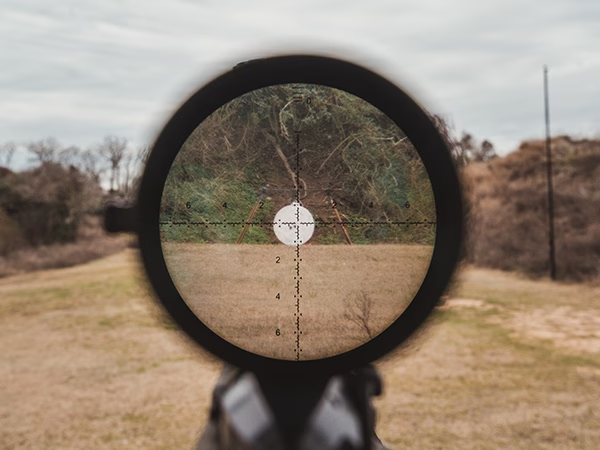
Primary Arms MPVO/HPVO ACSS Reticles
Once you move into medium and high-power variable optics, the reticle options shift toward more precision:
| Reticle | Hold System | Best Use | Why Choose It |
| ACSS Apollo | BDC (.308 / 6.5 CM) | Precision rifles & AR-10s | Built-in ranging, 50-yd holds, strong at distance |
| ACSS HUD DMR | BDC (.308 / .223) | DMRs & SPRs | General-purpose BDC with moving target leads |
| ACSS Athena BPR | MIL Grid | Long-range precision | Full MIL grid, caliber-agnostic, maximum flexibility |
| ACSS Deka G2 | MIL Crosshair | Dial-driven Long-range | Clean MIL reticle, floating dot, less visual clutter |
Why More Magnification isn’t “Better”
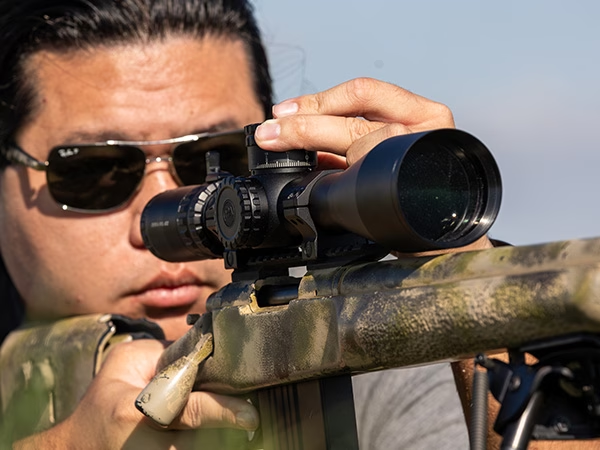
One common beginner mistake is assuming that more magnification equals more precision. It doesn’t—at least, not outside the world of benchrest shooting.
What matters is matching your magnification range to your actual shooting distances and the type of work the rifle does. A 3-18x scope won’t give you a real advantage on a defensive carbine. It’ll just be heavy and slow.
Magnification has two main purposes: spotting targets and making accurate long-distance shots. The key is to have enough magnification for your max effective range. But, you should avoid carrying extra glass and weight that might slow you down.
A 1-6x LPVO is ideal for a general-purpose AR-15 because most of your shooting happens inside 300 yards where 6x is ideal. Sure, an 18x might make it easier to see holes in paper targets, but if you need to see the whole target and its surroundings, you’ll need to zoom out.
The Real Cost of Over-Magnification
Higher magnification comes with trade-offs that aren’t always obvious on the spec sheet:
- Weight and Size: A 5-25x scope weighs considerably more than a 1-6x or even a 4-16x. That weight sits high on your rifle where it affects handling. For precision rifles on a bipod, that’s fine. For carbines you’re shouldering repeatedly, it’s pretty bad.
- Field of View: More magnification means a narrower field of view, making it harder to acquire targets quickly at lower power settings. This is why many shooters with high-magnification LPVOs rarely dial past 6x or 8x in practical use.
- Eye Relief and Eye Box: Higher magnification scopes are often harder to use. Move your head slightly, and the image blacks out. This becomes a real problem on recoiling rifles or when shooting from awkward positions.
Practical Magnification Guidelines
For most shooters, these ranges are the functional sweet spots:
- 0–300 yards: 1x to 6x is more than enough. You can usually make hits with a red dot at these distances, so 6x gives you a comfortable margin of added precision when you want it.
- 300–600 yards: 4x to 12x are your bread and butter. You’re now at ranges where precise wind calls and smaller target zones matter, and the extra magnification helps you see what you’re doing. Does that mean you can’t hit 400 with a 1x? No, but you’ll probably do better with some added magnification.
- 600–1,000 yards: 12x to 20x magnification is ideal when you’re reaching longer ranges. You can spot impacts, read mirage, and make fine adjustments. Going beyond 20x isn’t really necessary at this point.
- Beyond 1,000 yards: 25x to 30x starts to make sense. Even here, many experienced shooters rarely dial past 20x except for specific conditions or target sizes. This is best used on rifles that are well supported with tripods, bags, bipods, or sleds.
Also, don’t overlook the low end of your magnification range!
The 1x on an LPVO is a big advantage for close-range speed. If you’re creating a versatile rifle for defense, a 1x scope offers quick red-dot performance. This helps when you need to move fast. Or, if you do select an MPVO, you might also want to add an offset reflex to reclaim some of that close-quarters agility. We went into a lot of detail on your options with a previous blog comparing LPVOs vs. Precision Rifle Scopes, so check it out if you’d like to learn more.
How Much Should I Budget for an Optic?
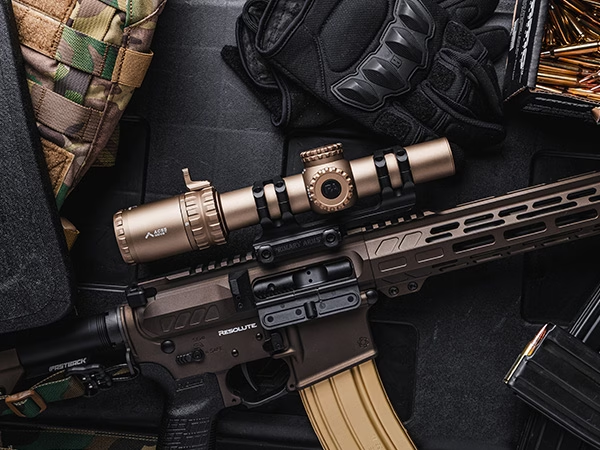
The old rule of thumb says to spend about 50% of your rifle’s cost on the optic. It’s not a bad starting point, as optics are one of the most significant upgrades you can make to a rifle’s performance. Good glass helps you shoot better. Bad glass can hold you back.
That said, the 50% guideline fails if you have a specific use-case in mind. Real-world budgeting depends more on what you’re building and how you’re going to use it.
If you’re putting a red dot on a $2,000 AR-15 SBR, you don’t need a $1,000 optic. A quality red dot in the $400–$600 range does the job perfectly. If you’re creating a long-range precision rig, consider this: high optical quality helps you spot impacts and read wind. So, spending more on the optic than the rifle can make sense. A $1,500 scope on a $1,000 Bergara or Tikka makes sense when glass quality matters as much as it does.
The main question is, “What does this rifle actually need to perform its expected role?”
A plinker for the range? The classic series is fine.
A carbine you’re training with regularly? SLx is a sweet spot.
The ‘no-compromise’ competition rifle or fighting rifle? Give PLx a close look.
Other Common Mistakes in Optics
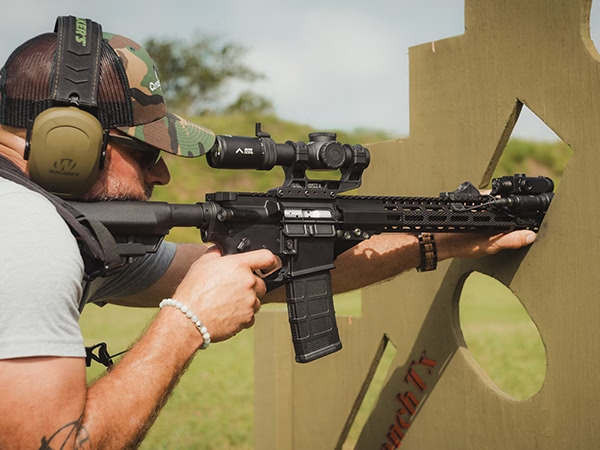
Even skilled shooters make common mistakes when choosing optics. Often, they focus on the wrong factors or don’t consider how they will use the rifle. Here are the mistakes that show up most often—and how to avoid them.
- Buying Based on Maximum Magnification Alone
We talked about this before, but it’s important to repeat: more magnification doesn’t always mean better performance. A 5-25x scope sounds better than a 3-18x on paper. However, if you shoot inside 500 yards, that extra zoom adds weight and size for little benefit. Worse, the extra bulk often leads to a narrower field of view. It also makes eye relief trickier, which can make the scope harder to use at your shooting ranges.
- Ignoring Weight and Balance
A heavy scope on the receiver moves the balance point forward and raises the center of gravity. This is a more important drawback for a carbine than for a bolt gun resting on a bipod.
Before choosing an optic, think about the whole setup. Check the scope weight, mount height, and ring weight. These factors impact how the rifle handles. A lighter optic that handles well might be easier to aim than a heavier optic with slightly better glass.
- Not Knowing When FFP Matters
Second focal plane (SFP) reticles stay the same size regardless of magnification. First focal plane (FFP) reticles change size with magnification. This means your holdovers and measurements remain accurate at any power setting. The mistake is picking one without understanding the trade-off.
If you’re running an LPVO that spends most of its time at 1x, SFP might make perfect sense. On a 1-6x scope, you probably won’t be using those holdovers until you’re approaching max magnification anyway. So, if the SFP scope is lighter, shorter, or more affordable, then it may even be more compelling than an FFP option.
HOWEVER, if you’re shooting a precision rifle with a high magnification scope, FFP should be mandatory. With these scopes, you’re very likely to be shooting at different zoom levels, meaning you need that FFP reticle to be effective. Some manufacturers still make HPVOs with SFP reticles. But nearly everyone now demands FFP for long-range work.
- Choosing a Bad Mount
Many people don’t realize how much engineering and technology are in optic mounts. In the same way that tires can make or break a car’s performance, mounts make the difference for a scope. A good optic on a cheap mount won’t reach its full potential. In fact, a bad mount can create issues that make the optic seem defective.
For AR-platform rifles and semi-autos, you generally want a cantilever one-piece mount. They spread recoil forces over a bigger area on the receiver. This prevents the rings from shifting in relation to one another. For bolt-action rifles, traditional rings or precision one-piece mounts are standard.
As for cant or tilt, stick with 0 MOA mounts unless you have a specific reason to dial in elevation adjustments regularly. Most shooting doesn’t need a canted mount, and adding unnecessary cant will just force you to shift your zero.
- Skipping the Proper Mounting Process
Even expensive mounts won’t perform if they’re not set up correctly. Loose rings, wrong torque specs, or bad scope alignment can cause zero shift, tracking problems, and poor performance.
Use a quality mounting system and follow proper torque specs. Level the scope correctly; buy a wedge or plumb line if needed. Use blue thread locker if instructed, then let it cure. Take the time to do it right the first time instead of troubleshooting zero problems for the next month.
- Buying an Optic That Doesn’t Match the Ammunition
BDC reticles are calibrated for specific loads at specific velocities. While you can be a little flexible by adjusting the zero, there is a limit. You shouldn’t expect a 7.5” AR pistol to line up with most 5.56 BDCs, since your velocity is always going to be low.
If you’re committed to a specific ammo load, a BDC reticle is great. If you shoot whatever ammo is on sale, a MIL-based reticle helps you correct your aim for whatever you use.
- Not Testing Before the Hunt/Match/Class
To some, this one might seem like a really, really obvious mistake. But I can assure you, it happens a lot.
Of course, mounting a new optic the night before any major event is a recipe for disaster. You do NOT want to be the last guy confirming zero at a carbine course. You do not want the instructor standing behind you—looming over you—while you slowly realize that your elevation is still like a foot off at 50 yards, and it won’t adjust any further.
Always take time to confirm your zero. Verify your turret tracking. Also, ensure the reticle works as you expect. While scope quality has improved considerably over the years, defects are always possible with any product. Optics manufacturers like PAO and Vortex are known for their QA and warranty service, but that isn’t a same-day solution.
Ideally, you should make a rule of running an optic once or twice before taking it to anything important. Confirm zero at your expected distance, verify a few holds if you’re using BDC or MIL, and make sure everything is good-to-go before it can ruin your day.
Conclusion
To pick the best Primary Arms scope, consider these three key factors:
- Magnification
- Reticle
- Price
Thankfully, Primary Arms Optics has a pretty intuitive tier system that makes it easy to find what you need.
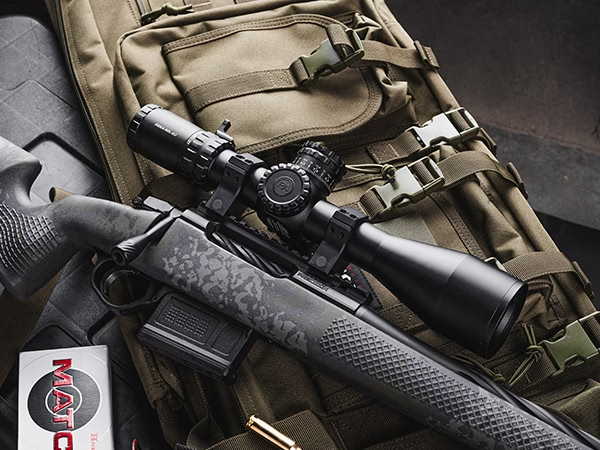
Remember: the right optic won’t make you an instant expert. However, it can remove some limits and help you perform at your skill level. Pick something that makes sense for your setup, mount it correctly, confirm your zero, and trust it to take you the distance.
Frequently Asked Questions (FAQ)
-
What is the Primary Arms ACSS reticle and how does it work?
The ACSS (Advanced Combined Sighting System) is a proprietary reticle design developed for Primary Arms optics that combines multiple aiming tools into one system. ACSS reticles integrate bullet drop compensation (BDC), wind holds, moving-target leads, and range estimation directly into the reticle pattern, allowing shooters to quickly adjust for distance and environmental factors without dialing turrets.
Many ACSS reticles also feature a chevron or horseshoe aiming point designed for rapid target acquisition at close range while still providing precision at longer distances. This design helps shooters make faster and more accurate shots across a wide range of shooting scenarios.
-
What are the different Primary Arms scope series (SLx, GLx, and PLx)?
Primary Arms organizes its optics into four product tiers: Classic Series, SLx, GLx, and PLx. Each line is designed for different budgets, features, and performance needs.
Classic Series® – Entry-level optics designed for shooters who want reliable performance at an affordable price. These scopes are ideal for casual range use, beginner shooters, rimfire rifles, and budget hunting setups.
SLx® Series – The largest and most popular Primary Arms lineup, known for strong value, durability, and advanced features like ACSS reticles. SLx optics are widely used for AR-15 rifles, hunting, and general-purpose shooting.
GLx® Series – Mid-tier optics that incorporate premium materials and technology while remaining more affordable than top-tier models. These optics offer improved glass quality and refined mechanical performance.
PLx® Series – The flagship Primary Arms optics line, built with high-end materials and advanced optical systems for professional use, competition shooting, and precision rifles.Together, these four tiers allow shooters to choose an optic that fits their budget, rifle setup, and intended use, from entry-level range rifles to professional-grade precision systems.
-
What magnification scope should I choose for my rifle?
The best magnification depends on how and where you plan to shoot. Common options include:
1-6x or 1-8x LPVO scopes – Excellent for AR-15 rifles and versatile shooting from close range to several hundred yards.
3-9x or 2-10x scopes – Popular for hunting and general-purpose rifles where moderate magnification is needed.
4-16x and higher magnification scopes – Better suited for precision shooting or longer distances.Low-power variable optics (LPVOs) are especially popular on modern sporting rifles because they can be used like a red dot at 1x magnification while still providing zoom for longer shots.
-
Are Primary Arms scopes good for beginners?
Yes. Many Primary Arms optics are designed to be user-friendly and affordable, making them a popular choice for new shooters. Features like ACSS reticles simplify aiming and range estimation, reducing the learning curve compared to traditional reticles. The combination of clear glass, intuitive reticle design, and strong value has made Primary Arms optics widely used by both beginners and experienced shooters.
-
What calibers are Primary Arms ACSS reticles designed for?
Many ACSS reticles are caliber-specific, meaning their bullet drop compensation marks are calibrated for common cartridges such as:
5.56 NATO / .223 Remington
.308 Winchester
6.5 Grendel
7.62×39
.300 BlackoutCaliber-specific reticles allow the BDC marks to align with the expected bullet trajectory, helping shooters make accurate holds at different distances without manual calculations.