Today, it’s a well-known fact that adding a quality optic to your rifle is one of the greatest ways to overhaul its performance, especially if you plan to use your rifle for any type of long-distance marksmanship. And for such applications, few optics get the job done quite like rifle scopes.
If you’ve been following our Behind the Glass series so far, you’ll know that we already covered some of Primary Arms Optics’ rifle scopes in Part Two, more specifically, their Low-Power Variable Optics. And while they’re certainly a solid rifle scope for a wide range of applications, they aren’t exactly the end-all be-all long-range optic, as emphasized by the “Low-Power” part of their name.
However, we briefly mentioned two other types of rifle scopes in that article: Medium-Power and High-Power Variable Optics, better known colloquially as MPVOs and HPVOs. By design, these optics offer much more in terms of ranged performance, with them having the capability to engage targets upwards of 1,000 yards in some cases.
And, as you’d likely suspect, PAO has a number of MPVO and HPVO options in their lineup, and there’s a lot to cover when it comes to understanding the intricacies of each optic. So, with that being said, welcome to Behind the Glass Part Four!
Advanced Precision: Understanding Rifle Scopes
As we laid out above, the term “rifle scope” encompasses several different types of optics, each one with its own unique capabilities and best use case. For many, MPVOs and HPVOs are typically the optics that come to mind when they think of what a traditional rifle scope is. Unlike the LPVOs we covered in Part Two, MPVOs and HPVOs are designed with long-range use in mind, making them a solid choice for everything from SPR and DMR rifle builds to bolt-action setups tailored for hunting or long-range marksmanship.
Still, both scope options have their own distinct advantages. Despite having a relatively similar silhouette in most cases, MPVOs and HPVOs are available with very different magnification ranges.
MPVO Magnification Ranges
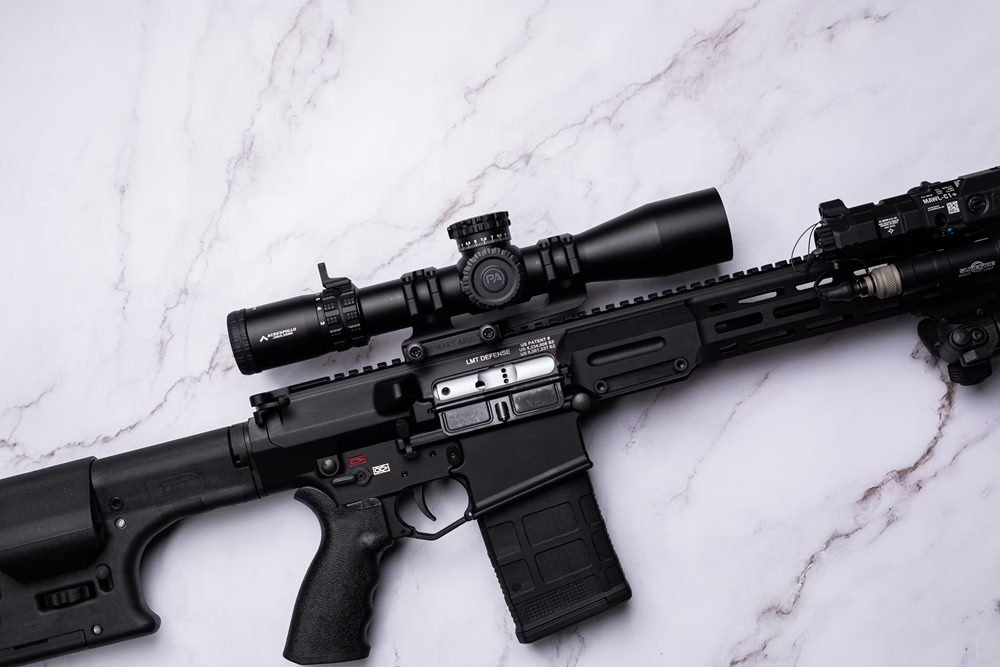
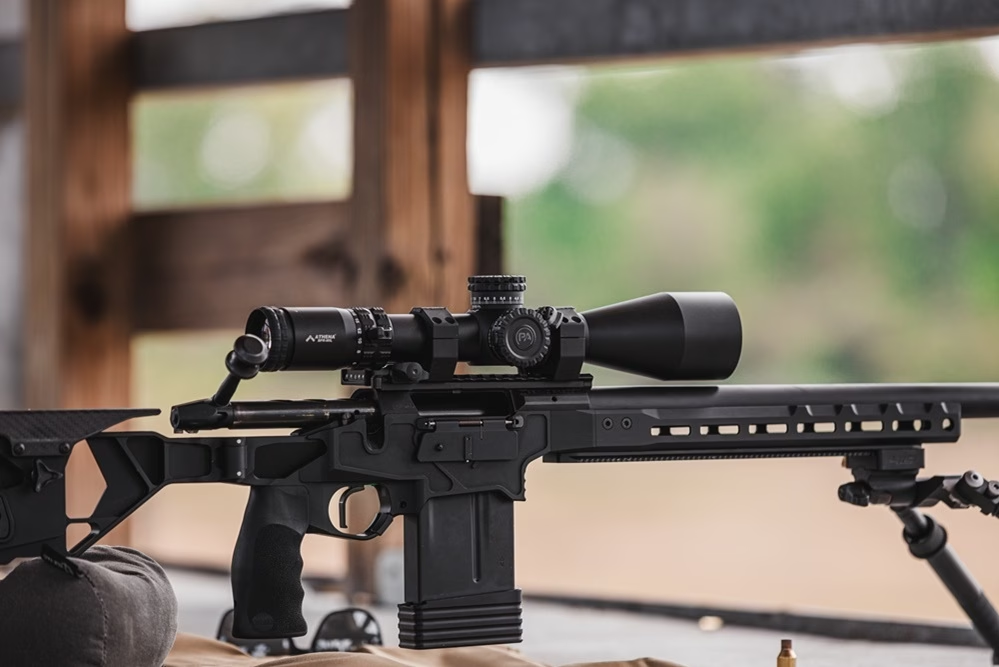
We go in-depth on these optics in our article, “A Guide to MPVOs”, but to get you up to speed on them, MPVOs aren’t strictly beholden to one specific magnification range. They offer a nice in-between magnification range when compared to LPVOs and HPVOs, making them a rather well-rounded optic. Although they aren’t as capable as LPVOs at close range, they can still be rather adept when engaging close targets, while still having the ability to adequately range targets out to around 1,000 yards. MPVOs are available in a wide range of magnification levels, but some of the most common you can expect to find are 2-12x, 4-16x, 3-18x, and 2.5-20x.
With these magnification ranges and the right reticle choice, you can easily range out to 1,000+ yards with these optics, making them immensely popular for rifles chambered in calibers like .308 Winchester, 6.5 Creedmoor, and even smaller calibers like 5.56 NATO, assuming you’re using specialized long-range loads. As such, you can expect to see such optics used on SPR and DMR rifle builds, as well as bolt-action hunting rifles too.
HPVO Magnification Ranges
As their name would lead you to believe, HPVOs offer much more magnification than MPVOs, but just like MPVOs, they aren’t locked into one specific magnification range. These scopes can have anywhere from a 4.5-27x, 5-30x, 4-32x, and even upwards of a 7-35x magnification range in some instances, making them ideal for dedicated long-range use.
Because of this, such optics are most widely used on bolt-action rifles, such as those chambered in higher power magnum cartridges like .300 Winchester Magnum and .338 Lapua Magnum for example. On semi-auto platforms though, like the AR-10 and other comparable rifles, you typically won’t see many enthusiasts running a scope with a magnification higher than 4.5-27x most of the time. However, it’s worth pointing out that rifle scopes with extreme magnification aren’t strictly used on large caliber rifles. For instance, in precision rimfire and benchrest rifle competitions, higher power scopes are commonly used to see smaller targets in more detail instead of engaging ones at extreme distances.
Still, no matter which scope you look at or what your purpose for using one is, something that’s true of all HPVOs is they aren’t all that conducive for close-range use. That said, it’s important to recognize that such use isn’t what they were designed for—these powerful optics have been engineered to offer the clarity and magnification needed for engaging targets at distances up to, and well beyond, 1,000 yards, making them most popular for rifles set up for dedicated long-range or precision use.
Which one is right for you?
Ultimately, it depends on what your rifle is capable of, as well as how you intend to use it. For instance, rifles like the AR-15, AR-10, and other semi-auto platforms can be built in an SPR or DMR configuration that can range to 750 and 1,000 yards, respectively. Many bolt-actions offer similar ranged capabilities too, making MPVOs the move.
On the flipside, HPVOs are best for dedicated long-range use. As we mentioned above, you’ll most often see such optics being used on high-power/magnum bolt-action rifles which can range out to well beyond 1,000 yards at times, making an HPVO the better optic choice for them.
But regardless of which scope type you decide on, you won’t be hard-pressed to find one, as PAO offers a whole swath of optics, including MPVO and HPVO options.
Why choose a Primary Arms Optics Rifle Scope
PAO rifle scopes are widely considered a top pick by many enthusiasts. PAO has an unwavering commitment to crafting high-quality optics, so whether you look at their more budget friendly, mid-grade, or professional series of optics, you can rest assured knowing you’re taking home a quality rifle scope at the end of the day.
And, since their lineup consists of a wide array of unique optic systems, they effectively offer something for everyone. Still, the sheer variety of PAO’s offerings is enough to cause some stress when trying to pick out the right optic for your setup. So, to make choosing one as easy as possible, we’re looking at some of their top MPVO and HPVO options below:
SLx® Series: Proven, Reliable, Affordable
The SLx series is the home to PAO’s entry-level optic systems, and although they’re some of the more budget-friendly optics on the market, this doesn’t mean that they’re lacking in terms of overall quality. Not only do these rifle scopes go through a series of rigorous quality control checks before leaving the factory, but they’re also packed with a plethora of top-tier features, giving premium quality without the premium price tag.
SLx 2-12×40 SFP Rifle Scope
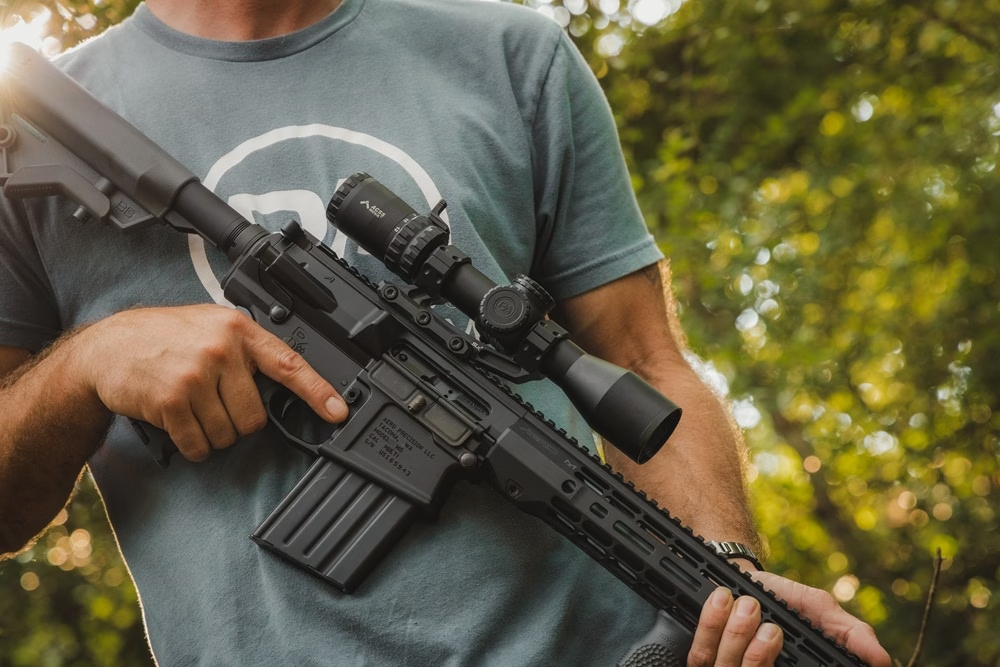
One of the newest additions to the SLx line is the SLx 2-12x40mm SFP Rifle Scope, a unique, utilitarian, and affordable MPVO that’s designed to offer flexible adaptability across multiple applications. Built around a rugged aluminum optic body, this scope is both water and shockproof, and it also comes with multi-coated lenses for optimal light transmission and image clarity. It’s a rather compact MPVO too—measuring 11.5 inches long and weighing only 22.85 ounces. While all these features make this optics one worth considering, one of its most enticing features is its reticle.
Much like the SLx 1-6x24mm SFP Rifle Scope Gen IV and the SLx 1-10x28mm SFP Rifle Scope that we covered in Part Two of Behind the Glass, the SLx 2-12×40 rifle scope also houses the popular ACSS® NOVA® reticle. Using a unique fiber wire design, its wire crosshairs provide an incredible amount of targeting data, such as moving target leads, ranging elements, and MIL subtensions for making more complex holds at distance. Also, the NOVA reticle makes use of an exceptionally bright fiber optic tube as the reticle’s center point of aim, providing you with a truly Red Dot Bright™ aiming point. One caveat the ACSS NOVA reticle has is that it’s only available in a second focal plane configuration.
SFP reticles stay the same size regardless of their magnification level, meaning the NOVAs holdovers are only accurate when it’s at its maximum magnification. Regardless, this optic is still rather adaptable thanks to its 2-12x magnification range, making it more than viable in both close- and medium- to long-range applications. There’s still a lot to cover when discussing the ACSS NOVA reticle system, so we recommend checking out our guide, “The ACSS NOVA: A True Red Dot Bright Scope” after you’ve read this one.
SLx 4.5-27×56 FFP Rifle Scope
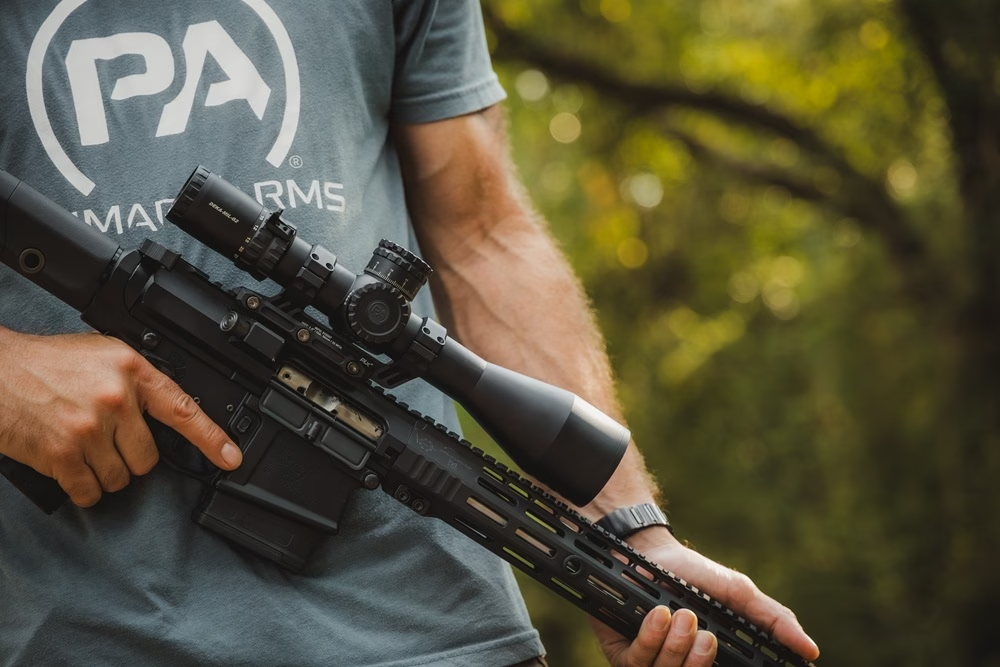
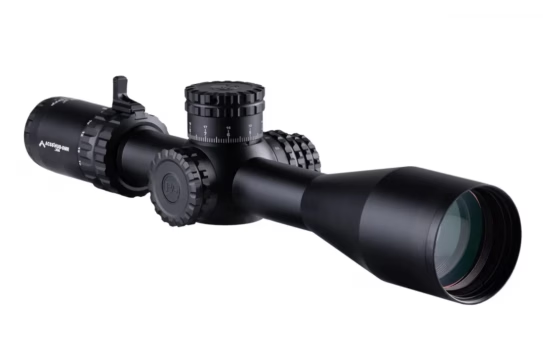
Offering higher magnification, the SLx 4.5-27×56 FFP Rifle Scope is one of the most budget-friendly HPVOs on the market, and one of the newest additions to the PAO lineup. Measuring 13.78 inches long and weighing 32.6 ounces, it’s a larger optic, but it’s still compatible with 34mm scope mounts, giving you no shortage of options to choose from. Plus, with it being an SLx series optic, it’s constructed around an exceptionally durable aluminum optic body and has multi-coated lenses. Unlike the SLx 2-12x Rifle Scope though, the SLx 4.5-27x Rifle Scope is a first focal plane (FFP) optic that’s currently available with two reticle configurations.
The SLx 4.5-27x56mm – ACSS® Athena® BPR MIL Reticle, as its name suggests, houses the ACSS Athena BPR MIL Reticle which has several features to make it an excellent pick for long-range precision. It has exceptionally fine MIL subtensions on both its horizontal and vertical crosshairs, an infinitely precise center chevron aiming point, and it has a full MIL grid with each hold spaced out to by 0.5 MILs, allowing you to pair this optic with just about any rifle and caliber. This reticle can also be illuminated too, giving you optimal visibility in all scenarios, regardless of how dim or bright your environment is.
You can also opt for the SLx 4.5-27x56mm – ACSS® DEKA® G2 Reticle as well. Like the ACSS Athena reticle, the DEKA G2 reticle makes use of MIL-based measurements, but comparatively, it has a more simplistic design. Rather than having a full MIL grid, it has a simpler crosshair design that’s complete with MIL subtensions and hash marks that measure in 0.1 and 0.2 MIL increments on both its vertical and horizontal crosshairs. Just like the Athena variant, the DEKA G2 reticle can also be illuminated, making it a solid pick for everything from SPR and DMR builds to hunting and precision rifles.
GLx® and PLx® Series Optics
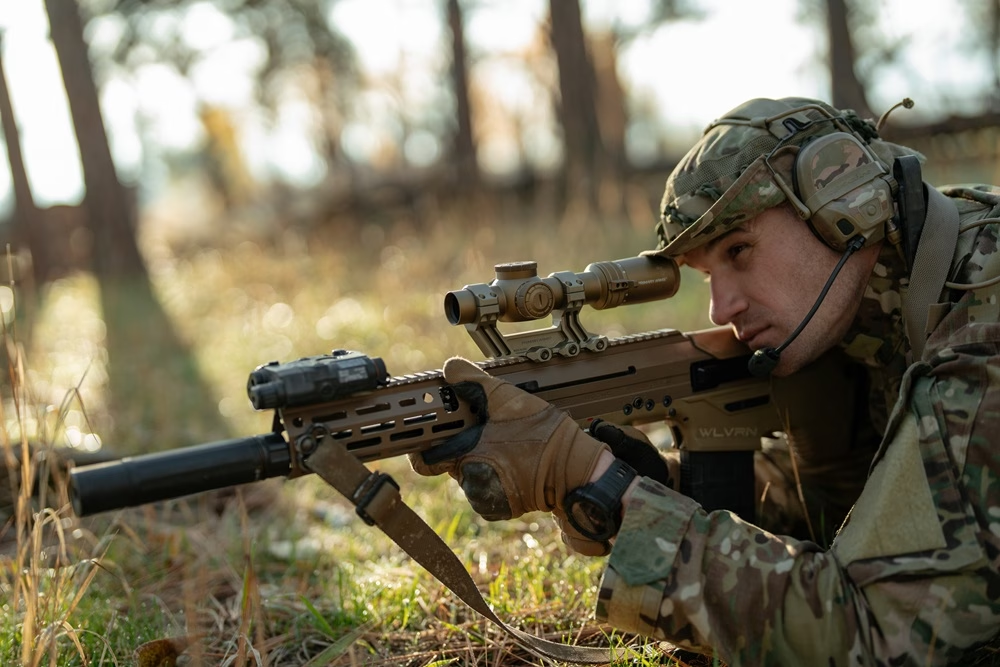
As of writing this, there currently aren’t any MPVOs or HPVOs offered in either the GLx® or PLx® series from Primary Arms Optics. Historically, PAO has offered both MPVO and HPVO optics in these optic lines, such as the GLx 3-18×44 FFP Rifle Scope and the PLx 6-30×56 FFP Rifle Scope—however, they have since been discontinued. Looking out on the horizon though, there are likely to be some new additions to both the GLx and PLx line in the not too-distant future.
Until then, there aren’t any other MPVO or HPVO options in either optic line, but there are other optics to choose from in each one though. In Part Two of Behind the Glass, we cover two of PAO’s flagship LPVOs, the PLxC 1-8×24 FFP RDB Rifle Scope – ACSS Raptor 5.56/.308 Yard G2 Reticle and the PLxC 1-8X24 FFP RDB Rifle Scope – ACSS Griffin MIL, two of the most popular optics in PAO’s PLx line. Both make use of the newly designed RDB reticle, which has a highly reflective grating micro-etched onto the reticle surface.
We highlight this new reticle technology in-depth on our New PLxC 1-8x24mm FFP ‘RDB’ Rifle Scope Featuring Diffractive ACSS® Raptor G2 Reticle product release. We recommend giving it a read to get a better idea of how they compare to other options on the market.
Conclusion
For long-range engagements no optic gets the job done like rifle scopes. A well-built rifle scope can fundamentally change the performance and overall versatility of your rifle, allowing you to accurately engage targets out to well over 1,000 yards in some cases. And when it comes to optics offered by PAO, they have some seriously high-quality rifle scopes to choose from.
Optics like the 2-12×40 SFP Rifle Scope offer a nice blend of both close- and medium range utility as its use of the ACSS NOVA reticle system makes it adaptable for use in a multitude of different applications. Meanwhile, if you’re in need of more power, the SLx 4.5-27×56 FFP Rifle scope is the move. Its greater magnification range can range out to 1,000 yards and beyond, while its specialized reticle selection gives you the ability to make more complex holds at distance, ensuring accuracy.
Regardless of which one you choose, you can rest assured that you’re getting a high-quality optic, as each of PAO’s optics are backed by their never-ending commitment to crafting top-tier optic systems to fit for all budgets. But, if you find yourself on the fence about whether a higher power rifle scope is the right fit for you, or if you just want to see what else PAO offers, our guide on Breaking Down PLx Reticles provides some solid insight on the different reticle systems found on PAO’s PLx Series optics.