Long distance precision tests the capabilities of your rifle setup, as well as your own individual skills as a marksman. And being as popular as it is, it’s no surprise that there are several rifle systems designed with long-range use in mind.
Although, yes, it takes more than just a rifle to hit a target at 1,000+ yards, having the right one certainly makes the job easier. Just like with any other rifle that’s specifically made for one task, it’s easy to get lost in the sauce when you’re new to the game, as even a simple search will bring up dozens of different models to consider.
If you’re new to the game, finding the right rifle can be a challenge, but it isn’t impossible. By knowing what to expect when getting into long-distance marksmanship, how different calibers perform, and the different advantages certain platforms offer, you’ll make the right choice. But to do so, you must know what to look for.
What is Considered “Long Range”?
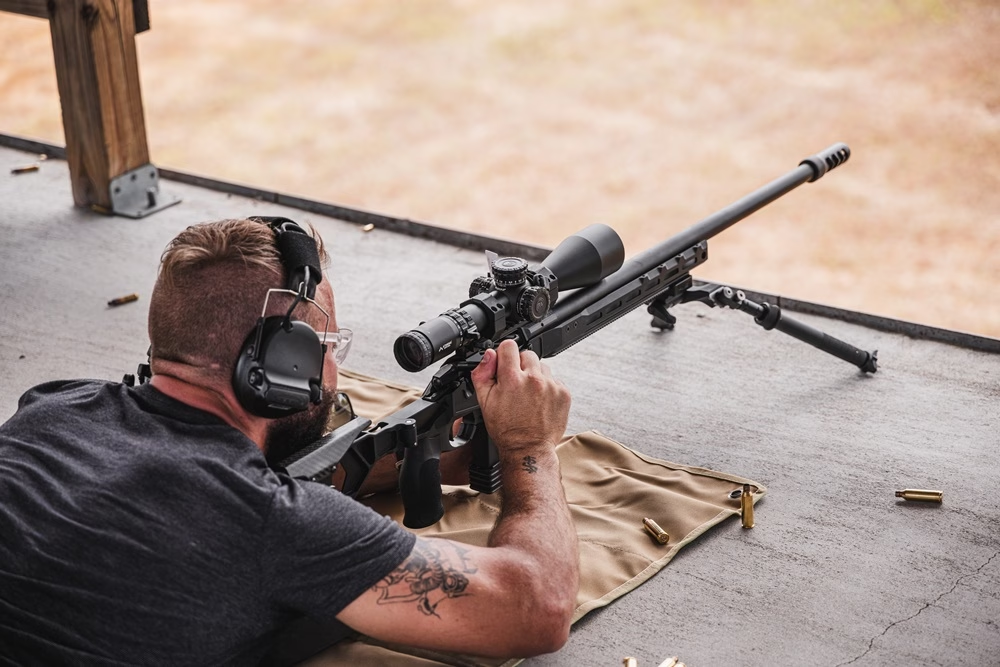
As far as practical marksmanship goes, anything within about 300 yards is considered short range. At this distance, it’s more than possible land hits on target with basic iron sights, which is why it’s most often a metric used for carbines like the AR-15. Medium range is typically anywhere from 300 to 600 yards away, while long-range can be anywhere from 600 yards and beyond.
Of course, it’s mostly dependent on opinion and context. As you get more proficient, what you once considered long distance, say 500 or 600 yards, might seem close. And at that point, you can start to push the distance as you get a feel for what you and your rifle are capable of.
But if you’re a complete beginner, we recommend spending some time learning the fundamentals at close range, and once you’re proficient there, you can start working your way up to the 1000-yard line or beyond.
Why Long Range?
Long distance precision is an excellent discipline for honing your skills as a sharpshooter, and it’s great for helping you understand how a bullet behaves after it leaves the barrel. After firing, your projectile is going to be affected by gravity, windspeed, humidity, and more, meaning you’ll need to know how to properly adjust your aim to compensate for each factor. While ballistic charts can get you some good baseline information, experience is the real teacher. Plus, what you learn at the range can be applied to other disciplines, such as competition and hunting.
What Makes a Good Beginner Long Range Rifle?
Manageable Recoil
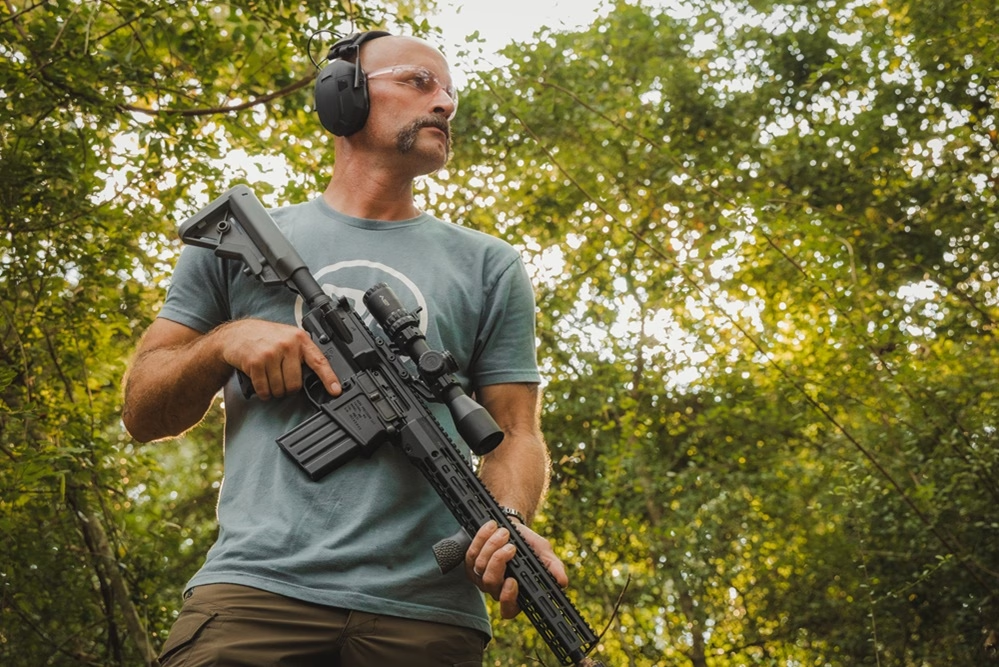
Controlling your rifle is imperative across applications, but in long-range shooting, high recoil can have unique secondary effects that hurt your performance. Having a harsh recoil impulse is typically the reason why many beginners have the tendency to flinch, or brace for the recoil, before pulling the trigger. Flinching can throw off your point of impact by several inches at close range, which can cause you to miss the target entirely in a long-distance context. Plus, you can lose sight of your target too. Seeing where your projectile impacts is necessary for getting a read on how to adjust your aim before taking your next shot (assuming you’re shooting without a spotter), and if you’re flinching, this isn’t always possible. Practice is the best way to break the habit of flinching, but having a controllable rifle goes a long way when you’re just getting started.
Mechanical Accuracy
Something else to be sure of if your rifle’s overall accuracy out of the box—this is better known as a rifle’s mechanical accuracy, something we cover in our guide, “Mechanical vs. Practical Accuracy”. Mechanical accuracy refers to the true, absolute accuracy of a rifle, absent any user error. A rifle capable of 1/4 MOA groups will always be easier to shoot at extreme ranges than one that groups 4 MOA. As such, it’s good to research each of your options to make sure that your rifle is made with high-quality components and comes from a reputable brand.
Common Calibers and Ammo Availability
Many of the calibers made specifically for long-range precision are fairly niche. Serious precision enthusiasts use less common calibers like 6mm Dasher, .300 PRC, and 6.5×47 Lapua, to name a few. To get the very best results, these shooters almost universally rely on handloading their own cartridges. But these aren’t the only calibers you can use for long-distance use.
Calibers like 6.5 Creedmoor and .308 Winchester are good picks. Compared to dedicated long-range calibers, .308 isn’t the best option for long-range precision per se, but it still performs well and is very common. 6.5 Creedmoor is a nice in-between option—it performs very well, it’s fairly common, and it’s relatively affordable, though it’s a bit more expensive than .308.
Ultimately, your choice of caliber is exactly that, your choice. But picking one is usually a matter of balancing performance and accessibility with what you can reasonably afford. Dedicated long-distance calibers are expensive and not that common, making your initial ammo investment quite big. Meanwhile, 6.5 Creedmoor and .308 are far more approachable for beginners.
Customizability
Being able to customize your rifle is always a plus, and when you’re getting into the long-distance precision space, it can be crucial. Generally, you shouldn’t alter your rifle too frequently. Long-distance precision is all about consistency, and changing your rifle often can cause you to lose out on performance. But this doesn’t mean you have to leave your rifle in its stock configuration.
It’s good to have a rifle that’s easy to customize and tailor to better fit your own needs and preferences. Semi-auto rifle systems based on the AR-10, as well as bolt-actions based on the Remington 700, are incredibly common, so it’s easy to find aftermarket parts for them. Compared to lesser known/more unique rifle systems, they’re generally a better option. Plus, with a more common platform, you’ll be able to upgrade your rifle as you go, which is perfect if you don’t have a large budget to start with.
Best Beginner Rifle: Bolt-Action vs. Semi-Auto.
Now that you have a good understanding of what to look for in a rifle, you can start searching for one, but this is usually easier said than done. For long-range use, two of the most popular options you can go for are bolt-action rifles and semi-auto ones like the AR-10. We have a guide, “Bolt-Actions vs. Semi-Auto Rifles” that covers both in-depth, but we’ll get you up to speed on both options below.
Bolt-Actions
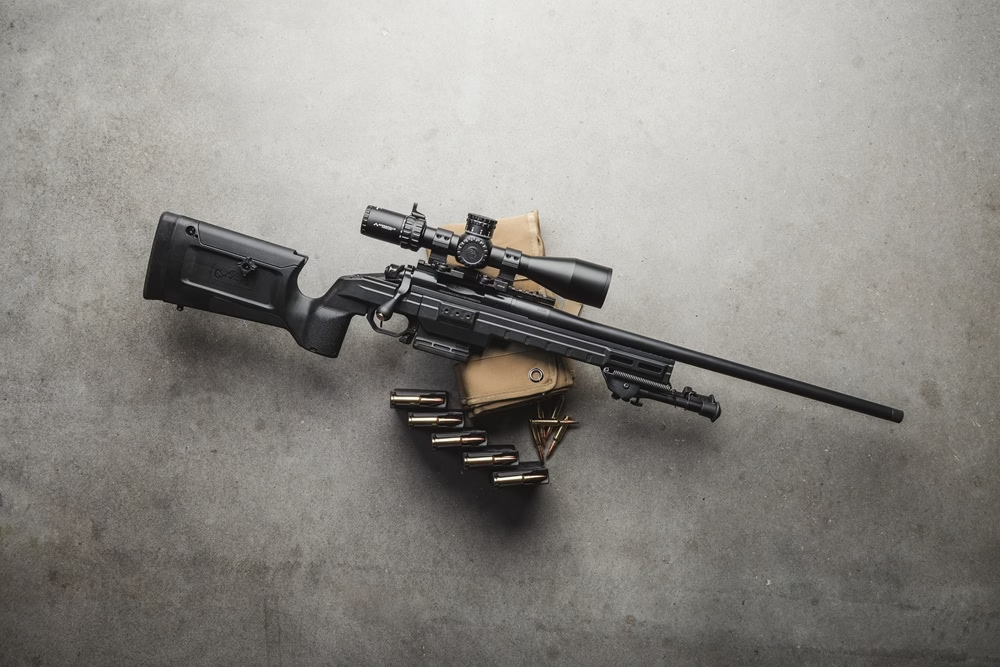
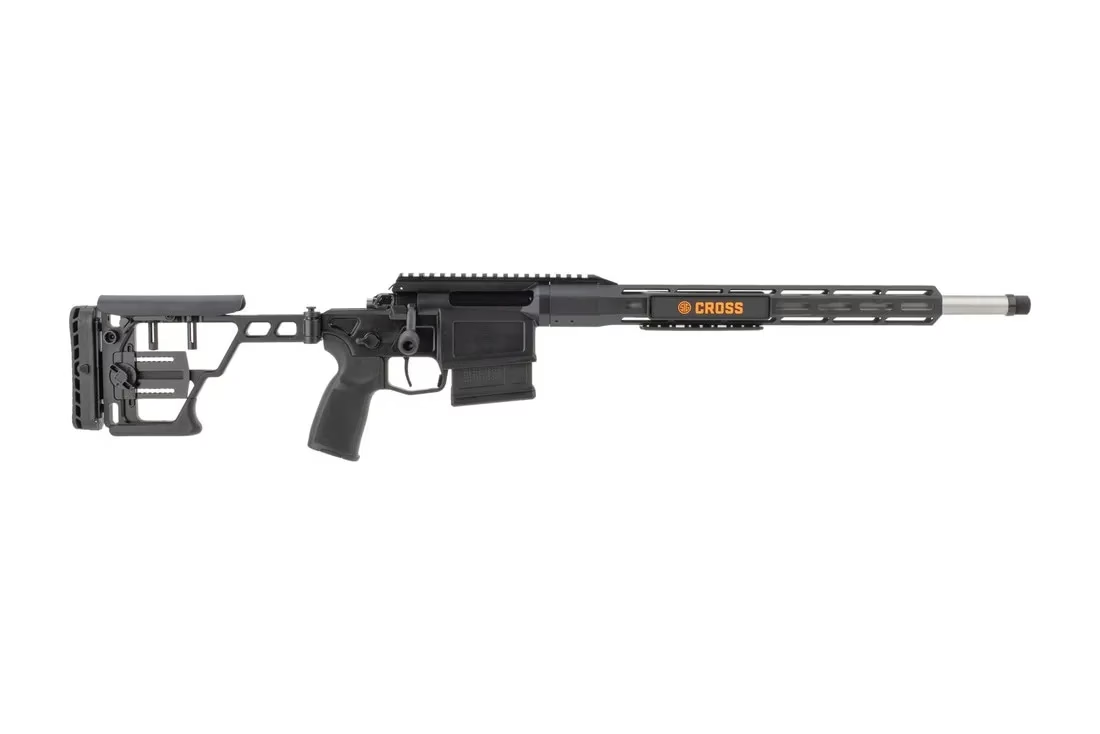
Bolt-action rifles are known for their exceptional reliability and precision, and for long-range use, it’s hard to beat their cost-effectiveness. Bolt-actions tend to have higher quality barrels than AR-10s, and when you take their lack of moving parts into consideration, their overall accuracy and precision is incredible. Their more minimalistic construction can make them lightweight too, though this depends on many factors, such as its barrel profile, stock, and accessories.
Since they need to be cycled manually, they don’t have the same rate of fire as AR-10s, but in a long-distance context, this isn’t that big of a deal.
AR-10
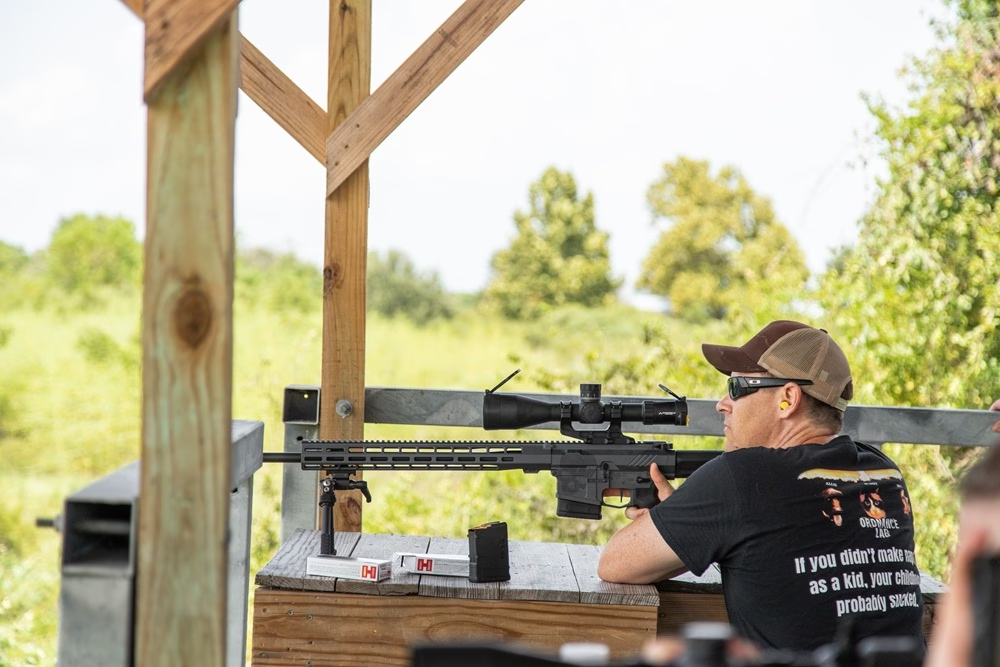
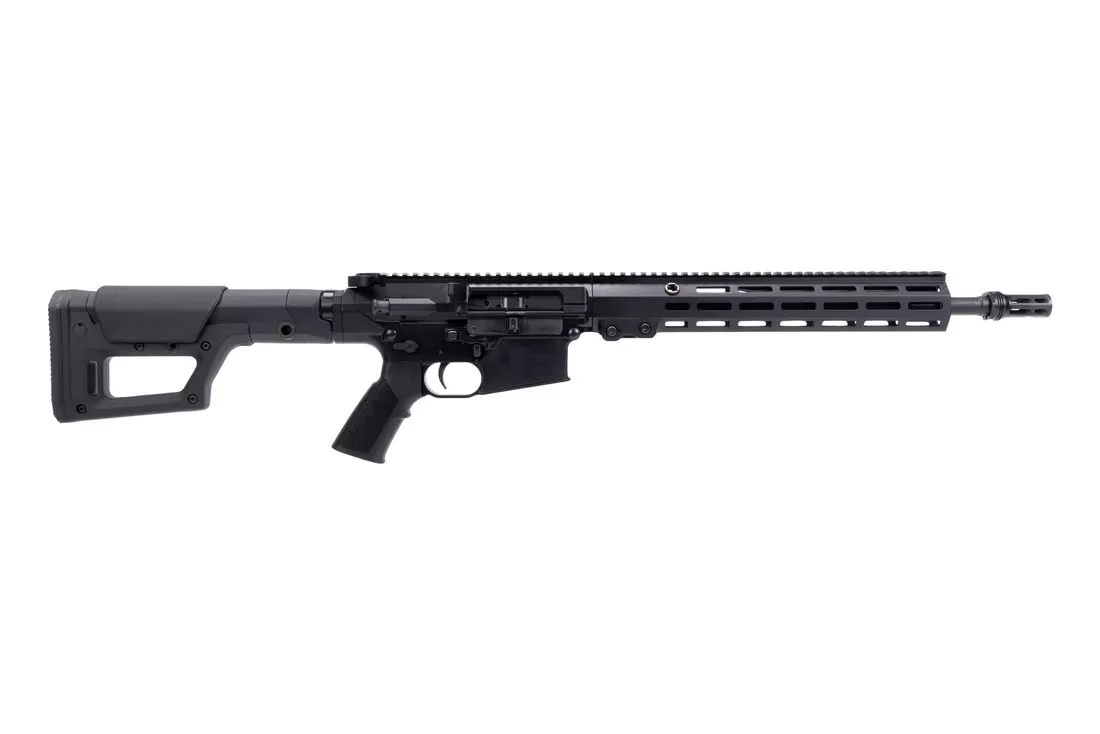
The AR-10 is a highly adaptable rifle system that can be set up for multiple applications, and it’s another popular rifle for long-distance use. Commonly chambered in .308 Winchester or 6.5 Creedmoor, they are some of the most popular semi-auto rifles on the market, as they share a lot in common with smaller AR-15 rifles. The most noticeable advantage AR-10s have over bolt-actions is their semi-automatic action. You can fire multiple rounds without having to manually cycle the action, letting you keep your focus solely on the target.
While beneficial, it comes with a caveat. Although AR-10s are exceptionally reliable, they have a more complex internal design, meaning they have more potential points of failure by default. Also, they aren’t as precise as bolt-actions either, as their added components and reciprocal mass have a negative impact on the barrel’s harmonics. Regardless, as far as adaptability goes, AR-10s are the move, and so long as you regularly maintain yours, it’ll be reliable enough for just about anything.
Which Should You Go With?
Between the two, bolt-action rifles are easily the most precise, as they excel in long-distance disciplines. Rifles like the Remington 700, Bergara Ridge Rifle, and the Tikka T3x are just a few of the many high-quality options available, and they each cost under $1,000. And if you’re interested in more of a budget rifle, the Ruger American is another solid pick that’s around $500.
Still, AR-10s are more adaptable and have the distinct advantage of being semi-automatic. With one, you can easily tailor your rifle for multiple applications outside of a precision role, with them being great for hunting and competitions. Although they usually don’t offer the same precision as a bolt-gun, they’re worth it for their modularity alone. Plus, there’s a plethora of options available from well-known brands like the Andro Corp Divergent, Ruger SFAR, Springfield Armory Saint Victor, POF USA Revolution, and more. You should expect to pay a bit more, as most of the precision-oriented AR10s are priced over $1000. However, if you’re a savvy shopper, you might be able to build an AR-10 from parts to save on cost and get exactly what you’re looking for.
Ultimately, choosing one over the other comes down to a matter of your personal preference. And if you take your needs into consideration before buying, you’ll make the right call.
Long Range Calibers for Beginners
Like we mentioned above, there are a lot of different calibers have been tailormade to offer incredible long-range performance. And on top of this, there are always more being developed to one-up the others, and most high-level competitors still prefer to handload their own rounds for consistency. This is costly to say the least, and it isn’t all that practical for beginners.
As a beginner, your priority is going to be to learn the fundamentals and hone your skill so you can work your way up to 1,000 yards. To do this effectively and affordably, you’ll need something that performs well and is still affordable. And fortunately, 6.5 Creedmoor and .308 Winchester are far more approachable from a beginner’s standpoint.
6.5 Creedmoor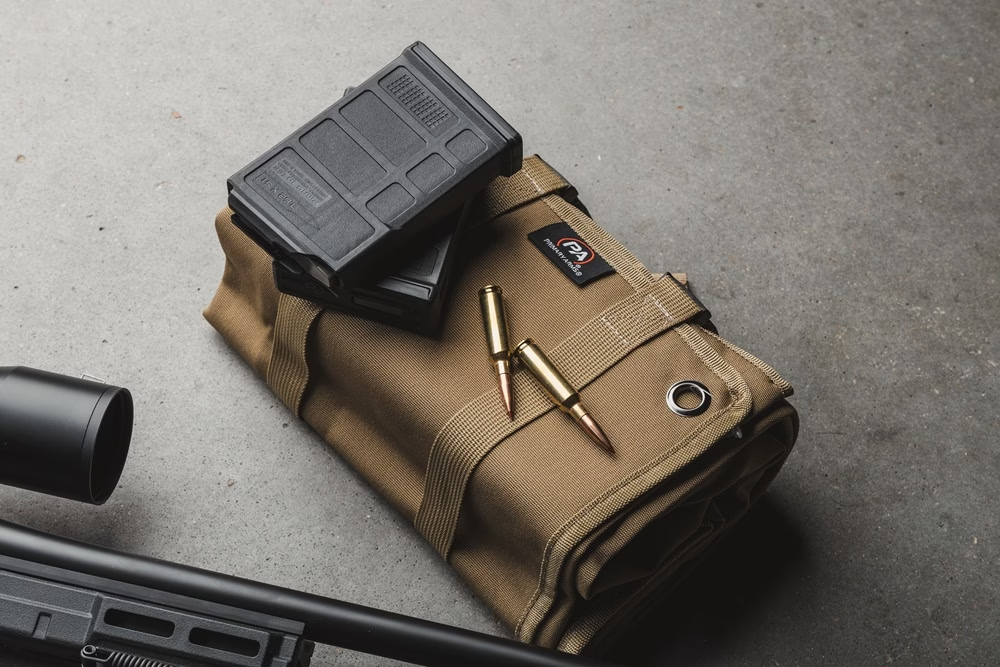 | .308 Winchester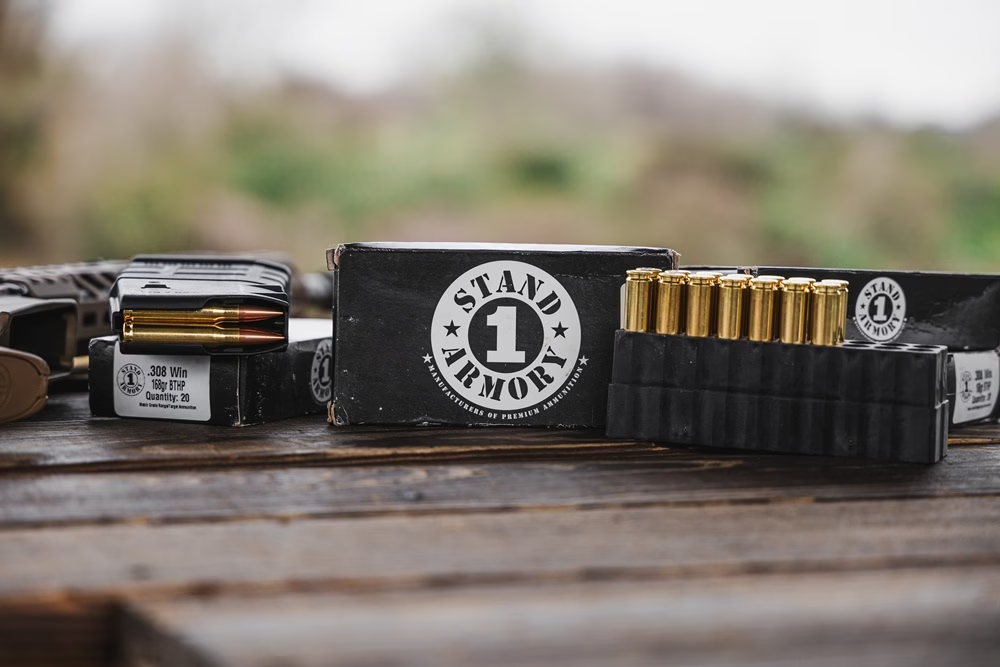 | |
|---|---|---|
| Role / Type: | Dedicated long-range rifle cartridge, designed in 2007 | Versatile battle rifle cartridge, designed in 1952 |
| Effective Range (Standard / Specialty): | Around 1,000+ yards / up to 1,300+ yards | Around 800+ yards / up to 1,000+ yards |
| Average Cost per Round (Standard): | Around $1.00 to $1.20+ | Around $0.70 to $1.00+ |
| Average Cost per Round (Specialty): | Around $1.50 to $2.00+ | Around $1.20 to $2.00+ |
| Characteristics and Availability: | High velocity, relatively flat trajectory, widely supported across the industry | Has decent long-range performance; it has more bullet drop due to its heavier projectiles, but it’s very easy to find |
| Beginner Considerations: | Very accessible, good for long-range use, hunting, and competitions, but it isn’t always budget‑friendly | Affordable, well‑rounded, and beginner‑friendly, though it doesn’t offer the same level of performance as 6.5 Creedmoor |
Which is Best?
Between 6.5 Creedmoor and .308 Winchester, you can’t go wrong with either one. 6.5 Creedmoor, despite being more expensive, is widely considered the better cartridge for dedicated long-range use—it can be incredibly precise, and it’s viable for other uses like hunting too.
On the flipside, .308 has been around for a long time, and is generally more readily available than 6.5 Creedmoor, as well as more budget friendly. It doesn’t offer the same high velocity and flat trajectory as 6.5, but it’s still more-than-capable of going the distance when needed. And, just like 6.5 Creedmoor, it’s quite formidable for hunting and competitive use too.
As far as dedicated long-range cartridges go, 6.5 Creedmoor is hard to beat. But, if you’re wanting something that’s a bit more affordable, .308 is a solid substitute. Regardless, compared to the niche calibers used by top-tier competitors, both 6.5 Creedmoor and .308 offer good performance, and you’ll have a far smaller initial ammo investment.
Conclusion
Long-distance marksmanship is both incredibly fun and incredibly difficult, and to go the distance, you need a rifle that’s fit for the job. Whether you prefer the precision and simplicity of a bolt-action rifle, or the modular adaptability of an AR-10, remember that your success depends on more than just your rifle platform of choice.
Factors like out-of-the-box accuracy, the caliber it’s chambered in, as well as configurability all play a key role in helping you figure out which is best for you. If you’re still on the fence about what’s one for you, take time to evaluate your needs and preferences. So long as you do, you can rest assured knowing that you’ll have the right rifle.
Frequently Asked Questions (FAQ)
-
What is the best beginner rifle for long-range shooting?
There are a lot of long-range rifles that are great for beginners. It’s impossible to objectively call one rifle the ‘best’, but the best to go with is one that’s accurate out of the box, has manageable recoil, and is chambered in a common caliber like 6.5 Creedmoor or .308 Winchester. The bolt-action rifles and rifles based on the AR-10 platform mentioned in this article are great options to consider.
-
Is 6.5 Creedmoor good for beginners?
Yes. 6.5 Creedmoor is widely considered one the most beginner friendly long range calibers thanks to its flat trajectory, low recoil, and excellent ammo availability.
-
Can hunting rifles be used for long range shooting?
Yes. Many modern hunting rifles, like most bolt-action rifles, are capable of accurate long-range shooting, especially when chambered in calibers like 6.5 Creedmoor.
-
Are AR-15 rifles good for long range shooting?
They can be, but it depends on how the rifle is configured. Standard AR-15s chambered in 5.56 NATO are effective out to about 500 yards. But, when using specialty 5.56 loads, or other calibers like 6.5 Grendel or 6mm ARC, the AR-15 can be accurate out to 750+ yards. For dedicated long-range use, rifles based on the AR-10 platform are a much better fit, as covered in this article. Being widely available in 6.5 Creedmoor and .308 Winchester, they’re much better suited for long-distance use.
-
How far should a beginner practice long range shooting?
If you’re a complete beginner, you should start by learning fundamentals at close range within 300 yards and back. Once proficient, you can work through medium-range distances (300–600 yards) and then push out to 600+ yards as your skills improve, and if you have the equipment to do so.