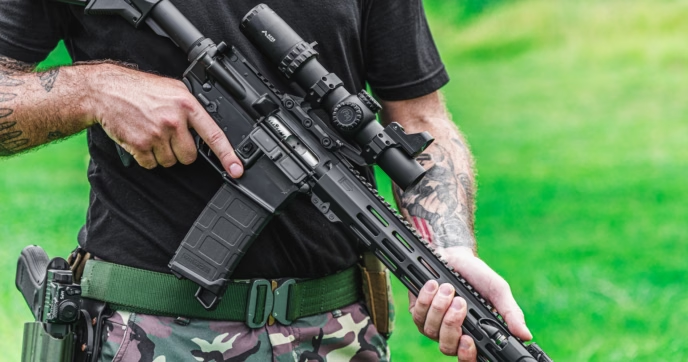
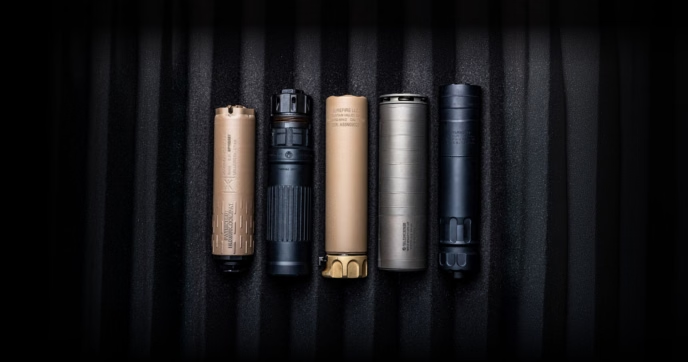
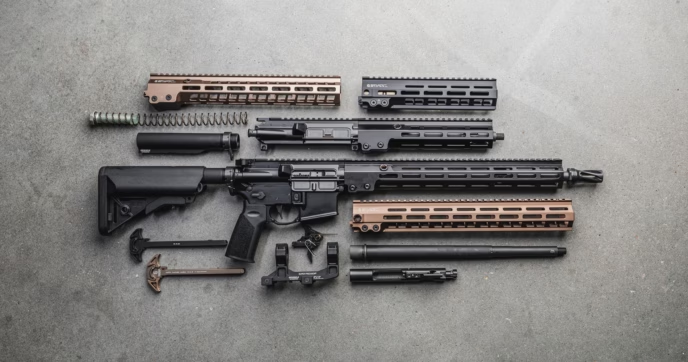
With suppressor interest and ownership having skyrocketed in recent months, many enthusiasts have been turning to easily suppressible calibers for their new rifle builds. While you might immediately think of something like .300 Blackout, it isn’t the only suppressible intermediate cartridge.
Developed by Hornady, .338 ARC has quickly become one of the industry’s favorite up-and-coming suppressor-ready cartridges. It boasts several qualities that make it a contender for compact suppressed rifle builds. But, in a market that’s dominated by other low-pressure rounds like .300 Blackout, it’s imperative to know what makes .338 ARC stand out.
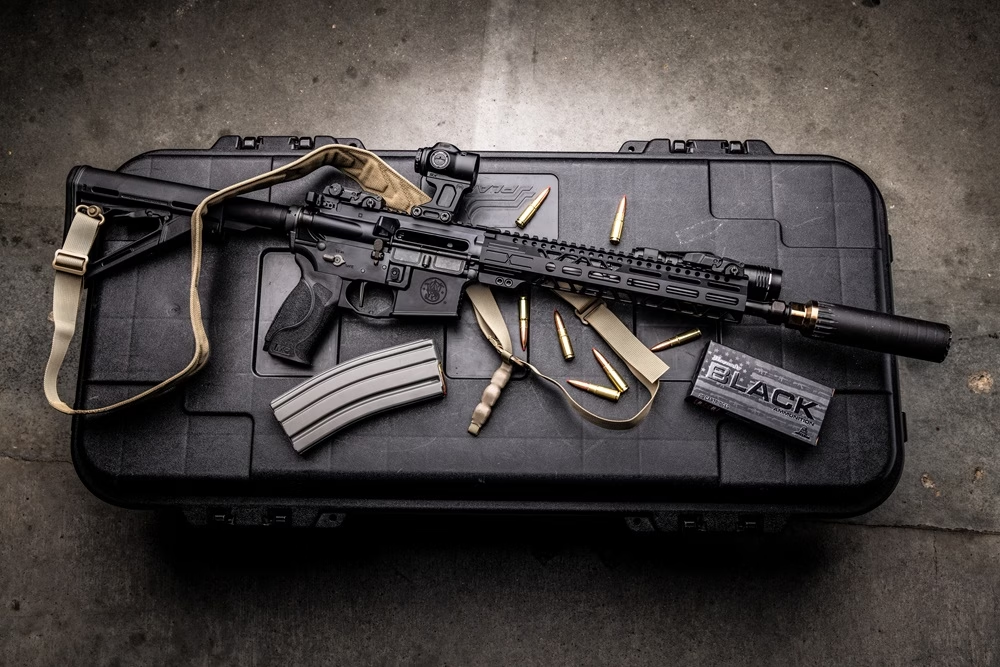
Understanding .338 ARC – Hornady’s vision for Suppressed Shooting
.338 ARC is a cartridge that was developed by Hornady in 2017. It was originally made to fulfill a need found by the U.S. DOD. And although the DOD ended up dropping this project for other ones, Hornady saw the potential it had. After refining its design, they eventually brought it to the civilian market in 2024.
Being a part of Hornady’s Advanced Rifle Cartridge, this cartridge has a lot of unique characteristics. As denoted by its name, it makes use of a large, .338-inch projectile—the same diameter used in both 8.6 Blackout and .338 Lapua Magnum. Using a larger projectile makes it far easier to create a hearing safe subsonic load that still packs some serious muzzle energy. To compliment the larger bullet, Hornady based its casing off 6.5 Grendel, giving .338 ARC a wide inner diameter. This not only lowers the chamber pressure, but it allows the powder to fully burn in rifles with shorter barrels.
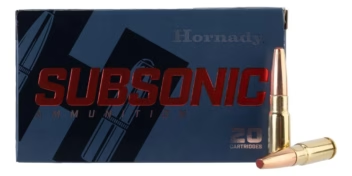
Hornady’s supersonic ammunition can use anywhere from 160- to 230-grain projectiles, while their subsonic ammo uses heavier 285- and even 307-grain bullets. The added weight afforded by the .338 caliber projectile allows such rounds to impart some serious energy on targets down range—up to 1,600+ ft-lbs in some instances. Additionally, .338 ARC also has a higher ballistic coefficient compared to other suppressible cartridges, so it isn’t as affected by air resistance and wind.
Regardless of its many benefits, understanding .338 ARC’s limitations is critical. Having an effective range of around 300 yards, it doesn’t offer much in terms of range performance. However, remember that it wasn’t designed to do so. By design, it’s made to offer incredible suppressed performance out of short-barreled rifles, while still having superior terminal ballistics.
Why Suppressed Shooting Matters for .338 ARC
One of the hallmark features of .338 ARC is its ability to perform well across multiple setups. On semi-auto platforms, it can reliably function with both sub- and super-sonic loads without needing to change the rifle’s gas setting. If your rifle doesn’t have an adjustable gas block, you’d still be able to shoot suppressed, or unsuppressed, with no issues.
In practice, you can use sub-sonic ammunition for defensive applications, getting superior sound suppression at the cost of ranged performance. But when needed, you could switch over to supersonic rounds for some extra range.
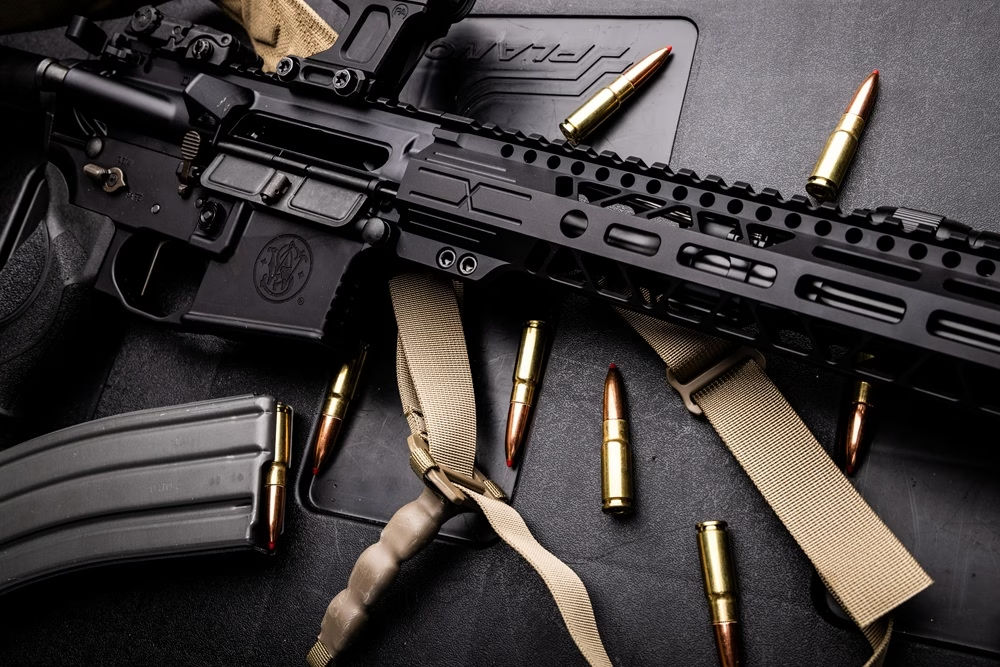
Subsonic vs. Supersonic .338 ARC Loads: Suppressed Performance
For a subsonic cartridge to be optimal for suppressor use, it needs to have two key characteristics: a low operating pressure and a heavy projectile.
Suppressors work by capturing the gases within a series of baffles or vents once they exit the muzzle. And while any round can be suppressed, whether it’s done so effectively depends entirely on the cartridge’s operating pressure. A high-pressure cartridge like 5.56 NATO can produce as much as 55,000 to 62,000+ PSI in some instances. Even with a suppressor, the gases created after firing still move fast enough to make a loud sound signature. In .338 ARC’s case, select sub-sonic ammunition typically generates around 30,000 PSI, almost half of the average 5.56 load.
With a lower chamber pressure, the gas has much more time to slow down, making it far easier for the suppressor to capture it. Still, making cartridge suppressor-ready goes beyond just making it quiet. Low operating pressure also means low velocity, and if a cartridge is going to have a low enough velocity as to not break the sound barrier, it needs to be able to maintain an effective terminal velocity. Fortunately, this isn’t a problem for .338 ARC. Like we mentioned earlier, .338 ARC loads can fire 300+ grain projectiles, giving them the mass needed to impart a serious amount of energy on target.
But, even when using supersonic ammunition, .338 ARC suppresses rather well. While it won’t be hearing safe by any means, shooting suppressed is always safer than shooting unsuppressed. Your ears will thank you.
Matching Loads to Real-World Use Cases
As you’ve likely gathered thus far, .338 ARC is a rather versatile cartridge. And as it’s grown in popularity, enthusiasts have used for everything from the average range trip and hunting to more intensive training and competitive use.
But no matter how you intend to use it, you’ll need to have the right load to maximize your performance.
Hunting
| Spec | 307-grain Sub-X® | 170-grain MonoFlex® |
|---|---|---|
| Muzzle Velocity | 1,050 FPS | 2,075 FPS |
| Muzzle Energy | 752 ft-lbs | 1,625 ft-lbs |
| G1 Ballistic Coefficient | .375 | .313 |
| Effective Range | Around 200+ yards | Around 300+ yards |
Much like .300 Blackout, .338 ARC is used widely for hunting invasive species and medium-sized game. Hornady’s 307-grain Sub-X® cartridge offers reliable expansion at subsonic velocities thanks to its Flex Tip insert. Additionally, it’s heavier grain weight makes it exceptionally effective at ethically taking down medium-sized pests and game. As such, this load is particularly useful for those wanting a suppressed hunting setup.
If you aren’t going for an ultra-quiet setup, or just want some extra distance, Hornady offers several supersonic hunting loads as well. Their 170-grain MonoFlex® ammunition extends its effective range to around 300 yards, while offering roughly 976 ft-lbs of muzzle energy at 300 yards. While it won’t be hearing safe, the extra velocity makes it practical for engaging further targets, like deer and other medium game.
Defensive and Competitive Shooting
| Spec | 285-grain FMJ Frontier® | 175-grain HP Match® Black® |
|---|---|---|
| Muzzle Velocity | 1,050 FPS | 2,075 FPS |
| Muzzle Energy | 698 ft-lbs | 1,673 ft-lbs |
| G1 Ballistic Coefficient | Not Listed | .385 |
| Effective Range | Around 200+ yards | Around 300+ yards |
For both defensive and competitive applications, .338 ARC can be a remarkably effective choice. One of Hornady’s most popular subsonic offerings is their 285-grain Frontier line. These loads make use of a 285-grain full metal jacket projectile, that, thanks to its lessened powder charge, is fine-tuned for suppressor use. At the muzzle, these rounds only produce around 1,050 FPS, so you won’t hear any supersonic crack from the bullet. Although its muzzle energy tapers off considerably past 100 yards, it still generates an impressive 698 ft-lbs of energy, making it a highly effective close-range cartridge.
Meanwhile, Hornady’s 175-grain Black series ammunition is the move when engaging further targets. Its higher velocity allows it to retain more of its energy after firing. In fact, at 200 yards, it can still impart around 1,115 ft-lbs of muzzle energy on target, with it having around 904 ft-lbs at 300 yards. This makes it a far more adaptable choice for engaging targets across various distances. While it isn’t a long-range caliber by any means, it certainly offers better performance than subsonic ammunition.
Ballistic Comparison to Other Suppressible Calibers
For its many advantages, .338 ARC isn’t the only easily suppressible intermediate cartridge around. We’ve mentioned it a few times thus far, but .300 Blackout has long been the go-to low-pressure cartridge for the AR-15 since its introduction. And, when stepping up to the AR-10/308 platform, you can use the new 8.6 Blackout cartridge.
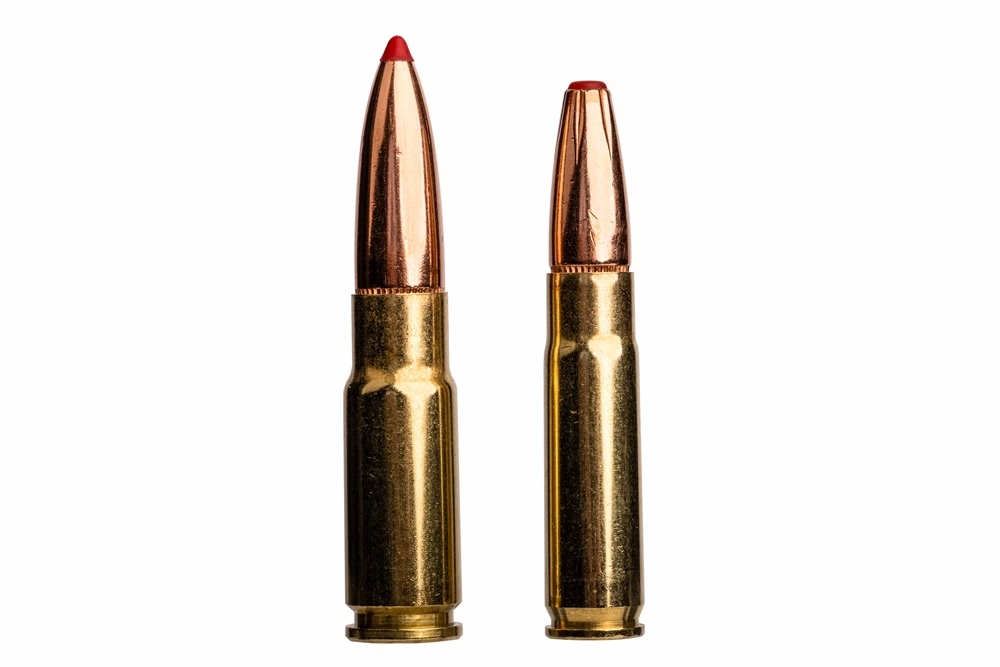
.338 ARC vs. .300 Blackout
Between the two, .338 ARC can deliver much more muzzle energy on target compared to .300 Blackout. For instance, standard FMJ .300 Blackout loads, like Hornady’s 125-grain FMJ Frontier ammo, have a muzzle velocity of 2,175 FPS, generating 1,313 ft-lbs of muzzle energy. Meanwhile, Hornady’s 175-grain can produce 1,673 ft-lbs of muzzle energy. .300 Blackout does win out in terms of velocity, but the difference isn’t too stark—around 150 to 175 FPS or so.
Their difference in muzzle energy is far more noticeable when shooting subsonic—Hornady even offers Sub-X loads for both cartridges too. The .300 Blackout Sub-X has a muzzle velocity of 1050 FPS, generating 465 ft-lbs of energy. The .338 ARC Sub-X load, as mentioned above, has the same velocity, but produces 752 ft-lbs of energy.
This isn’t to say that .338 ARC is inherently better than .300 Blackout by any means. .300 Blackout has been in production for nearly two decades, so there’s a lot of support for .300 Blackout. Several brands are continuing to push the boundaries of what’s possible with the cartridge, with it having far more variety than .338 ARC. Plus, .300 Blackout is generally more widely available and more affordable than .338 ARC.
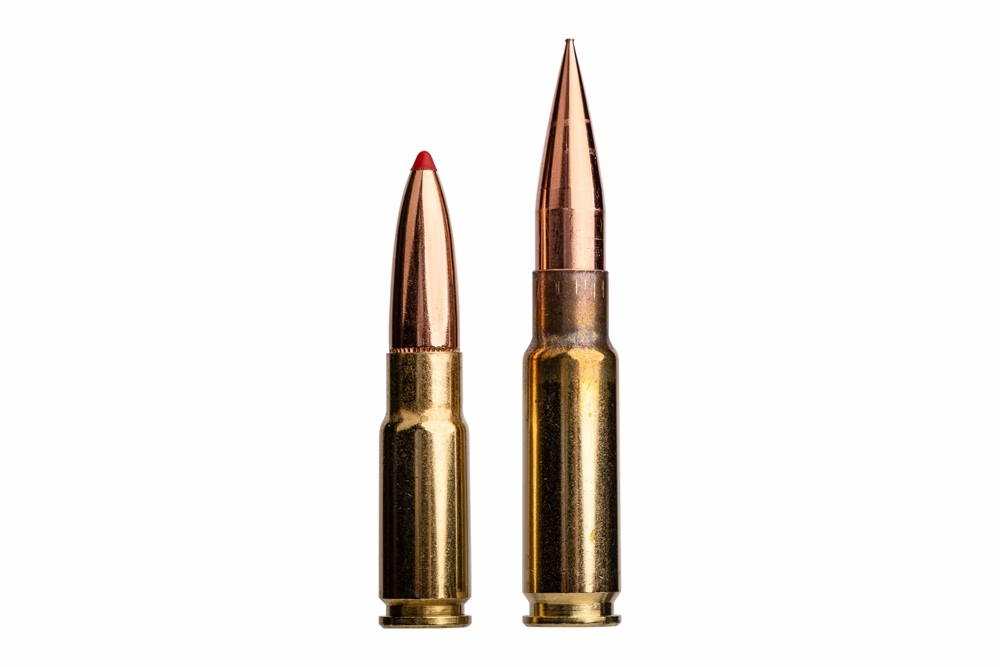
.338 ARC vs. 8.6 Blackout
First introduced in 2022, 8.6 Blackout has become one of the most popular easily suppressible cartridges on the market. It was even designed by the original developer of .300 Blackout, hence the name. The most noticeable difference between 8.6 and .338 ARC is their size. Despite using the same .338-inch projectile diameter, 8.6 Blackout has a much larger casing. Designed for the AR-10/308 platform, it’s capable of firing far heavier projectiles reliably, and when suppressed, quietly.
Overall, 8.6 Blackout produces much more muzzle energy than .338 ARC. In a supersonic configuration, 8.6 Blackout can have an effective range of up to 450+ yards. Such loads can have anywhere from a 2,000 to 2,400+ FPS muzzle velocity, creating upwards of 1,800+ ft-lbs of muzzle energy, depending on the manufacturer. Put simply, in terms of raw power, 8.6 can achieve much more thanks to its larger casing. It can hold a much greater powder charge than .338 ARC. But its powder charge isn’t just for creating high velocity.
8.6 Blackout offers incredible subsonic performance. With its larger powder charge, it can more effectively propel heavier projectiles at subsonic speeds. Different ammo manufacturers often use anywhere from 300- to 342-grain projectiles. And with a muzzle velocity of around 950 to 1,050 FPS, they can deliver anywhere from 900 to 1,200+ ft-lbs of energy on target. Compared to .338 ARC’s 752 ft-lbs—when using Hornady Sub-X ammo—the difference is quite extreme.
However, comparing both is sort of like comparing apples to oranges. Yes, they do both use a .338 projectile, but such a performance difference is expected considering 8.6 Blackout was designed for the AR-10 and other full-power rifle platforms. Regardless, it’s important to note that since both .338 ARC and 8.6 Blackout are relatively new cartridges, they aren’t as widely available. This is changing as they grow in popularity, but it’s worth considering.
Conclusion
As suppressor ownership continues to become more mainstream thanks to the Federal Tax Stamp reduction, the amount of caliber options to pick from can be overwhelming. Among the many options though, .338 ARC has quickly become a favorite for many.
.338 ARC is an incredible cartridge, that serves a nice middle ground between the tried and true .300 Blackout and the full-power 8.6 Blackout. Being backed by Hornady, there are a plethora of ammo loads available, with more surely to come.
Although it doesn’t have the pedigree of more common calibers like .300 Blackout, or the raw power of 8.6 Blackout, it certainly isn’t one to pass on.
Frequently Asked Questions (FAQ)
-
What is .338 ARC and who developed it?
.338 ARC is a cartridge developed by Hornady in 2017 that was originally created for a project within the U.S. DOD. After the DOD dropped the project, Hornady refined the design and brought it to the civilian market in 2024 as part of their Advanced Rifle Cartridge (ARC) line.
-
What chamber pressure does .338 ARC subsonic ammunition generate compared to 5.56 NATO?
Select subsonic .338 ARC loads generate around 30,000 PSI—roughly half the pressure of a standard 5.56 NATO load, which can reach 55,000 to 62,000+ PSI. The lower pressure gives expanding gases more time to slow down and cool, making suppression significantly more effective.
-
Does .338 ARC require an adjustable gas block to run both subsonic and supersonic loads suppressed?
Generally no, but this depends. On semi-auto platforms like the AR-15, .338 ARC can reliably cycle both subsonic and supersonic loads without changing the rifle’s gas setting in most instances, so an adjustable gas block isn’t always required when switching between suppressed and unsuppressed use. That said, an adjustable gas block can help to refine your rifle’s performance in either instance.
-
How does .338 ARC subsonic muzzle energy compare to .300 Blackout subsonic?
Both cartridges have a similar muzzle velocity of around 1,050 FPS when looking at their respective Sub-X loads, but .338 ARC produces 752 ft-lbs of muzzle energy versus 465 ft-lbs for .300 Blackout Sub-X.
-
What is the effective range of .338 ARC?
.338 ARC has an effective range of around 300 yards. It was designed for suppressed performance out of short-barreled rifles with superior terminal ballistics at close-range, making it less effective at distance.