The Ruger 10/22 has been a top-selling rifle for decades for good reason. I’ve seen it work just as well for brand-new shooters as it does for seasoned pros. Most of us love it because the ammo is cheap, making it the best tool for high-volume training or just a long day at the range. As far as plinking rifles go, the Ruger 10/22 will continue to stand as one of the industry’s rimfire powerhouses.
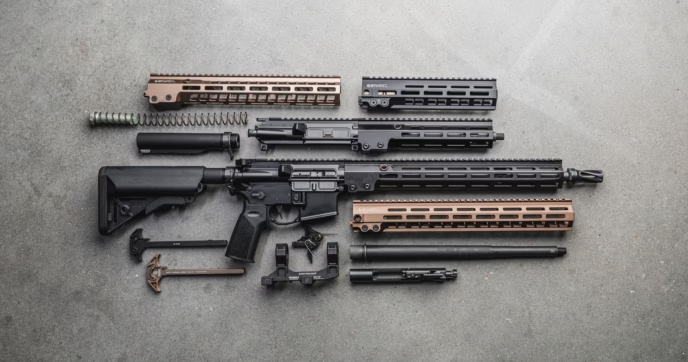
What really keeps me coming back to this platform is the massive aftermarket support. The customization options have created a whole sub-culture of builders. You aren’t stuck with what comes in the box. Because there are so many parts available, I’ve found you can easily tune these rifles to fit exactly what you need.

Benefits of Customizing Your Rifle
In my experience, customizing your rifle is the fastest way to improve your shooting. It changes both the feel and the actual performance of the gun. For example, the factory stocks are solid enough, but they are pretty basic. They often lack the right feel or adjustability. When I switch to an upgraded stock made of reinforced polymer or aluminum, the rifle feels lighter and much more stable.
This logic applies to every part of the build, especially if you have a specific goal in mind. You want a rifle built for your specific use-case. If I’m setting up for a rimfire competition, I’m going to want a light trigger and a fully adjustable stock. If I’m heading out for small-game hunting, I’ll pick a collapsible stock so it’s easier to carry through the woods.
Since there are so many components to choose from, it can feel overwhelming if you’re new to the platform. Here are the main things I consider before I start a new build.
| Upgrade | Why It’s Worth It | Ease of Install | Cost |
| Stock | Better fit and control. Improved ergonomics, adjustable LOP and comb height, lighter or more rigid options. Can completely change the feel of the rifle. | Easy. Drop-in swap, basic tools. | $$–$$$ |
| Trigger | Cleaner break, lighter pull, shorter reset. One of the biggest accuracy gains you can make. Helps shrink groups fast. | Easy to Moderate. Drop-in packs are simple. Internal kits take more care. | $$–$$$ |
| Barrels | Accuracy boost from better harmonics and tighter chambers. Bull barrels add stability. Lightweight options keep it handy. | Moderate. Requires disassembly but no gunsmithing for most. | $$–$$$ |
| Muzzle Devices | Helps manage movement and keeps sights flatter for quick follow ups. Adds versatility if running threaded setups. | Very Easy if threaded. Just torque properly. | $–$$ |
| Optics Mounts | Solid mounting equals consistent zero. Better alignment and eye relief options. | Very Easy. Screw on and torque to spec. | $–$$ |
| Optics | Unlocks precision potential. Clear glass and smart reticles make small targets easier and extend effective range. | Easy. Mount and level properly. | $$–$$$$ |
Customizing your Ruger 10/22

Stock Upgrades
There are numerous upgraded Ruger 10/22 stocks available for these rifles.
These stocks range from lighter options to full chassis systems. Some feature M-LOK compatibility and folding assemblies. In my experience, two of the most popular choices are the Magpul Hunter and Backpacker stocks. I’ve found the Hunter X-22 offers a lightweight polymer build that really performs. It includes M-LOK attachment points, sling mounts, and an adjustable rubber butt pad. The Backpacker is essentially the same stock, but specifically for 10/22 takedown models. What I like about it is that when you break it down into two halves, the forend and buttstock sections lock together, making it much easier to store or stow away when you’re not using it.
In addition to these stock systems, there are other chassis systems like the Luth-AR Modular Chassis and Oryx Sportsman Rifle Chassis are both solid adjustable chassis systems made of reinforced nylon and aluminum and steel, respectively.

Upgraded Triggers
On their own, 10/22 rifles already come with a good, albeit slightly heavy, 6-pound trigger. This isn’t bad, but it’s heavier than many enthusiasts prefer. That’s why aftermarket triggers are a popular upgrade.
Aftermarket triggers often have lighter pull weights. This makes it easier to pull the trigger while staying on target. Aftermarket triggers, such as Volquartsen’s, let you adjust pre-travel and over-travel. They offer a trigger pull weight between 1.5 and 5 pounds. Other triggers are available as well, with CMC and Timney being some of the most popular options.
Some Ruger 10/22s come pre-equipped with Ruger’s 2.5- to 3-pound BX-Trigger. If not, it’s available on its own as a drop-in upgrade. It’s also one of the most affordable 10/22 trigger upgrades on the market, usually retailing around $75.

Barrels
Barrels are one of the most important parts of a rifle. You don’t need to change the barrel on your 10/22 for casual plinking. But if you want to use certain muzzle devices or suppressors, you might have to. Standard 10/22 barrels often aren’t threaded. This means you can’t use suppressors or other muzzle devices. However, I’ve seen plenty of aftermarket options available for Ruger 10/22 barrels that solve this problem. Many competitive shooting disciplines use .22LR. A bull barrel can improve barrel harmonics, which is why I usually recommend them for precision shooting.
Tactical Solutions, or TacSol, offers many barrel options for the 10/22. They have bull barrel options for precision and lightweight options for mobility.
Of course, it’s much more cost-effective to get your preferred barrel included with the original rifle. If you haven’t picked up a 10/22, make sure to really spend time considering if you’ll need a different barrel down the line. It’s more sensible to get it built onto the gun from the start.

Muzzle Devices
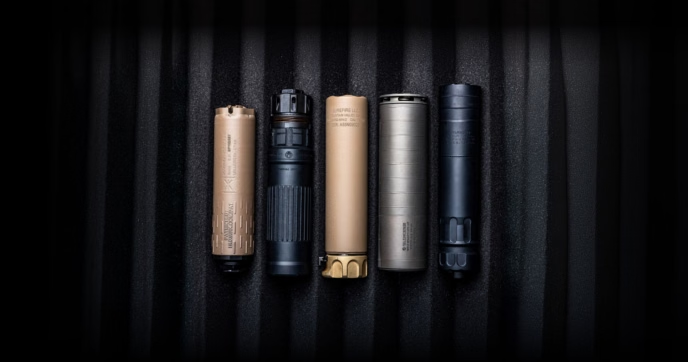
As mentioned before, having a threaded barrel opens you up to the possibility of running different muzzle devices. A muzzle brake or compensator isn’t really needed for .22LR due to its low recoil. However, they work great with suppressors.
By design, the .22LR is an incredibly low-pressure cartridge that doesn’t require a lot of powder to run efficiently. Because of this, it’s easy to find high-quality ammunition that runs efficiently when suppressed. I still suggest using quality hearing protection when you shoot, whether it’s suppressed or not.
Something to bear in mind with suppressors is that they’re an NFA regulated item that requires approval from the ATF before you’re able to own one. The process of getting one can also take quite a while to complete, with it lasting anywhere from a few weeks to several months. Because of this, I highly recommend researching all your available suppressor options before you buy one.

Optics
Most, if not all, Ruger 10/22 models come standard with iron sights, which are functional but largely outclassed by optics. Even though .22LR has an effective range of around 150 yards, you can stretch out the capabilities of your rifle with a good optic.
Red Dot Sights
Red dot sights are among the most popular optics on the market. They’re simple to attach to rifles. They can boost your speed in finding targets, improve accuracy, and increase situational awareness. Although iron sights work great, they require you to focus on the front sight rather than the target itself. This isn’t really an issue with red dots. They make it easier to aim with both eyes open, and so long as the optic is zeroed, all you need to do is put the reticle on target.
Variable Power Optics
The 10/22 may not have a long effective range. Still, many people (including me) use variable power optics with lower magnification settings. Variable power optics are exceptional for many applications. Aside from providing a clear reticle image, they can also be magnified to increase the overall visibility of your target.
If you’re interested in running a scope on your 10/22, you have many options to consider. There are a lot of solid optics to choose from that pair well with the 10/22. Vortex Optics, Burris, and SIG Sauer make various optic systems for rimfire rifles. Primary Arms Optics also has a scope with a dedicated .22 reticle that includes bullet drop compensation.
Mounts
Not all 10/22 models come with a picatinny rail or optic mount. Much like lever action guns, the Ruger 10/22 usually has mount points along the top of the receiver. If your rifle has these, you can attach picatinny rail sections or optics. Many 10/22 models already come with a picatinny top rail installed from the factory. If you plan to mount an optic on your rifle, choose a model with a pre-installed rail.

Conclusion
The Ruger 10/22 is a great rifle for both beginners and experienced shooters. It’s affordable, versatile, and perfect for a fun day at the range. But to enhance your shooting experience, customizing your rifle is a great option. It helps tailor the rifle to match your preferences perfectly.
If you’re just getting started, I’d recommend looking at triggers to start. If you need to improve ergonomics, an aftermarket stock is perfect. And if you don’t have an optic yet, that is probably the biggest upgrade you can make to any factory rifle.