TL;DR
For a duty-ready or general-purpose rifle build, we recommend the SSA® or G2S®. Its light pull weight offers better performance than mil-spec triggers, and it’s based on the SOCOM-contract SSF® fielded in many U.S. Military M4 service rifles. If your build is more precision-oriented, the SSA-E® offers finer control thanks to its lighter pull weight. The SD-C® and SD-E® offer the same pull weights as the SSA and SSA-E and have added leverage due to its flat-facing design. And if you’re building specifically for 3-Gun competition, the SD-3G® with its Hybrid Rolling Break design is engineered for high-speed use.
- Top Trigger – SSA-E: A precision-oriented two-stage trigger with a light 2.9- to 3.8-pound pull weight that’s based on the proven SSA trigger design; excels in DMR and SPR builds.
- Best Entry-Point – G2S: A more affordable trigger based on the SSA design; it shares the same pull weight, shape, and tool-steel construction, but has minor differences in pin design and a different inspection process; available around $175.
- Top Duty Trigger – SSA: A direct upgrade to the mil-spec trigger design with a 4.25- to 4.75-pound pull weight, tested to the Crane Division of the Naval Surface Warfare Center’s safety standards.
- Top Flat-Face Option – SD-E: The flat-facing counterpart of the SSA-E trigger that offers the same 2.9- to 3.8-pound pull weight with the added leverage and finger-placement flexibility of a flat trigger.
- Top Competition Trigger – SD-3G: A Hybrid Rolling Break trigger designed specifically for 3-Gun matches that comes standard with light (3– to 4-pound) and heavy (4.5– to 5.5-pound) springs.
Browse The Full Geissele Trigger Lineup at Primary Arms
How Do You Choose Between Geissele’s Triggers?
Geissele triggers each have their own distinctions. And while there’s always an argument to be had about which trigger is best, it’s important to recognize that choosing one is entirely subjective. At the end of the day, someone’s choice in trigger almost always comes down to their preference in two things: pull weight and trigger bow shape.
Pull weight is exactly how it sounds—it’s how heavy a trigger’s pull is. Your run-of-the-mill mil-spec trigger, the industry standard AR-15 trigger design derived from the U.S. Military’s design specifications (hence the name mil-spec), typically has a pull weight between 5.5 to around 8.5 pounds. A lighter pull weight, like 4.25 to 4.75 pounds, allows for more consistent and repeatable use, making them better for quick follow-up shots across dynamic applications. For precision shooting, you can go even lighter, like 2.9 to 3.8 pounds, for easier, more methodical shots at distance.
Once you’ve locked in the right pull weight, it’s just a matter of finding the right bow shape for you. Mil-spec triggers sport curved bows, but aftermarket ones can be curved, flat, or even semi-curved. Again, choosing between them is mostly a matter of personal preference, but they do have their advantages. Curved triggers offer more in terms of consistency, as the curve pulls your finger to the center with each pull. Flat triggers offer a bit more adaptability, as you can really place your finger anywhere on the trigger for more, or less, leverage.
Something else to make note of is the trigger’s pull type, which can be either single-stage, two-stage, or something more unique. Each monicker describes the characteristics of each trigger’s pull. Single-stage triggers break as soon as enough force is applied to the trigger, and when they reset, they’re positioned immediately at the trigger wall. Two-stage triggers pull in stages. During the first stage, there’s a little bit of creep until the trigger reaches the wall. The second stage is when the trigger breaks through the wall. These two are the most common trigger pull types, but there are more to consider. We’ll cover it below, but one of Geissele’s triggers uses a Hybrid Rolling Break design.
Geissele Triggers: Specs Rundown
| Trigger | Pull Type | First Stage Pull Weight | 2nd Stage Pull Weight | Total Pull Weight | Bow Shape and Intended Use |
|---|---|---|---|---|---|
| SSA | Two-Stage | 2.75 to 3.0 pounds | 1.5 to 1.75 pounds | 4.25 to 4.75 pounds | M4 curved; Designed for dynamic environments and mid-range carbine work. Safety certified by Crane Naval Surface Warfare Center. |
| SSA-E | Two-Stage | 2.0 to 2.5 pounds | 0.9 to 1.3 pounds | 2.9 to 3.8 pounds | M4 curved; Designed for precision applications such as Designated Marksman roles. |
| G2S | Two-Stage | 2.75 to 3.0 pounds | 1.5 to 1.75 pounds | 4.25 to 4.75 pounds | M4 curved; Designed for professional level defense and competitive use, as well as home defense and recreation. |
| SD-C | Two-Stage | 2.75 to 3.0 pounds | 1.5 to 1.75 pounds | 4.25 to 4.75 pounds | Flat; Geissele refers to it as the flat-bow variant of the SSA; it’s great for similar purposes. |
| SD-E | Two-Stage | 2.0 to 2.5 pounds | 0.9 to 1.3 pounds | 2.9 to 3.8 pounds | Flat; Geissele refers to it as the flat-bow version of the SSA-E; it’s great for similar purposes too. |
| SD-3G | Hybrid rolling break | — | — | 3.0 to 4.0 Pounds (light spring) 4.5 to 5.5 Pounds (heavy spring) | Flat; This trigger was designed specifically for use in Three-Gun Competitions. It can be used for other applications, but they aren’t its intended use. |
What’s the Difference Between the Geissele SSA and SSA-E?
Geissele SSA Trigger
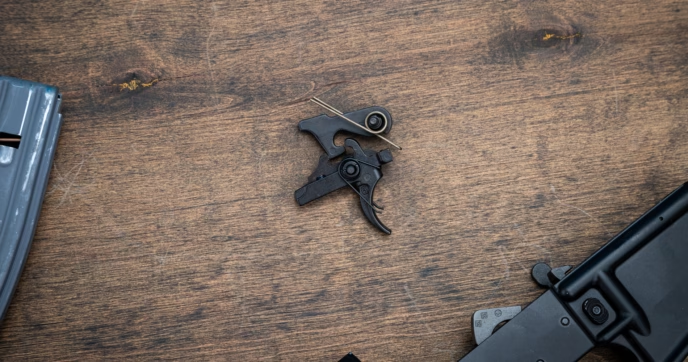
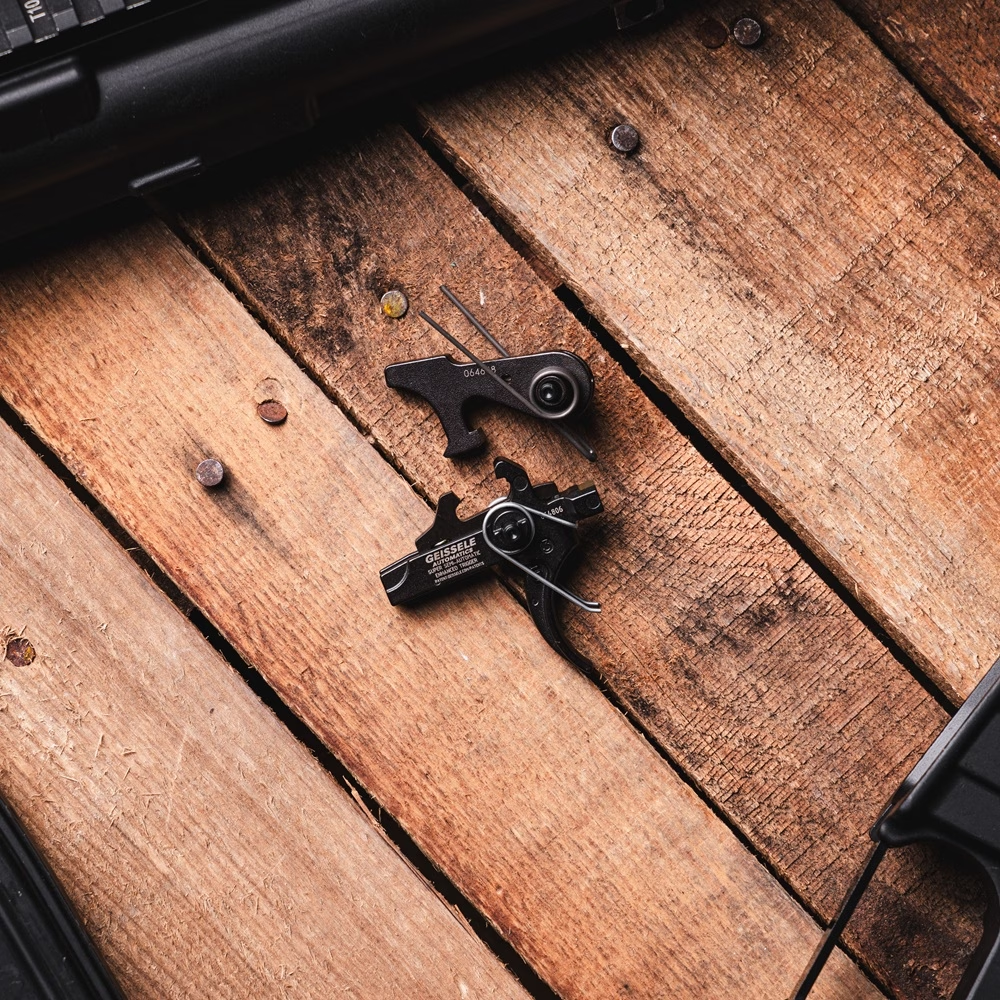
The SSA (Super Semi-Automatic) trigger is easily one of Geissele’s top models. Essentially, it’s a direct upgrade to the mil-spec trigger design. It has a much lighter 4.25-to-4.75-pound pull weight and makes use of the same standardized M4-style curved trigger face. Like mil-spec triggers, the SSA is exceptionally durable, as it’s even been tested to the Crane Naval Surface Warfare Center’s rigorous safety standards. Plus, with its two-stage design, it excels across a wide range of applications. With such credentials, it’s easy to see why it’s touted as one of the industry’s foremost duty-ready trigger packages.
This trigger shares the same DNA as one of Geissele’s SOCOM Contract triggers, the SSF (Super Select Fire). The SSF trigger was developed specifically as an upgraded replacement trigger for the M4 and has since been used widely within U.S. Military. The SSA trigger was created as its civilian counterpart, boasting the same specs, minus its select-fire capabilities. According to Geissele, the SSA trigger was designed to be light enough to maximize precision, while still being effective in high-speed close quarters use. And following its release, it’s been used by various Law Enforcement Agencies, as well as by enthusiasts in both competitive and defensive builds.
Geissele SSA-E Trigger
The SSA-E (Super Semi-Automatic Enhanced) is an upgraded version of the SSA trigger. They look identical, but the SSA-E has a much lighter pull weight of just 2.9- to 3.8-pounds. As such, it can perform well in many of the same applications, but functions particularly well in precision-oriented builds like SPRs and DMRs (Special Purpose and Designated Marksman Rifles).
Using the same combat-proven design, these triggers are ready for anything you or your environment can throw at them. Its lighter pull weight allows you to more easily run it faster, without the risk of outpacing its reset. While this makes it another excellent choice for something competitive or other high-speed use, like we said above, it excels in medium- to long-range precision. Less pull weight means less force is needed to pull the trigger. Ergo, less chance of shifting your point of impact accidentally by exerting too much force on it.
Take SPR setups for instance. These are specialized AR-15s designed to engage targets up to 750+ yards away, sometimes even further. A lighter trigger like the SSA-E isn’t a strict necessity, but it’s highly advantageous. Shots at such distances require you to be as dialed in as possible. And with a heavier trigger, putting more force onto the trigger can cause you to accidentally shift your POI. Geissele themselves have even said that it’s designed for scenarios that prioritize both agility and precision. And for such purposes, you can’t go wrong with it.
Is the SSA Worth it Over the G2S?
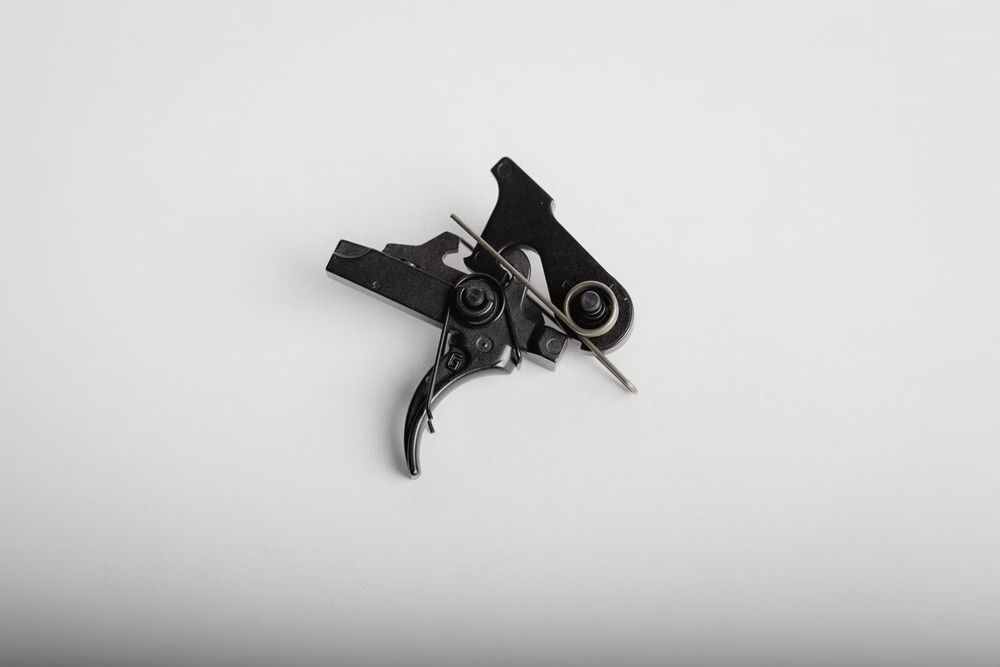
If you didn’t know what to look for, you probably wouldn’t be able to tell the difference between the G2S and the SSA triggers—and that’s kind of the point.
The G2S fills a niche role in Geissele’s trigger lineup, as it’s the most cost-effective trigger they offer. While a lot of people hear something like “cost-effective” and immediately brush it off as a cheap imitation of something more premium, you’ve got to remember that this is Geissele we’re talking about. And the G2S, on its own, is by far one of the top contenders for those wanting an upgrade over a basic mil-spec trigger.
You can think of the G2S as an entry-level version of the SSA trigger, as they share the same pull weight and shape. They’re even made from the same tool steel, but despite all these similarities, they aren’t completely identical. The G2S isn’t made to the same spec as the SSA. It uses a different design for holding the trigger pins in place, and it’s only spot-checked during the Magnetic Particle Inspection, not fully checked. An MPI is used to find surface level flaws in components like triggers. Don’t be worried though. Even though these triggers are just spot-checked, they still go through a rigorous quality-control checking process.
Even though you give up a bit in terms of durability, this trigger is still ready to see use across all conditions and applications. And with it priced around $175, it’s a great upgrade over more basic options.
What Is Geissele’s Super Dynamic Line?
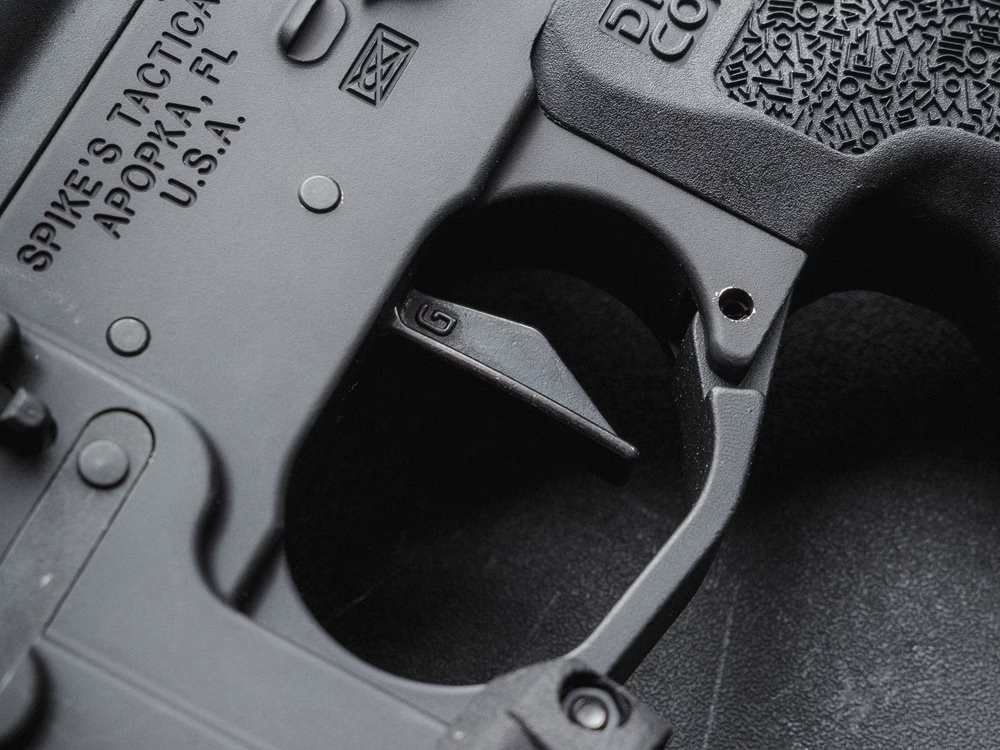
Both the SD-C (Super Dynamic Combat) and SD-E (Super Dynamic Enhanced) perform strikingly similar to the SSA and SSA-E, respectively. They’re essentially the flat-facing variants of the SSA and SSA-E, using the same pull weight and construction.
Like we mentioned, the bow shape of a trigger is one of the primary decision-driving factors it can have. And flat-faced triggers offer some real advantages. Depending on experience, some enthusiasts find them to be more comfortable to use, while others report that they feel lighter despite having the same pull weight.
Flat triggers offer more leverage than curved ones. Curved triggers naturally guide your finger to the center of the curve as you pull it. But, with a flat trigger, this doesn’t happen. As such, you can place your finger wherever it’s most comfortable to do so. If you were to pull it from a lower position than you normally would with a normal curved trigger, you’ll have a lot of extra leverage. With more leverage, you don’t have to exert as much force on the trigger when pulling, creating a lighter perceived pull weight. The pull weight hasn’t changed, but it certainly feels like it has.
Just like with the SSA and SSA-E trigger, the SD-C is better fitted for general purpose and duty AR-15 builds, while the SD-E is better suited for high-speed applications and precision use.
SD-3G
Also included in the lineup is the SD-3G (Super Dynamic 3-Gun), a competition trigger designed specifically for three-gun matches, hence its name. However, it isn’t just another flat-facing Geissele trigger. Rather than being a two-stage trigger, it uses a unique Hybrid Rolling Break design. This means that it sits comfortably between being a single-stage and a two-stage trigger. It doesn’t have a hard, defined wall, allowing you to pull straight through when firing. This allows you to make some fast shots in rapid succession, making it the perfect addition to a competition rifle.
This is also the only trigger in the chart from earlier with two distinct pull weights. The SD-3G comes standard with two sets of trigger springs—one light set and another heavy set. The light springs provide a 3- to 4-pound pull, while the heavy springs create a 4.5- to 5.5-pound pull, though neither is inherently better. And just like with the SD-C and SD-E, you can take advantage of the extra leverage offered by the flat trigger face, though it is available with a curved trigger face as well.
Its unique design does have its pros and cons though. For starters, it’s a very fast trigger. The lack of a defined wall lets you run it quickly, making it ideal for the fast-paced environment of three-gun matches. However, this comes at the cost of precise control. For instances requiring a touch more precision than usual, the lack of a wall makes controlling its pull a bit difficult. So, as its name suggests, it’s best to use this trigger on a dedicated competitive build.
What If Geissele Isn’t the Right Fit?
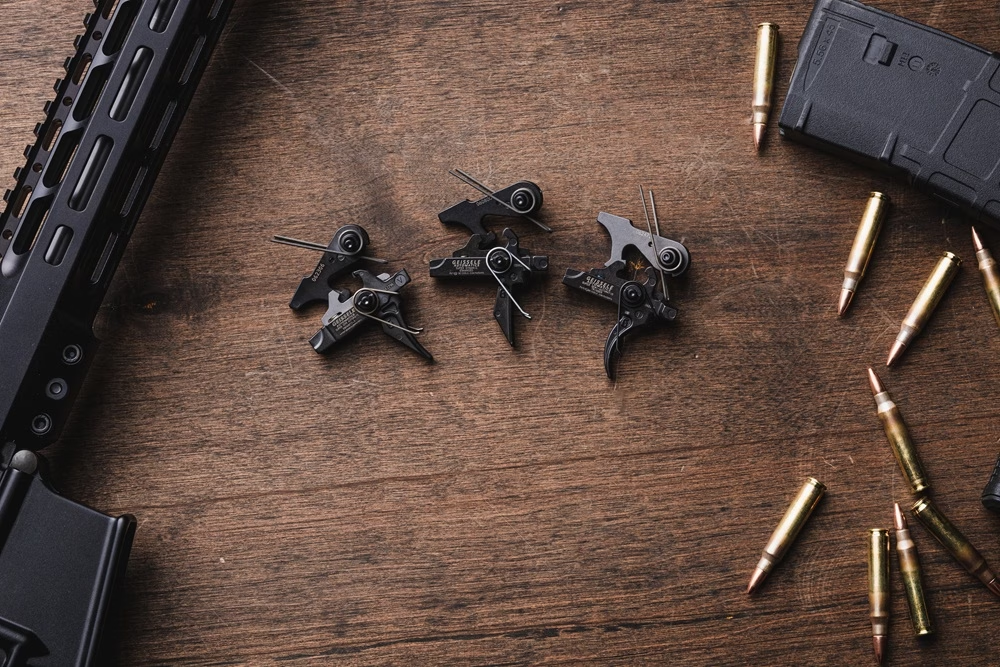
Personal preferences play a big role in determining which trigger is best for you. That’s why there’s so many trigger options in the first place. So, what if you’ve tried all the triggers we’ve gone over and don’t feel strongly towards any of them? Or, what if none of them really sound like they have what you’re looking for?
The AR platform has arguably the largest selection of aftermarket parts compared to any other rifle platform. So, if it’s looking like Geissele triggers aren’t the right fit, there’s a near-countless number of other options to consider. Brands like TriggerTech, RISE Armament, and LaRue Tactical are just a few of many solid options to consider. All AR-15 triggers are going to have some unique differences, but so long as you research each one, you’ll have no issue finding the one that’s best for your build.
Frequently Asked Questions (FAQ)
-
What is the difference between the Geissele SSA, SSA-E, G2S, and Super Dynamic triggers?
Each one is separated by their pull weight and bow shape. The SSA, G2S, and SD-C all share a published 4.25–4.75 lb total pull range. The SSA-E and SD-E share 2.9–3.8 lb. On bow shape, the SSA, SSA-E, and G2S use the classic M4 curved bow, while the SD-C, SD-E, and SD-3G use a flat bow. Geissele states their relationships directly on their site: the SD-C is the flat-bow variant of the SSA, and the SD-E is the flat-bow version of the SSA-E. The G2S has a slightly different design and manufacturing compared to the SSA. And the SD-3G is a unique trigger with a hybrid rolling break built for 3-Gun competition rather than a conventional two-stage. All weights are approximate per Geissele.
-
Is the Geissele G2S the same as the SSA?
Mechanically, they are nearly identical. Geissele manufactures the G2S from the same tool steel as the SSA, cuts the sears the same way with wire EDM (Electrical Discharge Machining), publishes the same 4.25- to 4.75-pound pull weight, and ensures that their overall feel and reliability are the same. Three things differ though; the G2S uses a different method of holding the hammer pin in place, it has no laser markings, and its parts are only spot checked during its magnetic particle inspection, not fully inspected. For most builds, this tradeoff is reasonable. For an agency with a documented inspection standard, the SSA is the correct specification.
-
Should I choose a flat or curved trigger bow?
That’s up to you. Flat trigger bows change feel, not pull weight. A flat bow gives you a consistent, repeatable finger placement and better leverage, which makes the trigger feel lighter than the scale says. A curved M4 bow naturally centers your finger and is what most AR owners have trained on for years. Flat bows suit deliberate, repeatable shooting and are common on precision and competition rifles. Still, the decision is ultimately up to your own personal preferences.
-
Which Geissele trigger is best for 3-Gun or USPSA?
For 3-Gun, the SD-3G is easily one of the best. Its hybrid rolling break design, shortened pull, and quick reset make it ideal for competitive use. Plus the SD-3G ships with two spring options: 3.0– to 4.0-pounds with the lighter spring, and 4.5– to 5.5-pounds with the heavier one. Geissele is direct about the limits—it is purpose-built for close-course competition use where rapid follow-up shots are common. It’s worth noting that Geissele has stated that these triggers are not compatible with pistol caliber carbine variants based on the AR-15 (like the AR-9). If you use them in such platforms, you run the risk of voiding the trigger assembly’s warranty.
-
Will a Geissele trigger fit my AR-15 or AR-10?
If your lower is designed to be compatible with mil-spec triggers, then yes. Geissele builds these triggers around mil-spec .154-inch diameter pins, which are common in both AR-15 and AR-308 platform rifles. The installation is more or less the same too. There are some exceptions to note though. Geissele’s AR-15 triggers are not compatible with the SIG Sauer MPX and MCX, and although they might fit, they aren’t designed to be compatible with AR-style pistol caliber carbines with such use voiding the warranty. Rifles based on the Colt 901 design need armorer pins sized for the wider receiver. And the SSA and SSA-E do not fit in HK416 rifles equipped with the firing pin safety.