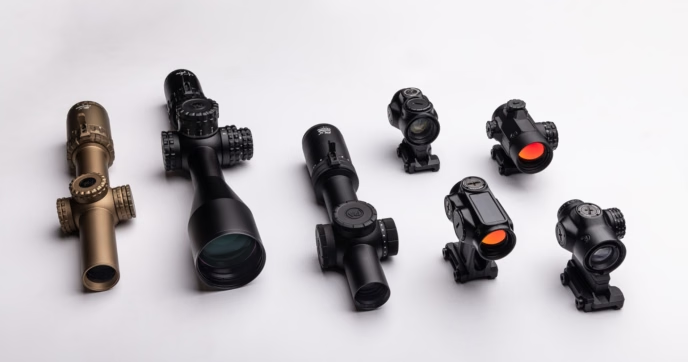
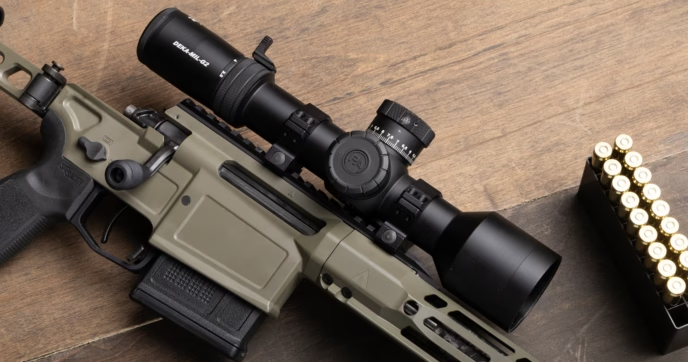
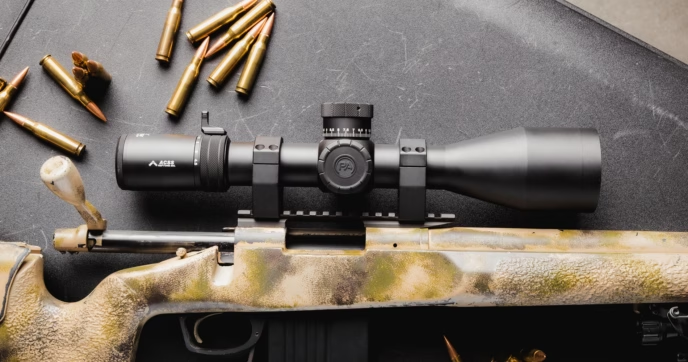
As some of our most recent articles have covered, long range shooting is one of the most impressive, and demanding, shooting disciplines. It does a lot to push your setup’s limits while testing your own capabilities as a sharpshooter. On top of this, there are several factors to account for. And one of the top things to consider is the wind.
At close range, windspeed doesn’t have much of an impact on your point of impact. But at distance, its effects are profound. As such, learning how to properly read windspeed and direction downrange is imperative.
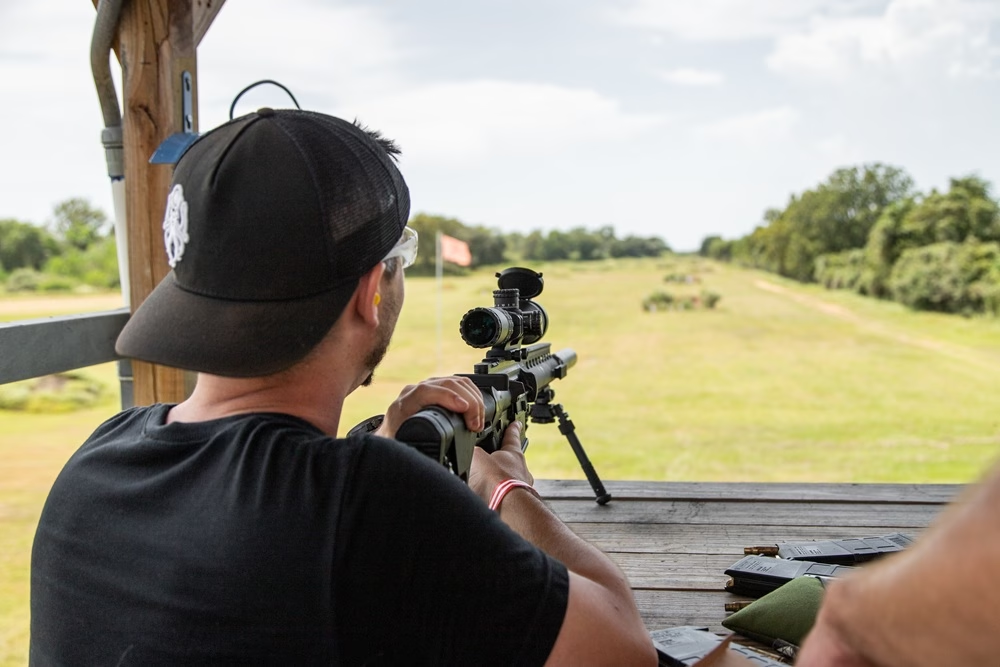
What is Long Range Shooting
The term ‘long-range’ is widely subjective, but for simplicity’s sake, it’s often viewed as any distance past 600 yards. At such distances, having high-quality rifle scopes is a necessity. And environmental factors such as temperature, humidity, and wind all begin to have more of an effect on your projectile’s point of impact (POI).
How does Wind Affect Shot Trajectory
The wind’s speed and direction can both have a serious effect on your POI. The faster/harder the wind blows, the greater effect it has on the bullet’s trajectory. It can push your projectile off its intended course, in a phenomenon known as wind drift. It’s also important to take note of the wind’s direction too. Wind is naturally omnidirectional, but you’ll often face crosswinds, headwinds, or tailwinds.
Crosswinds refer to the wind’s side-to-side movement. They can push your projectile towards either the left or right of your target. Headwinds blow toward you and won’t shift your POI laterally like crosswinds can. They can, however, cause your bullet to drop quicker since they create more drag. Last are tailwinds, which blow away from you in the direction of where you’re aiming. These are essentially the opposite of a headwind—they push the bullet forward, resulting in less drag and bullet drop.
Still, bear in mind that wind rarely ever moves perfectly in one direction. So, even if you set up your rifle in the same exact place every time you hit the range, the wind conditions will always be different to a degree.
Reading the Wind
Ideally, it’s best to use specialized tools like a wind meter to get the most exact read on wind conditions. But not everyone has the budget to afford them, and they aren’t entirely necessary for reading wind conditions. Fortunately, reading the wind is a lot easier than it sounds.
Environmental Indicators of Wind
At its core, reading wind conditions is all about making your best judgement based on different environmental cues.
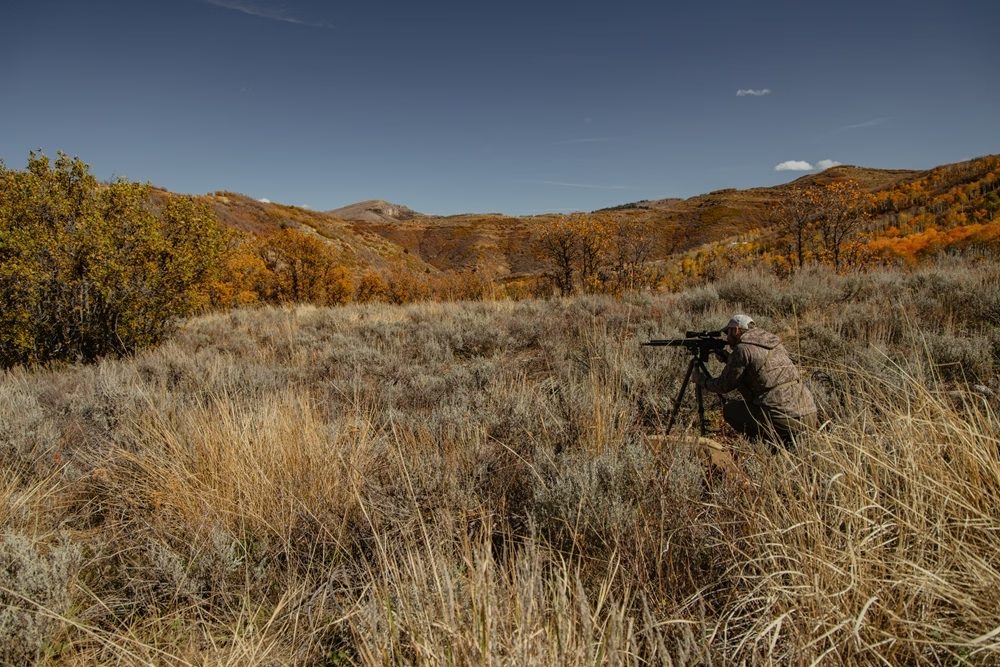
Start with what’s first noticeable. As the wind blows, look at your immediate surroundings to see how the wind is affecting it. Take notice of how grass, bushes, trees, and other plants around you are moving. If there aren’t any, pick up some dirt and slowly pour it out of your hand, to see where and how fast it blows. All of these are solid methods for getting a good baseline on the direction and relative speed of the wind as it blows.
Admittedly, assessing wind direction is pretty easy. Wind speed, however, requires some careful interpretation. Fortunately, the Beaufort Wind Scale is a great resource. Leaves start to rustle lightly when the wind is around 4 to 7 MPH. Small tree branches begin to sway at around 13 to 18 MPH, with larger ones beginning to move at around 19 to 24 MPH. Higher wind speeds around 25 to 31 MPH have a distinct whistling sound, and cause larger branches to sway. And finally, wind speeds higher than around 32+ MPH cause whole trees to move.
Taking all of this into consideration, you can easily get a good read on how to adjust your aim to account for wind. Still, it’s important to bear in mind that without a dedicated windmeter, your estimations are just that, estimation. But, with enough time and practice, your estimations will get more accurate. And, while knowing how to read the environment is beneficial, reading mirage can get you quick and accurate results too.
Understanding Mirage: What You’re Really Seeing
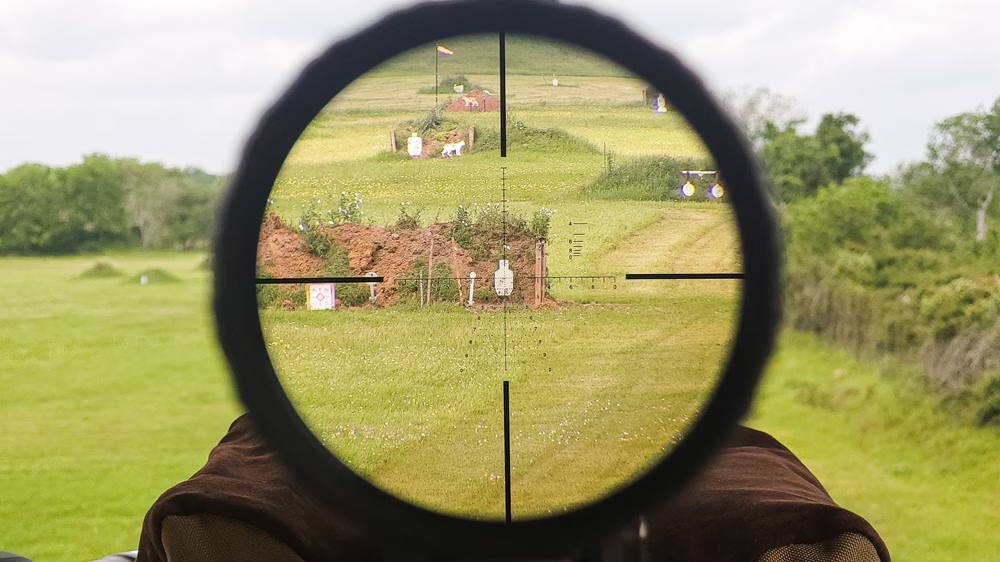
As noted earlier, the atmospheric conditions of your environment are hardly ever constant. Air currents and large gusts of wind cause the air temperature to shift slightly by a degree or two. And as different temperature air molecules come together, the light passing through them refracts differently, causing what we know as a heat mirage to occur.
You’ve likely seen a heat mirage in day-to-day life. The sort of shimmering waves that appear to emanate from a hot surface are a type of heat mirage. And this same phenomenon can be used to measure wind speed and direction.
How Mirage Indicates Wind Speed & Direction
As you increase your rifle scope’s magnification, heat mirages become clearer. And these mirage waves typically move in one of three variations.
A ‘boiling’ mirage occurs when the waves essentially flow straight up, indicating no serious wind down range. An ‘angled’ or ‘flowing’ mirage shows that there is moderate wind down range. And lastly, if the mirage is flat, or ‘streaming’, there are heavier winds down range. Still, just like reading wind based on visual cues, estimating your hold based on mirage is a gut feeling.
Without a dedicated windmeter, it’s impossible to get a hyper-accurate read on wind speed just by looking at the mirage. But, in time, and with enough practice, it can be done with a fair degree of accuracy.
Using your Rifle Scope to Read Mirage
Although there are several tools you can use, your rifle scope is arguably the most important. We already have a plethora of articles that discuss the various eccentricities of different optics, such as our guide on Rifle Scopes for Big Game Hunting. And while we highly recommend giving it a read once you’re through with this one, we can get you up to speed on the gist of what you’ll need to know.
Choosing the Right Scope for Long Range Shooting
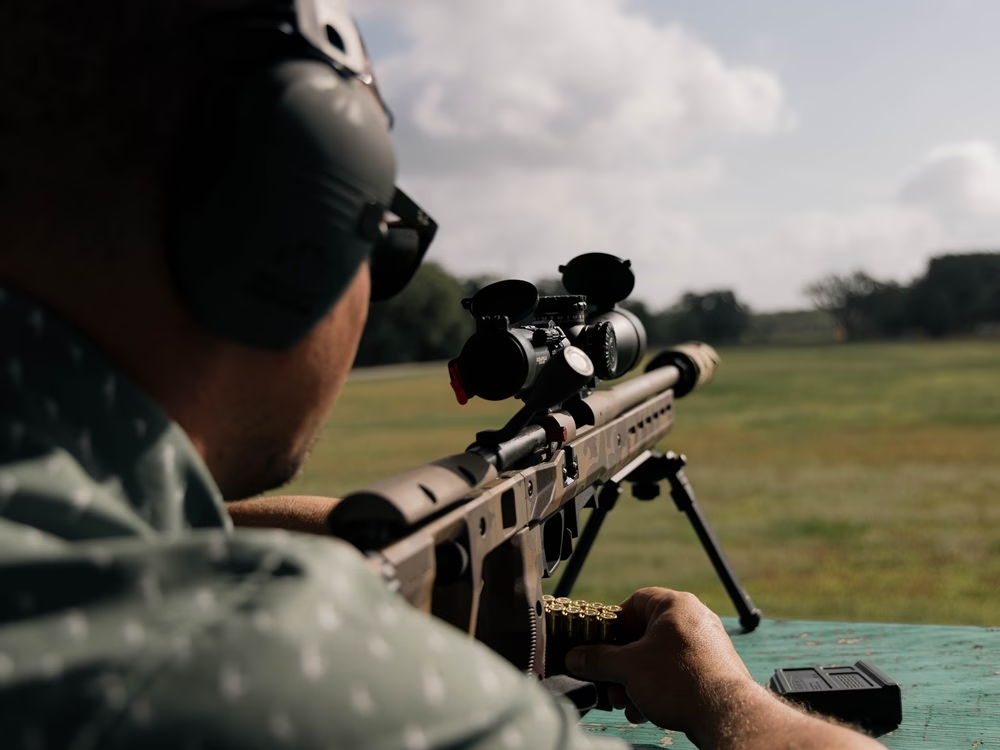
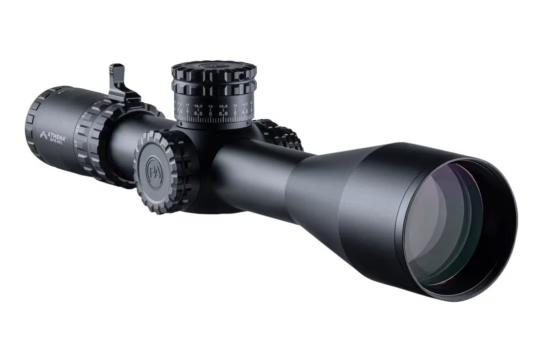
The optic industry is home to a near-infinite choice of rifle scopes. And it’s important to bear in mind that they aren’t all made the same. For any long-range discipline, your scope should ideally have high magnification, clear glass, a first-focal plane (FFP) construction, and an intuitive reticle.
Magnification and Image Quality
Two of the most important features your rifle scope can have are its magnification range and overall image quality. In the article above, we highlight three types of rifle scopes: Low-Power, Medium-Power, and High-Power Variable Optics (better known as LPVOs, MPVOs, and HPVOs). HPVOs are the superior long-range rifle scope. They offer the most in terms of magnification, with ranges like 4.5-27x, 6-30x, and even as much as 6-36x being common.
MPVOs can suffice in select instances, but they don’t offer as much zoom—usually somewhere around 2-10x or 3-18x. Finally, LPVOs aren’t the best pick for dedicated long-range use. They can have long-range utility, but their 1-6x, 1-8x, and 1-10x magnification ranges really limits their capabilities.
Regardless, your magnification range won’t mean much if your scope doesn’t offer good clarity. You’ll want to make sure that your optic uses clear glass. And fortunately, nearly all of the industry’s leading optic manufacturers use high-quality glass lenses. Brands like Primary Arms Optics, Nightforce, Vortex Optics, EOTech, and more, all offer scopes with immensely clear glass.
FFP vs. SFP Construction
Just as modern rifle scopes have evolved to offer increased magnification and clear lenses, they can also house some excellent reticles. So, in addition to proper magnification and clarity, you should also look for a scope with an FFP design.
In long-distance applications, FFP optics are some of the best to consider. With one, the size of the reticle increased along with your magnification. Because of this, your reticle and all your holdovers will remain accurate after zeroing, regardless of your magnification level. Second Focal Plane (SFP) optics are only truly accurate at max magnification. Plus, they widely make use of simpler reticles that don’t offer much in terms of holdover points.
FFP optics most often use etched reticles, which can feature more complex designs. These can include multiple floating elements that aren’t attached to the crosshairs, giving you far more flexibility for less shots downrange.
BDC vs. MOA vs. MIL
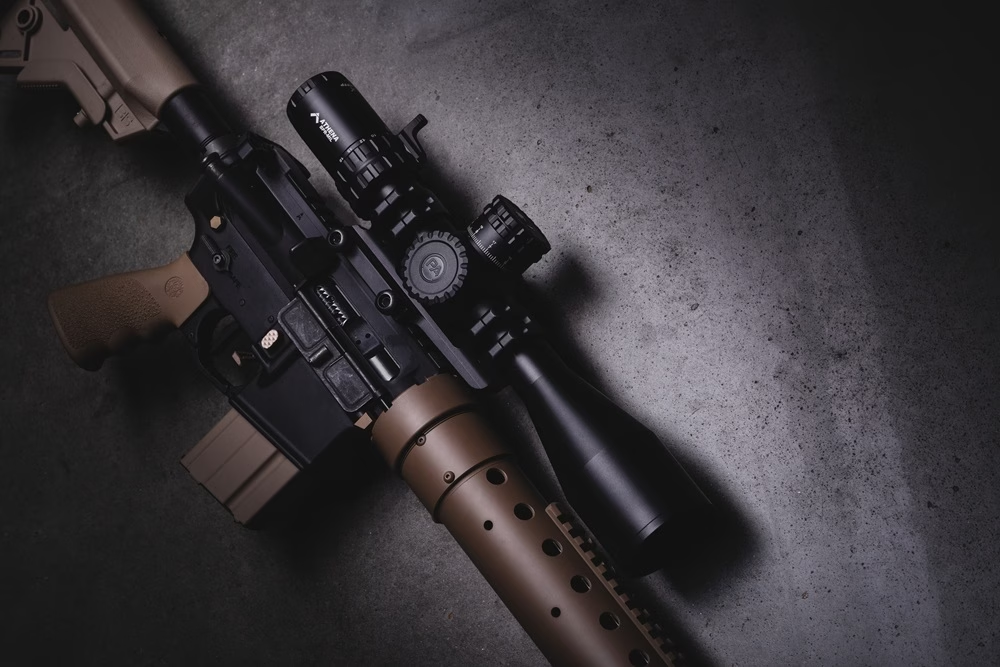
Another aspect of rifle scopes to consider is the type of reticle it houses. Outside of reticle construction, all rifle scopes use either a BDC-, MOA-, or MIL-based design. And depending on your preference, knowing their differences is crucial.
BDC Reticles
BDC stands for “Bullet Drop Compensation”, and they’re the simplest to use. Instead of relying on complex mathematics to estimate wind holds and elevation, BDC reticles are calibrated specifically for one or two calibers. As such, a lot of the guesswork that comes with long-distance targeting is removed. So, if you know your target distance and wind speed, you can adjust your aim accordingly.
As far as their utility goes, BDC reticles can be a solid pick for just about every application. There is a plethora of HPVOs with BDC reticles that can easily range out to over 1,000 yards. Just keep in mind that since BDC reticles are caliber specific, your options may be limited. Most resolute sharpshooters use niche calibers like 6mm Dasher, which don’t have dedicated BDC reticles. But, for more common calibers like 6.5 Creedmoor, 6.5 Grendel, and .224 Valkyrie, there is plenty to pick from.
MIL Reticles
MIL-based reticles are some of the most widely used reticles around the globe. The term ‘MIL’ or ‘MRAD’ is short for milliradian, which is a type of angular measurement used for long-range shooting. MIL reticles are popular for their use of the metric system. You can use yards and inches with MIL scopes, but doing so can get complicated, fast. Either way, MILs are essentially the standard operating language used by professional sharpshooters. They can be simplistic, with the crosshairs having a series of tick and hash marks. Or, they can have full grid designs, giving you a plethora of targeting data for more complex shots.
HPVOs like the Vortex Razor HD Gen III 6-36x56mm Rifle Scope make use of such designs. They come equipped with Vortex’s EBR-7 MRAD reticle, which is complete with multiple hash marks and a full MIL grid. Similar reticles can be found on MPVOs as well. The Nightforce NX8 2.5-20x50mm Rifle Scope features their renowned MIL-XT reticle. It’s equipped with a tiny, .05-MIL center dot, .2-MIL subtensions on its crosshairs, and a full Christmas Tree style MIL-grid below the horizontal stadia. For most applications, MIL scopes are the go-to reticle for any medium-to-long-distance engagements.
MOA Reticles
MOA reticles are another popular choice. They make use of another angular measurement system known as “Minutes of Angle” Basically, one MOA accounts for 1/60th of a degree, and at 100 yards, 1 MOA represents about 1 inch (1.047 specifically). It also works well with imperial measurements, making it a popular reticle option for hunters in the United States.
In general, MOA reticles are perfectly fine for long-distance use. They offer more precise adjustments than MIL reticles, but they aren’t as quick to use. In more dynamic situations, they aren’t necessarily the greatest option. Plus, since MIL reticles are used widely in professional applications across the globe, there aren’t as many resources available on how to effectively use them. And this also means that there are comparatively fewer MOA scopes available. Still, there are plenty of high-power optics available with MOA-based reticles.
Which is Best?
Of the three, we recommend going with a MIL-based reticle. They offer the most in terms of adaptability, and with practice, you’ll be able to make quick, on-the-fly adjustments when needed. But, if you prefer BDC or MOA reticles, they can suffice as well.
Conclusion
Wind is easily one of the most critical factors to account for when shooting at distance. Even a slight breeze can be enough to cause you to miss your target, so knowing how to read it is imperative.
Although tools such as windmeters provide the most accurate data, you can get a solid estimation of wind speed and direction by knowing what to look for. Grass, trees, dirt/dust, and heat mirages can all give you all the info you need to make the right hold on target. Plus, you can do a lot with just your scope.
Regardless of whether you opt for one of the optics highlighted above, or a different one entirely, reading the wind and mirage is entirely possible. So long as you’re equipped with a high-quality scope that’s outfitted with the reticle type you use best, you’ll be ready for anything the environment can throw at you.
Frequently Asked Questions (FAQ)
-
What is a mirage when shooting at long range?
A mirage is visual distortion that’s caused by different temperature air molecules coming together. The temperature difference causes light to refract differently, causing it to appear like a shimmering wave. Its movement speed and direction can be used to estimate wind speed and direction downrange.
-
Is mirage or wind more important for long range shooting?
Both are important, but they aren’t comparable against each other. Mirage can be used as a tool to measure wind speed and direction, but the mirage itself isn’t what affects your point of impact. Wind speed and direction is what impacts your POI.
-
At what magnification should I read mirage?
Many shooters find it helpful to reduce magnification to around 10x–15x to keep mirage patterns readable. Any higher and the image can distort into an unreadable “boil.” Some experienced shooters read mirage at higher magnifications, but dialing back is a good starting point.
-
Is MRAD or MOA better for long range shooting?
MRAD is popular among long range shooters due to simpler math and faster wind hold calculations. MOA is still very precise and is used widely by American hunters. So, either system works, but MRAD is viewed as the universal language for sharpshooters.
-
What is the best scope for long range shooting?
The best long-range scope is the one that has clear glass, an FFP design, and a reticle with multiple wind holds. Brands like Vortex and Nightforce are well-regarded options, and Primary Arms’ PLx and GLx lines with ACSS reticles offer purpose-built wind holds and ranging features at a competitive price point.